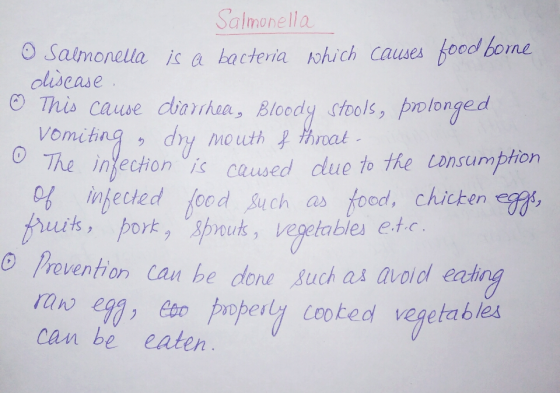
Choose one foodborne illness. Explain the bacteria conditions for growth and complicating factors. Describe how to...
Choose one foodborne illness. Explain the bacteria conditions for growth and complicating factors. Describe how to prevent transmission of foodborne illnesses.
Homework Answers
Add Answer to:
Choose one foodborne illness. Explain the bacteria conditions
for growth and complicating factors. Describe how to...
You have been assigned to develop a plan to prevent foodborne illness through the use of...
You have been assigned to develop a plan to prevent foodborne illness through the use of food safety and biotechnology. Include the following in your plan: Describe what food safety is and why it is important. Name the pathogens that cause foodborne illness. Distinguish between food spoilage and foodborne illness. Identify the four Cs that can prevent foodborne illness. Explain the “Danger Zone” and identify the temperature ranges that define this zone. Discuss how the food supply is protected in...
Salmonella bacteria are the most frequently reported cause of foodborne illness. Please discuss what you can...
Salmonella bacteria are the most frequently reported cause of foodborne illness. Please discuss what you can do to prevent and protect you and your family members from salmonellosis based on the knowledge of the characteristics of salmonella and its exposure pathway.
Escherichia coli is a bacteria that requires oxygen for growth. Very briefly describe the conditions needed...
Escherichia coli is a bacteria that requires oxygen for growth. Very briefly describe the conditions needed to grow 5ml of liquid culture of E.coli in the laboratory? Include 1. Temperature 2. Media 3. Oxygen requirements 4. Glassware 5. Equipment
Explain how bacteria can be used in Food production Explain the fermentation of Milk & Cheese...
Explain how bacteria can be used in Food production Explain the fermentation of Milk & Cheese Explain the use of starter cultures Explain the difference between foodborne infection & foodborne intoxication
List and describe the phases of the bacteria growth with regards to: a) Number of cells;...
List and describe the phases of the bacteria growth with regards to: a) Number of cells; b)”Tooling”; c) generation time; d) viability; e) mortality, f) pH changes in media; g) waste production List three (3) instruments often used to detect the growth of bacteria. How are these instruments used to estimate the growth of microorganisms? Discuss the techniques that are frequently employed to detect/estimate bacteria growth. Explain the advantages and weaknesses of these methods.
How is the Gram stain used to classify bacteria? How do antibiotics inhibit the growth of...
How is the Gram stain used to classify bacteria? How do antibiotics inhibit the growth of bacteria? Explain how carriers play an important role in the transmission of pathogens. Jan acquired a MRSA infection during a stay at a rehabilitation facility. Jan’s physician tells her that her MRSA was caused by S. aureus. How would you explain to Jan what S. aureus is and how it can cause diseases?
Describe the process that allow Gram-positive bacteria to be tolerant to harsh environmental conditions. Explain why...
Describe the process that allow Gram-positive bacteria to be tolerant to harsh environmental conditions. Explain why these bacteria are a threat in food industry.
8. One of the most common causes of foodborne illness is a. improper holding temperatures b. too much exposure to a...
 8. One of the most common causes of foodborne illness is a. improper holding temperatures b. too much exposure to air c. high-acid foods d. low-acid foods 9. The most likely source of botulism is a. highly processed foods b. home canned foods c. unrefrigerated foods d. fresh foods 10.Salmonella bacteria are found most commonly in a. meat, eggs, rice b. eggs, chicken, milk products c. pork, chicken, cheese d. fish, cheese fruit 11.E coli is found most often in...
Explain how the five factors of production relate to the growth of entrepreneurship and the growth...
Explain how the five factors of production relate to the growth of entrepreneurship and the growth of firms
2. What mode of reproduction do bacteria use? Describe a bacterial growth curve. Describe what happens...
 2. What mode of reproduction do bacteria use? Describe a
bacterial growth curve. Describe what happens at each step along
the curve. What are some parameters that would affect how the curve
looks? How would you predict the curve would look under different
conditions?
17. Big Red's spot test produced the results shown below: What conclusions can be drawn from these results?
2. What mode of reproduction do bacteria use? Describe a
bacterial growth curve. Describe what happens at each step along
the curve. What are some parameters that would affect how the curve
looks? How would you predict the curve would look under different
conditions?
17. Big Red's spot test produced the results shown below: What conclusions can be drawn from these results?
 8. One of the most common causes of foodborne illness is a. improper holding temperatures b. too much exposure to air c. high-acid foods d. low-acid foods 9. The most likely source of botulism is a. highly processed foods b. home canned foods c. unrefrigerated foods d. fresh foods 10.Salmonella bacteria are found most commonly in a. meat, eggs, rice b. eggs, chicken, milk products c. pork, chicken, cheese d. fish, cheese fruit 11.E coli is found most often in...
 2. What mode of reproduction do bacteria use? Describe a
bacterial growth curve. Describe what happens at each step along
the curve. What are some parameters that would affect how the curve
looks? How would you predict the curve would look under different
conditions?
17. Big Red's spot test produced the results shown below: What conclusions can be drawn from these results?
2. What mode of reproduction do bacteria use? Describe a
bacterial growth curve. Describe what happens at each step along
the curve. What are some parameters that would affect how the curve
looks? How would you predict the curve would look under different
conditions?
17. Big Red's spot test produced the results shown below: What conclusions can be drawn from these results?
Most questions answered within 3 hours.
-
Where is the error in this code sequence?
String s1 = "Hello";
String s2 = "ello";...
asked 10 months ago -
Financial data for Joel de Paris, Inc., for last year
follow:
Joel de Paris, Inc.
Balance...
asked 10 months ago -
Consider this reaction:
Al2(SO4)3 (aq)+ BaCl3
(aq) Al2Cl6 (aq)- +
3BaSO4(s) . What is the...
asked 10 months ago -
Suppose that Savneet is considering increasing her
recent random sample from 20 car rentals to 40...
asked 10 months ago -
Trucks arrive at an unloading terminal at an average rate of 120
per hour.
Trucks arrive...
asked 10 months ago -
Why are methanol and ethanol completely soluble in water while
octanol is not very little soluble....
asked 10 months ago -
A facilities manager at a university reads in a research report
that the mean amount of...
asked 10 months ago -
When the CuSO4 is rehydrated by adding water to the anhydrous
compound, is this an endothermic...
asked 10 months ago -
A ray of sunlight is passing from diamond into crown glass; the
angle of incidence is...
asked 10 months ago -
A block of mass 0.249 kg is placed on top of a light, vertical
spring of...
asked 10 months ago -
how do the kidneys compensate in the presences of acidosis
a) trigger hyperventilate
b) reserve acid...
asked 10 months ago -
Question 501 pts
The rental rate of capital to the firm increases. Which of the
following...
asked 10 months ago