
Homework Answers


Add Answer to:
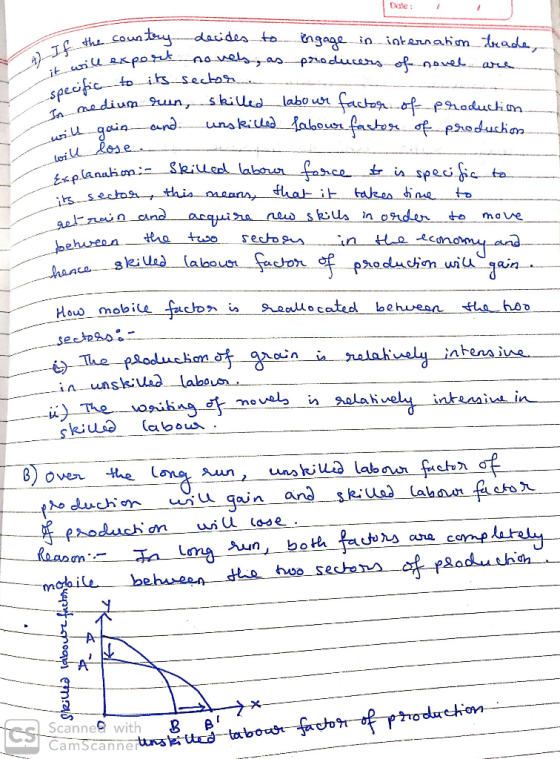
Suppose Elmira is a small country that produces two goods, grain and novels, with two factors...
1-Home produces 2 goods X and Y . Home country has two factors of production, Labor...
1-Home produces 2 goods X and Y . Home country has two factors of production, Labor and Capital. All consumers at Home have preferences over two goods that can be represented by the utility function U(X,) =XY . The factor requirements per unit of output of the two goods are also fixed and they are shown in the following table: Good X Good Y Labour 1/3 2/3 Capital 2/3 1/3 Home country has 360 units of Labour and 600 units...
61 Suppose that we are in a two-factor, two-country world where the factors of production are...
 61 Suppose that we are in a two-factor, two-country world where the factors of production are labor (L) and land (T), the returns to the factors are the wage rate (w) and the rental rate on land (t), and the countries are country A and country B. In this situation, country A is land-abundant relative to country B by the physical definition of relative factor abundance if price (or economic) definition if _, and country A is land-abundant relative to...
Suppose that there are two countries (Germany and Italy) two goods (computers and food) and two...
Suppose that there are two countries (Germany and Italy) two goods (computers and food) and two factors of production (skilled and unskilled labor). Also, assume that Germany is skilled-labor abundant while Italy is unskilled-labor abundant. Suppose further that computers are skilled-labor intensive and food is unskilled-labor intensive. What will happen to the wage of skilled labor relative to the wage of unskilled labor in each country following trade liberalization?
6. A country ABC produces two goods: apples and jeans. The production of both goods requires...
 6. A country ABC produces two goods: apples and jeans. The production of both goods requires the use of both labour and capital. payments to labour are $100,000 and payments to capital are $80,000. In jeans production payments to labour are $125,000 and payments to capital are $90,000. Using this information, identify which good is intensive in capital in production, and which is intensive a. In apple production, in labour in production b. The country now enters into trade with...
Suppose the wage ratio of skilled labor v.s. unskilled labor, wH/wL, is highest in country A,...
Suppose the wage ratio of skilled labor v.s. unskilled labor, wH/wL, is highest in country A, intermediate in country B, and lowest in country C, and country C's production involves two stages/tasks, the skilled-labor intensive R&D and the unskilled-labor intensive components. (a) To which country should country C offshore its component production so that country C's output is maximized? (b) Use a PPF-indifference curve graph with components on the X axis and R&D on the Y axis to show the...
International Economics Chapter 5 Problem Set 1. Consider a long-run model for a country producing two...
International Economics Chapter 5 Problem Set 1. Consider a long-run model for a country producing two products (digital cameras and baskets) using two factors (capital and labor). Assume camera production is capital intensive. Use a box diagram to illustrate the effects of an outmigration of labor (in other words, labor supply decreases) on output in each industry. What happens to the wage-to-rental-rate ratio? (6 pts) 2. Suppose a country has two specific factors, land and capital. Land is an input...
Consider a 2x3 specific-factors model, with all associated assumptions, where HOME is a small cou...
Consider a 2x3 specific-factors model, with all associated assumptions, where HOME is a small country and has two sectors, (1) light manufactured goods and (2) industrial goods, and three factors, (i) capital (which is mobile between sectors), (ii) unskilled labor (which is specific to light manufactures) and (iii) skilled labor (which is specific to industrial goods). (a) If the unskilled laborers express a strong preference against free trade, what does this suggest about HOME’s comparative advantage? Explain. (b) If, as...
Consider a 2x3 specific-factors model, with all associated assumptions, where HOME is a small country and...
Consider a 2x3 specific-factors model, with all associated assumptions, where HOME is a small country and has two sectors, (1) light manufactured goods and (2) industrial goods, and three factors, (i) capital (which is mobile between sectors), (ii) unskilled labor (which is specific to light manufactures) and (iii) skilled labor (which is specific to industrial goods). (e) Suppose, after opening to trade, HOME experiences a significant inflow of foreign direct investment (FDI). What do you expect to happen to the...
2. Suppose country X produces two goods- computer (capital intensive) and shoes (labor intensive). The diagram...
 2. Suppose country X produces two goods- computer (capital intensive) and shoes (labor intensive). The diagram shows country X's PPF and the change of production point from A to B when country X starts trading with country Y. If country X is abundant in capital and Y is abundant in labor. a. Label the two axes in the diagram. b. Then draw: - the relative price lines before and after trade, - two indifference curves that maximize utility before and...
2. (a) Suppose that the government in country A cuts down a large part of the...
2. (a) Suppose that the government in country A cuts down a large part of the country’s forested area to make land available for productive purposes. Using the Specific Factors model, examine the implications of this “deforestation” on the economy’s resource allocation and relative prices. (Assume that the economy produces two goods: manufacturing and food, and owns three factors of production: land, which is specific to the food industry; capital, which is specific to the manufacturing industry; and labor, which...
 61 Suppose that we are in a two-factor, two-country world where the factors of production are labor (L) and land (T), the returns to the factors are the wage rate (w) and the rental rate on land (t), and the countries are country A and country B. In this situation, country A is land-abundant relative to country B by the physical definition of relative factor abundance if price (or economic) definition if _, and country A is land-abundant relative to...
 6. A country ABC produces two goods: apples and jeans. The production of both goods requires the use of both labour and capital. payments to labour are $100,000 and payments to capital are $80,000. In jeans production payments to labour are $125,000 and payments to capital are $90,000. Using this information, identify which good is intensive in capital in production, and which is intensive a. In apple production, in labour in production b. The country now enters into trade with...
 2. Suppose country X produces two goods- computer (capital intensive) and shoes (labor intensive). The diagram shows country X's PPF and the change of production point from A to B when country X starts trading with country Y. If country X is abundant in capital and Y is abundant in labor. a. Label the two axes in the diagram. b. Then draw: - the relative price lines before and after trade, - two indifference curves that maximize utility before and...
Most questions answered within 3 hours.
-
Where is the error in this code sequence?
String s1 = "Hello";
String s2 = "ello";...
asked 11 months ago -
Financial data for Joel de Paris, Inc., for last year
follow:
Joel de Paris, Inc.
Balance...
asked 11 months ago -
Consider this reaction:
Al2(SO4)3 (aq)+ BaCl3
(aq) Al2Cl6 (aq)- +
3BaSO4(s) . What is the...
asked 11 months ago -
Suppose that Savneet is considering increasing her
recent random sample from 20 car rentals to 40...
asked 11 months ago -
Trucks arrive at an unloading terminal at an average rate of 120
per hour.
Trucks arrive...
asked 11 months ago -
Why are methanol and ethanol completely soluble in water while
octanol is not very little soluble....
asked 11 months ago -
A facilities manager at a university reads in a research report
that the mean amount of...
asked 11 months ago -
When the CuSO4 is rehydrated by adding water to the anhydrous
compound, is this an endothermic...
asked 11 months ago -
A ray of sunlight is passing from diamond into crown glass; the
angle of incidence is...
asked 11 months ago -
A block of mass 0.249 kg is placed on top of a light, vertical
spring of...
asked 11 months ago -
how do the kidneys compensate in the presences of acidosis
a) trigger hyperventilate
b) reserve acid...
asked 11 months ago -
Question 501 pts
The rental rate of capital to the firm increases. Which of the
following...
asked 11 months ago