1. A car traveling at a speed of vo = 52 m/s stops smoothly (that is,...
1. A car traveling at a speed of vo = 52 m/s stops smoothly (that is, its deceleration is constant) over a distance of d = 147 m. After the car has gone 1/3 of the stopping distance, what is its speed?
v1/3 =
2. An athlete sprinter 50m in 9.3 seconds, and then walks slowly back to the starting line in total time of 58 seconds. (Assume he runs in the positive direction.) What is his average walking velocity?
vav =
Homework Answers

Add Answer to:
1. A car traveling at a speed of vo = 52
m/s stops smoothly (that is,...
4 (2.52). The minimum stopping distance for a car traveling at a speed of 30 m/s...
 4 (2.52). The minimum stopping distance for a car traveling at a speed of 30 m/s is 60 m, including the distance traveled during the driver's reaction time of 0.50 s. a) What is the deceleration of the car while braking? b) What is the minimum stopping distance for the same car traveling at a speed of 40 m/s with the same reaction time and deceleration?
a car is traveling at a constant speed of Vo on a straight, level road. After...
a car is traveling at a constant speed of Vo on a straight, level road. After the brakes are applied at t=0 seconds, the motion can be approximated by: x=t^3/100-t^2 +17t where x is the distance traveled in meters and t is the time in seconds. Determine: A the initial velocity (Vo), B. the time required for the car to stop, C. The distance required for the car to stop, and D. The maximum deceleration during braking.
A car is traveling at a speed of 20 m/s when the driver applies the brakes....
A car is traveling at a speed of 20 m/s when the driver applies the brakes. The car stops in 5 seconds. How far (in meters) does the car travel in that time? Assume the car’s deceleration is constant.
Problem 3. A car is traveling at a speed of 20 m/s when the driver applies...
 Problem 3. A car is traveling at a speed of 20 m/s when the driver applies the brakes. The car stops in 5 seconds. How far (in meters) does the car travel in that time? Assume the car's deceleration is constant.
Consider a car with mass M. If the car has an initial speed of vo and...
Consider a car with mass M. If the car has an initial speed of vo and a maximum braking force of Fb, write an expression for the stopping distance, i.e. the distance needed to stop if the full braking force is applied.Calculate the stopping distance for M = 1250 kg, vo = 14.0 m/s, and Fb = 2580 N.
A driver is traveling at a speed of 70 km/h in car A when he looks...
 A driver is traveling at a speed of 70 km/h in car A when he looks down to text a friend that he is running late. Just before he looks down. he is 80 m from an intersection, and a bicydist B, traveling at a constant speed of 10m/s,s d= 40 m from that same intersection. The light turns red during the 3 s text, and when the driver looks up, he hits the brakes, causing a constant deceleration of...
A car of mass m, traveling at speed v, stops in time t when maximum braking...
A car of mass m, traveling at speed v, stops in time t when maximum braking force is applied. Assuming the braking force is independent of mass, what time would be required to stop a car of mass 2m traveling at speed v?
Problem 4 A car of mass m is traveling at a slow velocity vo If it...
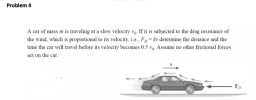 Problem 4 A car of mass m is traveling at a slow velocity vo If it is subjected to the drag resistance of the wind, which is proportional to its velocity, i.e., FD- kv determine the distance and the time the car will travel before its velocity becomes 0.5 Vo. Assume no other frictional forces act on the car
Problem 6 An electron with speed vo 2.37x10⁶ m/s is traveling parallel to and along the...
 Problem 6 An electron with speed vo 2.37x10⁶ m/s is traveling parallel to and along the same direction as an electric field of magnitudeE7.19x103 N/C. (a) How far will the electron travel before it stops? Submit Answer Tries 0/6 (b) How much time will elapse before it returns to its starting point?
QUESTION6 Traveling with an initial speed of vo 53 km/h, a car accelerates at 3,259 km/h2 along a straight road. Wh...
 QUESTION6 Traveling with an initial speed of vo 53 km/h, a car accelerates at 3,259 km/h2 along a straight road. What would be the distance traveled (in meters) to reach a final speed for the car to reach a final speed v 106 km hr? QUESTION7 The velocity of a particle is v = 2.1/ + (3-20 j mis, where t is in seconds. Ifrs 0 when t = o, determine the displacement of the particle in the x direction...
 4 (2.52). The minimum stopping distance for a car traveling at a speed of 30 m/s is 60 m, including the distance traveled during the driver's reaction time of 0.50 s. a) What is the deceleration of the car while braking? b) What is the minimum stopping distance for the same car traveling at a speed of 40 m/s with the same reaction time and deceleration?
 Problem 3. A car is traveling at a speed of 20 m/s when the driver applies the brakes. The car stops in 5 seconds. How far (in meters) does the car travel in that time? Assume the car's deceleration is constant.
 A driver is traveling at a speed of 70 km/h in car A when he looks down to text a friend that he is running late. Just before he looks down. he is 80 m from an intersection, and a bicydist B, traveling at a constant speed of 10m/s,s d= 40 m from that same intersection. The light turns red during the 3 s text, and when the driver looks up, he hits the brakes, causing a constant deceleration of...
 Problem 4 A car of mass m is traveling at a slow velocity vo If it is subjected to the drag resistance of the wind, which is proportional to its velocity, i.e., FD- kv determine the distance and the time the car will travel before its velocity becomes 0.5 Vo. Assume no other frictional forces act on the car
 Problem 6 An electron with speed vo 2.37x10⁶ m/s is traveling parallel to and along the same direction as an electric field of magnitudeE7.19x103 N/C. (a) How far will the electron travel before it stops? Submit Answer Tries 0/6 (b) How much time will elapse before it returns to its starting point?
 QUESTION6 Traveling with an initial speed of vo 53 km/h, a car accelerates at 3,259 km/h2 along a straight road. What would be the distance traveled (in meters) to reach a final speed for the car to reach a final speed v 106 km hr? QUESTION7 The velocity of a particle is v = 2.1/ + (3-20 j mis, where t is in seconds. Ifrs 0 when t = o, determine the displacement of the particle in the x direction...
Most questions answered within 3 hours.
-
Where is the error in this code sequence?
String s1 = "Hello";
String s2 = "ello";...
asked 11 months ago -
Financial data for Joel de Paris, Inc., for last year
follow:
Joel de Paris, Inc.
Balance...
asked 11 months ago -
Consider this reaction:
Al2(SO4)3 (aq)+ BaCl3
(aq) Al2Cl6 (aq)- +
3BaSO4(s) . What is the...
asked 11 months ago -
Suppose that Savneet is considering increasing her
recent random sample from 20 car rentals to 40...
asked 11 months ago -
Trucks arrive at an unloading terminal at an average rate of 120
per hour.
Trucks arrive...
asked 11 months ago -
Why are methanol and ethanol completely soluble in water while
octanol is not very little soluble....
asked 11 months ago -
A facilities manager at a university reads in a research report
that the mean amount of...
asked 11 months ago -
When the CuSO4 is rehydrated by adding water to the anhydrous
compound, is this an endothermic...
asked 11 months ago -
A ray of sunlight is passing from diamond into crown glass; the
angle of incidence is...
asked 11 months ago -
A block of mass 0.249 kg is placed on top of a light, vertical
spring of...
asked 11 months ago -
how do the kidneys compensate in the presences of acidosis
a) trigger hyperventilate
b) reserve acid...
asked 11 months ago -
Question 501 pts
The rental rate of capital to the firm increases. Which of the
following...
asked 11 months ago