
Homework Answers
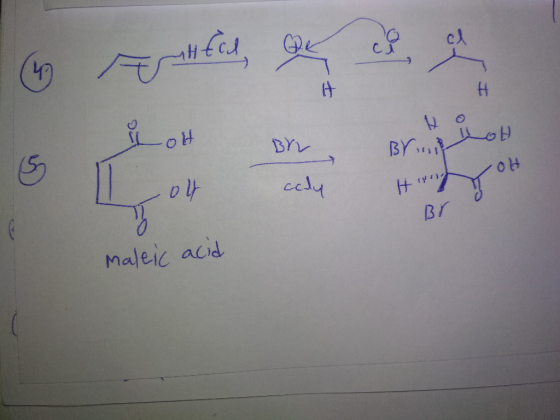
4. Alkene undergo Electrophilic Addition reactions since double bond of aljAlk acts as nucleophilie and try to add to Electrophile (HCl)
Hence Both H and Cl will add to double bond of Alkene.
5. Br2 addition is trans hence maleic acid forms trans dibromide.
Add Answer to:
4.HCl is known to give addition reactions to carbon-carbon double bonds. Why is this behavior not...
2. Certain addition reactions will occur where the product has a different carbon skeleton than the...
 2. Certain addition reactions will occur where the product has a different carbon skeleton than the starting material. Why does this occur? The reaction below is one of those reactions. Predict the major and minor product.(5 pts) CH3 CH3C-C HC CH2 CH3
14. An unknown with more than five carbon atoms is soluble in HCL, Which of the...
 14. An unknown with more than five carbon atoms is soluble in HCL, Which of the following is (are) likely to be? Amine ) Carboxylic acid C) Phenol D) Phenol or carboxylic acid 15. If an unknown is identified as either a carboxylic acid or phenol, the solubility in NalICO is used to differentiate between the two. This is done because: the carboxylic acid is a weaker acid than phenol and it will'not dissolve in NalHCO, the carboxylic acid is...
Predict the product for each of the following reactions: Hint/ Explanation: - For the first reaction, HCl will add to...
 Predict the product for each of the following reactions:
Hint/ Explanation:
- For the first reaction, HCl will add
to the carbon atoms of the triple bond. The addition is
stereoselective. A similar addition occurs with the resulting
compound and HBr. Consider Markovnikov\'s rule for determining the
regiochemistry.
- Internal alkynes undergo
stereoselective hydrohalogenation via anti addition to give the (Z)
product.
Predict the product for each of the following reactions:
Hint/ Explanation:
- For the first reaction, HCl will add
to the carbon atoms of the triple bond. The addition is
stereoselective. A similar addition occurs with the resulting
compound and HBr. Consider Markovnikov\'s rule for determining the
regiochemistry.
- Internal alkynes undergo
stereoselective hydrohalogenation via anti addition to give the (Z)
product.
Look up and draw the mechanism for the addition of Br2 to double bonds. Reference the...
 Look up and draw the mechanism for the addition of Br2 to
double bonds. Reference the source from which you acquired the
mechanism.
Give the IUPAC name of the major product in the above-mentioned
reaction.
Draw the major product of obtained in the addition of Br2 to
stilbene.
Is this isomer chiral? What would be the optical rotation if
this sample was placed in a polarimeter?
Would a student obtain the same product if you started with
cis-stilbene instead of...
Look up and draw the mechanism for the addition of Br2 to
double bonds. Reference the source from which you acquired the
mechanism.
Give the IUPAC name of the major product in the above-mentioned
reaction.
Draw the major product of obtained in the addition of Br2 to
stilbene.
Is this isomer chiral? What would be the optical rotation if
this sample was placed in a polarimeter?
Would a student obtain the same product if you started with
cis-stilbene instead of...
1. Give the structure of the product(s) for the following addition reactions. Show appropriate stereochemistry if...
 1. Give the structure of the product(s) for the following addition reactions. Show appropriate stereochemistry if necessary to get the full credits. (5 points) 50% H2SO4 50% H20 1. BH3, THF 2. H2O2/KOH CH3COOH ry condon YY PEO 1. 03 2. Zn/H2O 2. Give the syn or anti addition products for the following addition reactions. Show appropriate stereochemistry if necessary to get the full credits. (5 points total) Hz/Pt 1 point 1 point Hypt DBk Det ook o BryH2O 1....
1. In each of the following addition reactions (1) using arrows provide a mechanistic explanation of...
 1. In each of the following addition reactions (1) using arrows provide a mechanistic explanation of the course of the reaction (show transition state for concerted mechanism and intermediate for two-step mechanism); (ii) write the product/s of the reaction; (iii) name the reaction product/s. (4 x 5= 20 points) a. Sulfuric acid catalyzed hydration (addition of H:0) of 2-methyl-but-2-ene b. Addition of molecular bromine to l-methyl-cyclohex-l-ene c. Addition of hydrogen bromide to (3R)-2,3-dimethyl-pent-1-ene, present product/s through Fischer projection. d. Hydroboration...
Why doesnt an enolate ion form in basic conditions? Why is it an addition reaction? Give...
 Why doesnt an enolate ion form in basic conditions? Why is it an
addition reaction?
Give the expected major organic product of each of the following reactions HOO-CH3 NaOH + CH3OH (excess) - + CH3OH (excess) →
Why doesnt an enolate ion form in basic conditions? Why is it an
addition reaction?
Give the expected major organic product of each of the following reactions HOO-CH3 NaOH + CH3OH (excess) - + CH3OH (excess) →
Identify each of the following reactions as synthesis, decomposition, combustion, single replacement, or double replacement. If...
 Identify each of the following reactions as synthesis, decomposition, combustion, single replacement, or double replacement. If the reaction is a single or double replacement reaction, tell if the reaction occurs spontaneously. If the reaction does not occur spontaneously, write "No Reaction." If the reaction does occur spontaneously for single and double replacement write a balanced molecular, total ionic, and net ionic equation. For the other types of reactions, write a balanced chemical equation. 2. Water and dinitrogen trioxide gas 3....
QUESTION 4 [1,2- versus 1,4-Addition Reactions] 4.1 Propose a detailed mechanism for the reaction of 2-butenal...
 QUESTION 4 [1,2- versus 1,4-Addition Reactions] 4.1 Propose a detailed mechanism for the reaction of 2-butenal with ethynylmagnesium bromide in dry THF followed by quenching with dilute aqueous acid. (5) 4.2 Propose a plausible mechanism for the reaction of 1,3-diphenyl-2-propen-1- one with potassium cyanide in ethanol followed by aqueous work-up. 1 (5) 4.3 Predict and draw the structure of the product of the reaction of 2-methyl-1,3- cyclohexanedione with methyl vinyl ketone (3-buten-2-one) in methanol in the presence of potassium hydroxide....
Addition Reaction (Ch. 8. primarily) Learning Outcomes: By successfully completing this assignment, the student will demonstrate...
 Addition Reaction (Ch. 8. primarily) Learning Outcomes: By successfully completing this assignment, the student will demonstrate the ability to: (A) Provide proper curved-arrow mechanisms for addition reactions involving alkene reactants. (B) Predict the correct structure of the products of addition reactions, including correct regiochemistry and stereochemistry. (C) Provide reasonable explanations for mechanistic steps in addition reactions based on energy considerations and the structures of reactants, intermediates, and transition states. 1. The following molecule will be the reactant for all reactions...
 2. Certain addition reactions will occur where the product has a different carbon skeleton than the starting material. Why does this occur? The reaction below is one of those reactions. Predict the major and minor product.(5 pts) CH3 CH3C-C HC CH2 CH3
 14. An unknown with more than five carbon atoms is soluble in HCL, Which of the following is (are) likely to be? Amine ) Carboxylic acid C) Phenol D) Phenol or carboxylic acid 15. If an unknown is identified as either a carboxylic acid or phenol, the solubility in NalICO is used to differentiate between the two. This is done because: the carboxylic acid is a weaker acid than phenol and it will'not dissolve in NalHCO, the carboxylic acid is...
 Predict the product for each of the following reactions:
Hint/ Explanation:
- For the first reaction, HCl will add
to the carbon atoms of the triple bond. The addition is
stereoselective. A similar addition occurs with the resulting
compound and HBr. Consider Markovnikov\'s rule for determining the
regiochemistry.
- Internal alkynes undergo
stereoselective hydrohalogenation via anti addition to give the (Z)
product.
Predict the product for each of the following reactions:
Hint/ Explanation:
- For the first reaction, HCl will add
to the carbon atoms of the triple bond. The addition is
stereoselective. A similar addition occurs with the resulting
compound and HBr. Consider Markovnikov\'s rule for determining the
regiochemistry.
- Internal alkynes undergo
stereoselective hydrohalogenation via anti addition to give the (Z)
product.
 Look up and draw the mechanism for the addition of Br2 to
double bonds. Reference the source from which you acquired the
mechanism.
Give the IUPAC name of the major product in the above-mentioned
reaction.
Draw the major product of obtained in the addition of Br2 to
stilbene.
Is this isomer chiral? What would be the optical rotation if
this sample was placed in a polarimeter?
Would a student obtain the same product if you started with
cis-stilbene instead of...
Look up and draw the mechanism for the addition of Br2 to
double bonds. Reference the source from which you acquired the
mechanism.
Give the IUPAC name of the major product in the above-mentioned
reaction.
Draw the major product of obtained in the addition of Br2 to
stilbene.
Is this isomer chiral? What would be the optical rotation if
this sample was placed in a polarimeter?
Would a student obtain the same product if you started with
cis-stilbene instead of...
 1. Give the structure of the product(s) for the following addition reactions. Show appropriate stereochemistry if necessary to get the full credits. (5 points) 50% H2SO4 50% H20 1. BH3, THF 2. H2O2/KOH CH3COOH ry condon YY PEO 1. 03 2. Zn/H2O 2. Give the syn or anti addition products for the following addition reactions. Show appropriate stereochemistry if necessary to get the full credits. (5 points total) Hz/Pt 1 point 1 point Hypt DBk Det ook o BryH2O 1....
 1. In each of the following addition reactions (1) using arrows provide a mechanistic explanation of the course of the reaction (show transition state for concerted mechanism and intermediate for two-step mechanism); (ii) write the product/s of the reaction; (iii) name the reaction product/s. (4 x 5= 20 points) a. Sulfuric acid catalyzed hydration (addition of H:0) of 2-methyl-but-2-ene b. Addition of molecular bromine to l-methyl-cyclohex-l-ene c. Addition of hydrogen bromide to (3R)-2,3-dimethyl-pent-1-ene, present product/s through Fischer projection. d. Hydroboration...
 Why doesnt an enolate ion form in basic conditions? Why is it an
addition reaction?
Give the expected major organic product of each of the following reactions HOO-CH3 NaOH + CH3OH (excess) - + CH3OH (excess) →
Why doesnt an enolate ion form in basic conditions? Why is it an
addition reaction?
Give the expected major organic product of each of the following reactions HOO-CH3 NaOH + CH3OH (excess) - + CH3OH (excess) →
 Identify each of the following reactions as synthesis, decomposition, combustion, single replacement, or double replacement. If the reaction is a single or double replacement reaction, tell if the reaction occurs spontaneously. If the reaction does not occur spontaneously, write "No Reaction." If the reaction does occur spontaneously for single and double replacement write a balanced molecular, total ionic, and net ionic equation. For the other types of reactions, write a balanced chemical equation. 2. Water and dinitrogen trioxide gas 3....
 QUESTION 4 [1,2- versus 1,4-Addition Reactions] 4.1 Propose a detailed mechanism for the reaction of 2-butenal with ethynylmagnesium bromide in dry THF followed by quenching with dilute aqueous acid. (5) 4.2 Propose a plausible mechanism for the reaction of 1,3-diphenyl-2-propen-1- one with potassium cyanide in ethanol followed by aqueous work-up. 1 (5) 4.3 Predict and draw the structure of the product of the reaction of 2-methyl-1,3- cyclohexanedione with methyl vinyl ketone (3-buten-2-one) in methanol in the presence of potassium hydroxide....
 Addition Reaction (Ch. 8. primarily) Learning Outcomes: By successfully completing this assignment, the student will demonstrate the ability to: (A) Provide proper curved-arrow mechanisms for addition reactions involving alkene reactants. (B) Predict the correct structure of the products of addition reactions, including correct regiochemistry and stereochemistry. (C) Provide reasonable explanations for mechanistic steps in addition reactions based on energy considerations and the structures of reactants, intermediates, and transition states. 1. The following molecule will be the reactant for all reactions...
Most questions answered within 3 hours.
-
Where is the error in this code sequence?
String s1 = "Hello";
String s2 = "ello";...
asked 11 months ago -
Financial data for Joel de Paris, Inc., for last year
follow:
Joel de Paris, Inc.
Balance...
asked 11 months ago -
Consider this reaction:
Al2(SO4)3 (aq)+ BaCl3
(aq) Al2Cl6 (aq)- +
3BaSO4(s) . What is the...
asked 11 months ago -
Suppose that Savneet is considering increasing her
recent random sample from 20 car rentals to 40...
asked 11 months ago -
Trucks arrive at an unloading terminal at an average rate of 120
per hour.
Trucks arrive...
asked 11 months ago -
Why are methanol and ethanol completely soluble in water while
octanol is not very little soluble....
asked 11 months ago -
A facilities manager at a university reads in a research report
that the mean amount of...
asked 11 months ago -
When the CuSO4 is rehydrated by adding water to the anhydrous
compound, is this an endothermic...
asked 11 months ago -
A ray of sunlight is passing from diamond into crown glass; the
angle of incidence is...
asked 11 months ago -
A block of mass 0.249 kg is placed on top of a light, vertical
spring of...
asked 11 months ago -
how do the kidneys compensate in the presences of acidosis
a) trigger hyperventilate
b) reserve acid...
asked 11 months ago -
Question 501 pts
The rental rate of capital to the firm increases. Which of the
following...
asked 11 months ago