Can someone please help me with these 3 problems and explain it clear. thank you :)
Homework Answers
![75) a) Equation: CO(g) + 2H, (B) = CH2OH(E) Anda = [IXAC: (ch, etc.) = (1xACCO) + 2xAGH)]klim ol (-16242)-(K=15732x) Jasenol](http://img.homeworklib.com/questions/c95c7a20-757e-11ea-b73c-093a2bc35777.png?x-oss-process=image/resize,w_560)
Add Answer to:
Can someone please help me with these 3 problems and explain it
clear. thank you :)...
Consider the following reaction: CO(g)+2H2(g)⇌CH3OH(g) Kp=2.26×10⁴ at 25 ∘C. Calculate ΔGrxn for the reaction at 25...
Consider the following reaction: CO(g)+2H2(g)⇌CH3OH(g) Kp=2.26×10⁴ at 25 ∘C. Calculate ΔGrxn for the reaction at 25 ∘C under each of the following conditions. Part A: standard conditions Part B: at equalibrium Part C: PCH3OH= 1.5 atm ; PCO=PH2= 1.4×10⁻² atm
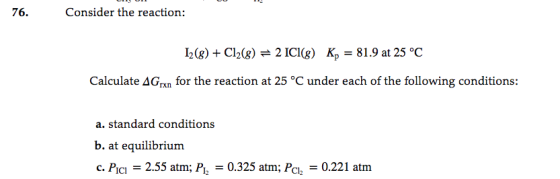
Consider the following reaction: I2(g)+Cl2(g) ⇌ 2ICl(g) Kp= 81.9 at 25 ∘ C. Calculate ΔGrxn for the reaction at 25 ∘...
Consider the following reaction: I2(g)+Cl2(g) ⇌ 2ICl(g) Kp= 81.9 at 25 ∘ C. Calculate ΔGrxn for the reaction at 25 ∘ C under each of the following conditions. Part A. Standard conditions Part B. At equilibrium Part C. PICl= 2.59 atm PI2= 0.322 atm PCl2= 0.221 atm
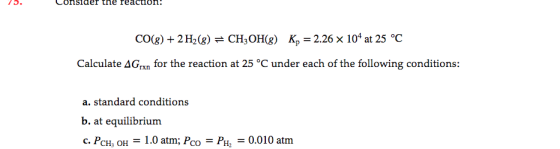
73. Consider the reaction: CO(g) + 2H2(g) <--> CH3OH(g) Kp= 2.26X10E4 at 25 C Calculate ΔGorxnfor...
73. Consider the reaction: CO(g) + 2H2(g) <--> CH3OH(g) Kp= 2.26X10E4 at 25 C Calculate ΔGorxnfor the reaction at 25C under each of the following conditions: a. standard conditions b. at equilibrium c. PCH3OH= 1.0 atm; PCO= PH2 = 0.010 atm
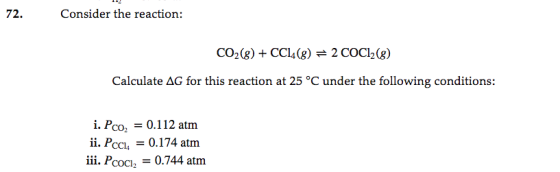
Calculate ΔG for this reaction at 25 ∘C under the following conditions: PCH3OH= 0.845 atm PCO=...
Calculate ΔG for this reaction at 25 ∘C under the following conditions: PCH3OH= 0.845 atm PCO= 0.115 atm PH2= 0.160 atm CH3OH(g)⇌CO(g)+2H2(g)
Consider the following reaction: CH3OH(g)⇌CO(g)+2H2(g) Calculate ΔG for this reaction at 25 ∘C under the following...
Consider the following reaction: CH3OH(g)⇌CO(g)+2H2(g) Calculate ΔG for this reaction at 25 ∘C under the following conditions: PCH3OH= 0.840 atm PCO= 0.130 atm PH2= 0.175 atm
Consider the following reaction: CH3OH(g)⇌CO(g)+2H2(g) Calculate ΔG for this reaction at 25 ∘C under the following...
Consider the following reaction: CH3OH(g)⇌CO(g)+2H2(g) Calculate ΔG for this reaction at 25 ∘C under the following conditions: PCH3OH= 0.835 atm PCO= 0.135 atm PH2= 0.165 atm
Consider the following reaction: I2(g)+Cl2(g) ⇌ 2ICl(g) Kp= 81.9 at 25 ∘ C. Calculate ΔGrxn for...
Consider the following reaction: I2(g)+Cl2(g) ⇌ 2ICl(g) Kp= 81.9 at 25 ∘ C. Calculate ΔGrxn for the reaction at 25 ∘ C under each of the following conditions. PICl= 2.58 atm ; PI2= 0.324 atm ; PCl2= 0.221 atm . Express your answer using one significant figure.
The equilibrium constant in terms of pressures for the reaction SnO2(s) + 2CO(g) Sn(s) + 2CO2(g)...
The equilibrium constant in terms of pressures for the reaction SnO2(s) + 2CO(g) Sn(s) + 2CO2(g) at 25 °C is Kp = 0.124. Calculate the reaction quotient Q for each of the following conditions and determine whether solid Sn is consumed or produced as the reaction comes to equilibrium. (A) PCO = 0.249 atm; PCO2 = 0.108 atm; Sn is a) consumed b) produced (B) PCO = 6.34×10⁻² atm; PCO2 = 0.174 atm; Sn is a)consumed b) produced
AGº is -32.7 kJ/mol of N2 for the reaction N2 (g) + 3H2 (g) = 2NH3(g)...
 AGº is -32.7 kJ/mol of N2 for the reaction N2 (g) + 3H2 (g) = 2NH3(g) This calculation was for the reaction under standard conditions—that is, with all gases present at a partial pressure of 1 atm and a temperature of 25°C. Calculate AG for the same reaction under the following nonstandard conditions: . PN2 = 2.00 atm, PH2 = 7.00 atm, PNH3 = 0.021 atm, . and T = 100°C.
Consider the following reaction: I2(g)+Cl2(g) ⇌ 2ICl(g) Kp= 81.9 at 25 ∘ C. Calculate ΔGrxn for...
Consider the following reaction: I2(g)+Cl2(g) ⇌ 2ICl(g) Kp= 81.9 at 25 ∘ C. Calculate ΔGrxn for the reaction at 25 ∘ C under each of the following conditions. A) standard conditions B) at equilibrium C) P ICl= 2.56 atm ; P I2= 0.316 atm ; P Cl2= 0.215 atm .
 AGº is -32.7 kJ/mol of N2 for the reaction N2 (g) + 3H2 (g) = 2NH3(g) This calculation was for the reaction under standard conditions—that is, with all gases present at a partial pressure of 1 atm and a temperature of 25°C. Calculate AG for the same reaction under the following nonstandard conditions: . PN2 = 2.00 atm, PH2 = 7.00 atm, PNH3 = 0.021 atm, . and T = 100°C.
Most questions answered within 3 hours.
-
Where is the error in this code sequence?
String s1 = "Hello";
String s2 = "ello";...
asked 10 months ago -
Financial data for Joel de Paris, Inc., for last year
follow:
Joel de Paris, Inc.
Balance...
asked 10 months ago -
Consider this reaction:
Al2(SO4)3 (aq)+ BaCl3
(aq) Al2Cl6 (aq)- +
3BaSO4(s) . What is the...
asked 10 months ago -
Suppose that Savneet is considering increasing her
recent random sample from 20 car rentals to 40...
asked 10 months ago -
Trucks arrive at an unloading terminal at an average rate of 120
per hour.
Trucks arrive...
asked 10 months ago -
Why are methanol and ethanol completely soluble in water while
octanol is not very little soluble....
asked 10 months ago -
A facilities manager at a university reads in a research report
that the mean amount of...
asked 10 months ago -
When the CuSO4 is rehydrated by adding water to the anhydrous
compound, is this an endothermic...
asked 10 months ago -
A ray of sunlight is passing from diamond into crown glass; the
angle of incidence is...
asked 10 months ago -
A block of mass 0.249 kg is placed on top of a light, vertical
spring of...
asked 10 months ago -
how do the kidneys compensate in the presences of acidosis
a) trigger hyperventilate
b) reserve acid...
asked 10 months ago -
Question 501 pts
The rental rate of capital to the firm increases. Which of the
following...
asked 10 months ago