The equilibrium constant in terms of pressures for the reaction SnO2(s) + 2CO(g) Sn(s) + 2CO2(g)...
The equilibrium constant in terms of pressures for the reaction SnO2(s) + 2CO(g) Sn(s) + 2CO2(g) at 25 °C is Kp = 0.124. Calculate the reaction quotient Q for each of the following conditions and determine whether solid Sn is consumed or produced as the reaction comes to equilibrium.
(A) PCO = 0.249 atm; PCO2 = 0.108 atm; Sn is a) consumed b) produced
(B) PCO = 6.34×10⁻² atm; PCO2 = 0.174 atm; Sn is a)consumed b) produced
Homework Answers
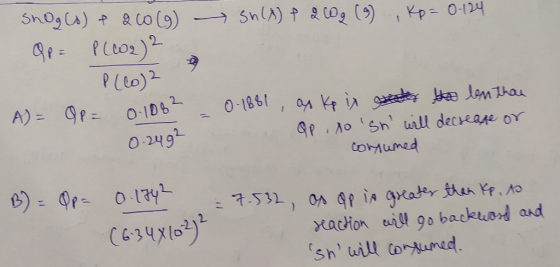
If you have any questions please comment
If you satisfied with the solution please rate it thanks
Add Answer to:
The equilibrium constant in terms of pressures for the reaction
SnO2(s) + 2CO(g) Sn(s) + 2CO2(g)...
For the reaction: SnO2(s) + 2CO(g) left right arrow Sn(s) + 2CO2(g), Kp = 0.025 at...
For the reaction: SnO2(s) + 2CO(g) left right arrow Sn(s) + 2CO2(g), Kp = 0.025 at 500°C. What is the value of Kc for the reaction at the same temperature? Enter your answer with 3 decimal places.
The equilibrium constant in terms of pressures for the reduction of tungsten(IV) oxide to tungsten at...
The equilibrium constant in terms of pressures for the reduction of tungsten(IV) oxide to tungsten at 25 °C is Kp = 3.82×10⁻⁴, corresponding to the reaction WO2(s) + 2CO(g) <--> W(s) + 2CO2(g) If the total pressure of an equilibrium system at 25 °C is 2.82 atm, calculate the partial pressures of CO(g) and CO2(g). PCO = _____atm PCO2 = ______atm
The equilibrium constant in terms of pressures, Kp, for the reaction NH3(g)+ HI(g) NH4I(s) at 400...
 The equilibrium constant in terms of pressures, Kp, for the reaction NH3(g)+ HI(g) NH4I(s) at 400 °C is 4.65. (a) If the partial pressure of ammonia is PNH, 0.881 atm and solid ammonium iodide is present, what is the equilibrium partial pressure of hydrogen iodide at 400 °C? PHI atm (b) An excess of solid NH,I is added to a container filled with NH3 at 400 °C and a pressure of 1.17 atm. Calculate the pressures of NH(g) and HI(g)...
1. calculate Kp for the reaction C(s) + Co2(g) = 2Co(g at 1300 k and 1...
1. calculate Kp for the reaction C(s) + Co2(g) = 2Co(g at 1300 k and 1 atm, the equilibrium mixture contains 85% co and 10.5% co2 by volume. 2. calculate the partial pressure of Co2 if Pco is changed to 10^-3 ATM.
Be sure to answer all parts. The equilibrium constant (Kp) for the reaction below is 4.40...
Be sure to answer all parts. The equilibrium constant (Kp) for the reaction below is 4.40 at 2000. K. H2(g) + CO2(g) ⇌ H2O(g) + CO(g) Calculate Δ G o for the reaction. kJ/mol Calculate Δ G for the reaction when the partial pressures are PH2 = 0.22 atm, PCO2 = 0.83 atm, PH2O = 0.66 atm, and PCO = 1.12 atm.
The equilibrium constant Kp for the reaction C(s)+H2O(g)⇌CO(g)+H2(g) is 2.44 at 1000 K. What are the...
The equilibrium constant Kp for the reaction C(s)+H2O(g)⇌CO(g)+H2(g) is 2.44 at 1000 K. What are the equilibrium partial pressures of H2O, CO, and H2 if the initial partial pressures are PCO=1.15 atm, and PH2= 1.45 atm? Part A What is the equilibrium partial pressure of H2O? Part B What is the equilibrium partial pressure of CO? Part C What is the equilibrium partial pressure of H2?
The equilibrium constant Kp for the reaction C(s)+H2O(g)⇌CO(g)+H2(g) is 2.44 at 1000 K. What are the...
The equilibrium constant Kp for the reaction C(s)+H2O(g)⇌CO(g)+H2(g) is 2.44 at 1000 K. What are the equilibrium partial pressures of H2O, CO, and H2 if the initial partial pressures are PCO= 1.30 atm, and PH2= 1.40 atm? Part A What is the equilibrium partial pressure of H2O? What is the equilibrium partial pressure of CO? What is the equilibrium partial pressure of CO?
Consider the following reaction at equilibrium. 2CO2 (g) 2CO (g) + O2 (g) ΔH° = -514...
Consider the following reaction at equilibrium. 2CO2 (g) 2CO (g) + O2 (g) ΔH° = -514 kJ Le Châtelier's principle predicts that the equilibrium partial pressure of CO (g) can be maximized by carrying out the reaction ________. A.) at low temperature and low pressure B.) at low temperature and high pressure C.) at high temperature and low pressure D.) in the presence of solid carbon E.) at high temperature and high pressure
The equilibrium constant in terms of pressures for the reaction COCl2(g) <--> CO(g) + Cl2(g) is...
The equilibrium constant in terms of pressures for the reaction COCl2(g) <--> CO(g) + Cl2(g) is Kp = 5.00 at 873 K. (a) A pure sample of gaseous phosgene, COCl2(g), is introduced into a rigid flask at a temperature of 873 K so that its original pressure is 0.121 atm. Calculate the fraction of this starting material that is converted to products at equilibrium. (b) A second sample of phosgene is introduced into a rigid flask at a temperature of...
Consider the heterogeneous equilibrium process: C(s) + CO2(g) ⇆ 2CO(g) At 700°C, the total pressure of...
Consider the heterogeneous equilibrium process: C(s) + CO2(g) ⇆ 2CO(g) At 700°C, the total pressure of the system is found to be 1.50 atm. If the equilibrium constant (KP) is 1.52, calculate the equilibrium partial pressures of CO and CO2.
 The equilibrium constant in terms of pressures, Kp, for the reaction NH3(g)+ HI(g) NH4I(s) at 400 °C is 4.65. (a) If the partial pressure of ammonia is PNH, 0.881 atm and solid ammonium iodide is present, what is the equilibrium partial pressure of hydrogen iodide at 400 °C? PHI atm (b) An excess of solid NH,I is added to a container filled with NH3 at 400 °C and a pressure of 1.17 atm. Calculate the pressures of NH(g) and HI(g)...
Most questions answered within 3 hours.
-
Where is the error in this code sequence?
String s1 = "Hello";
String s2 = "ello";...
asked 10 months ago -
Financial data for Joel de Paris, Inc., for last year
follow:
Joel de Paris, Inc.
Balance...
asked 10 months ago -
Consider this reaction:
Al2(SO4)3 (aq)+ BaCl3
(aq) Al2Cl6 (aq)- +
3BaSO4(s) . What is the...
asked 10 months ago -
Suppose that Savneet is considering increasing her
recent random sample from 20 car rentals to 40...
asked 10 months ago -
Trucks arrive at an unloading terminal at an average rate of 120
per hour.
Trucks arrive...
asked 10 months ago -
Why are methanol and ethanol completely soluble in water while
octanol is not very little soluble....
asked 10 months ago -
A facilities manager at a university reads in a research report
that the mean amount of...
asked 10 months ago -
When the CuSO4 is rehydrated by adding water to the anhydrous
compound, is this an endothermic...
asked 10 months ago -
A ray of sunlight is passing from diamond into crown glass; the
angle of incidence is...
asked 10 months ago -
A block of mass 0.249 kg is placed on top of a light, vertical
spring of...
asked 10 months ago -
how do the kidneys compensate in the presences of acidosis
a) trigger hyperventilate
b) reserve acid...
asked 10 months ago -
Question 501 pts
The rental rate of capital to the firm increases. Which of the
following...
asked 10 months ago