
Homework Answers
Q3)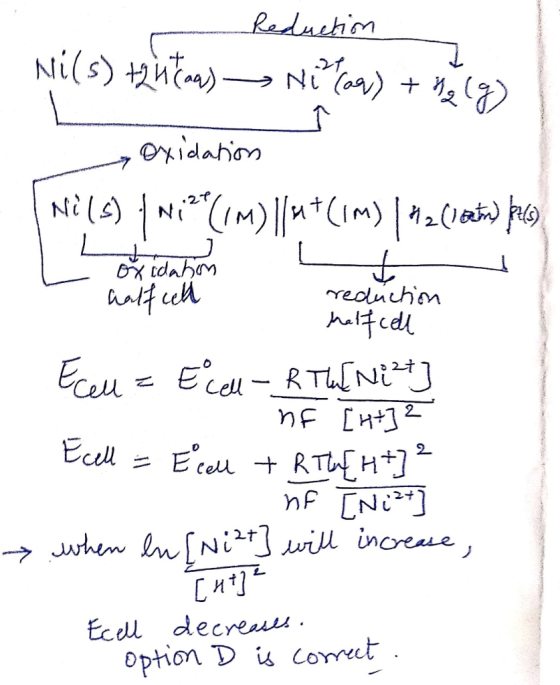
Q4) Elevation in boiling point
whenever a non-volatile solute is added to a pure solvent, the elevation of boiling point (∆Tb) is observed which is directly proportional to the molal concentration of the solute in a solution.
∆Tb = Kbm
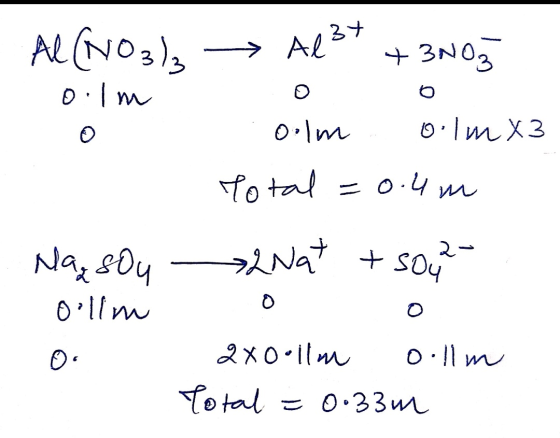
 As
K2CO3 has higher molality than others
that's why it will elevate the boiling point maximum.
As
K2CO3 has higher molality than others
that's why it will elevate the boiling point maximum.
Option C is correct.
Add Answer to:
5) For the electrochemical cell Ni(s) i Ni?(1 M H (1M) H (1 atm) Ps), which...
3. For the electrochemical cell: Pt(s) | H2(1 atm) | H'(I M)I| C u2(1 M) Cu(s),...
 3. For the electrochemical cell: Pt(s) | H2(1 atm) | H'(I M)I| C u2(1 M) Cu(s), which one of the following changes will cause an increase in the cell voltage? A) Lower the H2(g) pressure. B) Increase the size/mass of the copper electrode. C) Lower the H (aq) concentration. D) Decrease the concentration of Cu* ion. E) None of the above. 2+
Given the electrochemical cell reaction H,(g) + PbSO,(s) 2H (a) +SO, (aq) Pb(s), predict the effect...
 Given the electrochemical cell reaction H,(g) + PbSO,(s) 2H (a) +SO, (aq) Pb(s), predict the effect of the following changes on the observed cell voltage (increase, decrease, or no effect): a. increase in the pressure of H2 b. increase in the size of the lead electrode c. decrease in the pH of the cell electrolyte d. dissolution of Na SO, in the cell electrolyte e. decrease in the amount of PbSO f. dissolution of a small amount of NaOH in...
H aq H g anode An electrochemical cell consists of a H aq 1 .00 M H g) cat ode connected to a which e H concentration a ofa u er cons nu of a weak acid HA(0.116 M), mixed with its conjugate base, A (...
 H aq H g anode An electrochemical cell consists of a H aq 1 .00 M H g) cat ode connected to a which e H concentration a ofa u er cons nu of a weak acid HA(0.116 M), mixed with its conjugate base, A (0.143 M). The measured cell voltage is E°ell 0.163 V at 25 °C, with PH2-1.00 atm at both electrodes. Calculate the pH in the buffer solution and the K of the weak acid. Ka
H...
H aq H g anode An electrochemical cell consists of a H aq 1 .00 M H g) cat ode connected to a which e H concentration a ofa u er cons nu of a weak acid HA(0.116 M), mixed with its conjugate base, A (0.143 M). The measured cell voltage is E°ell 0.163 V at 25 °C, with PH2-1.00 atm at both electrodes. Calculate the pH in the buffer solution and the K of the weak acid. Ka
H...
Part I. (3 pt for each. No need to show calculation or explanation.) 1. The thermochemical...
 Part I. (3 pt for each. No need to show calculation or explanation.) 1. The thermochemical equation for the formation of ammonia from elemental nitrogen and hydrogen is as follows: N:(g) + 3 H:(8) = 2 NH3(g) AH--92.2 kJ Given a system that is initially at equilibrium, which of the following actions cause the reaction to proceed to the left? a) adding N2(g) b) removing NH3(8) c) removing H:(8) d) decreasing the temperature e) adding a catalyst H C CH3...
 3. For the electrochemical cell: Pt(s) | H2(1 atm) | H'(I M)I| C u2(1 M) Cu(s), which one of the following changes will cause an increase in the cell voltage? A) Lower the H2(g) pressure. B) Increase the size/mass of the copper electrode. C) Lower the H (aq) concentration. D) Decrease the concentration of Cu* ion. E) None of the above. 2+
 Given the electrochemical cell reaction H,(g) + PbSO,(s) 2H (a) +SO, (aq) Pb(s), predict the effect of the following changes on the observed cell voltage (increase, decrease, or no effect): a. increase in the pressure of H2 b. increase in the size of the lead electrode c. decrease in the pH of the cell electrolyte d. dissolution of Na SO, in the cell electrolyte e. decrease in the amount of PbSO f. dissolution of a small amount of NaOH in...
 H aq H g anode An electrochemical cell consists of a H aq 1 .00 M H g) cat ode connected to a which e H concentration a ofa u er cons nu of a weak acid HA(0.116 M), mixed with its conjugate base, A (0.143 M). The measured cell voltage is E°ell 0.163 V at 25 °C, with PH2-1.00 atm at both electrodes. Calculate the pH in the buffer solution and the K of the weak acid. Ka
H...
H aq H g anode An electrochemical cell consists of a H aq 1 .00 M H g) cat ode connected to a which e H concentration a ofa u er cons nu of a weak acid HA(0.116 M), mixed with its conjugate base, A (0.143 M). The measured cell voltage is E°ell 0.163 V at 25 °C, with PH2-1.00 atm at both electrodes. Calculate the pH in the buffer solution and the K of the weak acid. Ka
H...
 Part I. (3 pt for each. No need to show calculation or explanation.) 1. The thermochemical equation for the formation of ammonia from elemental nitrogen and hydrogen is as follows: N:(g) + 3 H:(8) = 2 NH3(g) AH--92.2 kJ Given a system that is initially at equilibrium, which of the following actions cause the reaction to proceed to the left? a) adding N2(g) b) removing NH3(8) c) removing H:(8) d) decreasing the temperature e) adding a catalyst H C CH3...
Most questions answered within 3 hours.
-
Where is the error in this code sequence?
String s1 = "Hello";
String s2 = "ello";...
asked 11 months ago -
Financial data for Joel de Paris, Inc., for last year
follow:
Joel de Paris, Inc.
Balance...
asked 11 months ago -
Consider this reaction:
Al2(SO4)3 (aq)+ BaCl3
(aq) Al2Cl6 (aq)- +
3BaSO4(s) . What is the...
asked 11 months ago -
Suppose that Savneet is considering increasing her
recent random sample from 20 car rentals to 40...
asked 11 months ago -
Trucks arrive at an unloading terminal at an average rate of 120
per hour.
Trucks arrive...
asked 11 months ago -
Why are methanol and ethanol completely soluble in water while
octanol is not very little soluble....
asked 11 months ago -
A facilities manager at a university reads in a research report
that the mean amount of...
asked 11 months ago -
When the CuSO4 is rehydrated by adding water to the anhydrous
compound, is this an endothermic...
asked 11 months ago -
A ray of sunlight is passing from diamond into crown glass; the
angle of incidence is...
asked 11 months ago -
A block of mass 0.249 kg is placed on top of a light, vertical
spring of...
asked 11 months ago -
how do the kidneys compensate in the presences of acidosis
a) trigger hyperventilate
b) reserve acid...
asked 11 months ago -
Question 501 pts
The rental rate of capital to the firm increases. Which of the
following...
asked 11 months ago