
Homework Answers
Add Answer to:
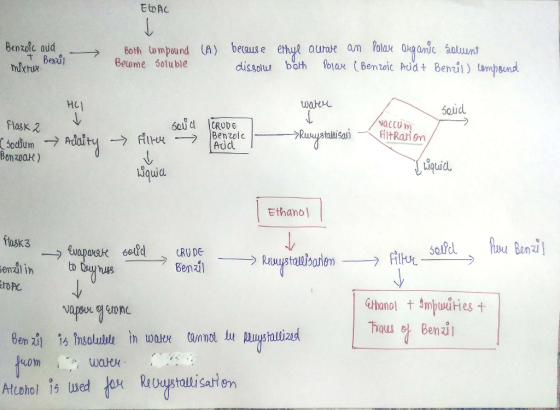
fill in the empty shapes in the flow chart
A.
B.
C.
D.
Eryl acetate Sodium...
fill in the blanks Ethyl acetate (EIOAC) Sodium bicarbon ate solution Benzoic acid + benzil moture...
 fill in the blanks
Ethyl acetate (EIOAC) Sodium bicarbon ate solution Benzoic acid + benzil moture Мх. shake Settle separate upper laver Organic laver-> flask 3 lower layer Aqueous layer-> flask 2 HС Water Flask 2 aque ous sodium benzoate in water) CRUDE BENZOIC ACID PURE BENZOIC ACID Solid sold Acidify Filter Recrvst Liquid (filtr ate) Liquid filtr ate) Water + impunities+ trace of benzoic acid Aqueous NaCl+ excess HCl solid PURE Filter Solid CRUDE BENZIL Recrvst BENZIL Flask 3...
fill in the blanks
Ethyl acetate (EIOAC) Sodium bicarbon ate solution Benzoic acid + benzil moture Мх. shake Settle separate upper laver Organic laver-> flask 3 lower layer Aqueous layer-> flask 2 HС Water Flask 2 aque ous sodium benzoate in water) CRUDE BENZOIC ACID PURE BENZOIC ACID Solid sold Acidify Filter Recrvst Liquid (filtr ate) Liquid filtr ate) Water + impunities+ trace of benzoic acid Aqueous NaCl+ excess HCl solid PURE Filter Solid CRUDE BENZIL Recrvst BENZIL Flask 3...
Acid/Base Extraction ACID/BASE EXTRACTION Provide a flow chart detailing the acid/base extraction/separation of the compounds shown...
 Acid/Base Extraction
ACID/BASE EXTRACTION Provide a flow chart detailing the acid/base extraction/separation of the compounds shown below. Your answer must employ the following reagents: methylene chloride, hydrochloric acid (1M & 6M), sodium hydroxide (1M & 6M), 10% sodium bicarbonate (aq). Clearly indicate the product(s) and layers formed following each step of your separation scheme. HINT: phenol is soluble in sodium hydroxide solution but insoluble in neutral water or sodium bicarbonate solution. Benzoic acid is soluble in both sodium hydroxide and...
Acid/Base Extraction
ACID/BASE EXTRACTION Provide a flow chart detailing the acid/base extraction/separation of the compounds shown below. Your answer must employ the following reagents: methylene chloride, hydrochloric acid (1M & 6M), sodium hydroxide (1M & 6M), 10% sodium bicarbonate (aq). Clearly indicate the product(s) and layers formed following each step of your separation scheme. HINT: phenol is soluble in sodium hydroxide solution but insoluble in neutral water or sodium bicarbonate solution. Benzoic acid is soluble in both sodium hydroxide and...
Draw an extraction flow chart for the Extraction experiment you completed. experiment below Separation of a...
Draw an extraction flow chart for the Extraction experiment you completed. experiment below Separation of a Benzoic Acid/Biphenyl Mixture by Acid-Base Extraction Prepare the solution to be extracted by dissolving 2.5 g of a 1:1 mixture of benzoic acid/ biphenyl in 25 mL of tert-butyl methyl ether (MTBE) . Using a 125 mL separatory funnel extract the ether solution with a mixture containing 10 mL of distilled water and 15 mL of saturated NaHCO3 . Repeat After removing the aqueous...
Construct a flow chart describing the seperation of the mixture and the isolation of each compound...
 Construct a flow chart describing the seperation of the
mixture and the isolation of each compound in this experiment. (Lab
steps/procedures includes for reference)
4. Construct a flow chart describing the separation of the mixture and the isolation of each compound in this experiment. A commonly used method of separating a mixture of organic compounds is known as liquid-liquid extraction. Most reactions of organic compounds require extraction at some stage of product purification. In this experiment you will use extraction...
Construct a flow chart describing the seperation of the
mixture and the isolation of each compound in this experiment. (Lab
steps/procedures includes for reference)
4. Construct a flow chart describing the separation of the mixture and the isolation of each compound in this experiment. A commonly used method of separating a mixture of organic compounds is known as liquid-liquid extraction. Most reactions of organic compounds require extraction at some stage of product purification. In this experiment you will use extraction...
2. Write the chemical formulas for the following: b. aluminum a. copper c. hydrochloric acid e....
 2. Write the chemical formulas for the following: b. aluminum a. copper c. hydrochloric acid e. copper(II) chloride g. sodium hydroxide i. hydrogen k. carbon dioxide m. calcium carbonate o. aluminum chloride q. calcium chloride d. magnesium sulfate – f. sodium bicarbonate h. methane j. sodium chloride 1. oxygen n. magnesium hydroxide p. sodium carbonate — r. water t. carbon monoxide S. sodium v. iron u. sulfur w.iron (II) sulfide y. sulfuric acid x. magnesium chloride z. sodium sulfate 3....
Experiment . the reduction of bencil (March 2020) Your name Sodium borohydride is a convert recent...
 Experiment . the reduction of bencil (March 2020) Your name Sodium borohydride is a convert recent for the reduction of dehydes and ketones to 1" and 2 alcohols, respectively. The mechanism of the reaction - (below) is straightforward and is driven by boron's affinity for oxygen. In addition, given borohydride's remarkably low reactivity with OH groups under neutral and especially basic conditions, this reaction can be done in alcohol solvents. This means that (unlike LAH or Grignard reactions) no separate...
Experiment Write Up Proposal You will write up a synthesis procedure for one reaction that could...
 Experiment Write Up Proposal You will write up a synthesis procedure for one reaction that could be potentially run in a face- to-face Chem 2321 lab session. Your proposal will include an introduction and procedure. The procedure will include step-by-step instructions for running the reaction (including reaction monitoring), work-up. (product isolation and purification), and analysis (characterization). You will need to include sample calculations for percent yield and provide sample spectra analysis. You must upload your proposal as a single document...
 fill in the blanks
Ethyl acetate (EIOAC) Sodium bicarbon ate solution Benzoic acid + benzil moture Мх. shake Settle separate upper laver Organic laver-> flask 3 lower layer Aqueous layer-> flask 2 HС Water Flask 2 aque ous sodium benzoate in water) CRUDE BENZOIC ACID PURE BENZOIC ACID Solid sold Acidify Filter Recrvst Liquid (filtr ate) Liquid filtr ate) Water + impunities+ trace of benzoic acid Aqueous NaCl+ excess HCl solid PURE Filter Solid CRUDE BENZIL Recrvst BENZIL Flask 3...
fill in the blanks
Ethyl acetate (EIOAC) Sodium bicarbon ate solution Benzoic acid + benzil moture Мх. shake Settle separate upper laver Organic laver-> flask 3 lower layer Aqueous layer-> flask 2 HС Water Flask 2 aque ous sodium benzoate in water) CRUDE BENZOIC ACID PURE BENZOIC ACID Solid sold Acidify Filter Recrvst Liquid (filtr ate) Liquid filtr ate) Water + impunities+ trace of benzoic acid Aqueous NaCl+ excess HCl solid PURE Filter Solid CRUDE BENZIL Recrvst BENZIL Flask 3...
 Acid/Base Extraction
ACID/BASE EXTRACTION Provide a flow chart detailing the acid/base extraction/separation of the compounds shown below. Your answer must employ the following reagents: methylene chloride, hydrochloric acid (1M & 6M), sodium hydroxide (1M & 6M), 10% sodium bicarbonate (aq). Clearly indicate the product(s) and layers formed following each step of your separation scheme. HINT: phenol is soluble in sodium hydroxide solution but insoluble in neutral water or sodium bicarbonate solution. Benzoic acid is soluble in both sodium hydroxide and...
Acid/Base Extraction
ACID/BASE EXTRACTION Provide a flow chart detailing the acid/base extraction/separation of the compounds shown below. Your answer must employ the following reagents: methylene chloride, hydrochloric acid (1M & 6M), sodium hydroxide (1M & 6M), 10% sodium bicarbonate (aq). Clearly indicate the product(s) and layers formed following each step of your separation scheme. HINT: phenol is soluble in sodium hydroxide solution but insoluble in neutral water or sodium bicarbonate solution. Benzoic acid is soluble in both sodium hydroxide and...
 Construct a flow chart describing the seperation of the
mixture and the isolation of each compound in this experiment. (Lab
steps/procedures includes for reference)
4. Construct a flow chart describing the separation of the mixture and the isolation of each compound in this experiment. A commonly used method of separating a mixture of organic compounds is known as liquid-liquid extraction. Most reactions of organic compounds require extraction at some stage of product purification. In this experiment you will use extraction...
Construct a flow chart describing the seperation of the
mixture and the isolation of each compound in this experiment. (Lab
steps/procedures includes for reference)
4. Construct a flow chart describing the separation of the mixture and the isolation of each compound in this experiment. A commonly used method of separating a mixture of organic compounds is known as liquid-liquid extraction. Most reactions of organic compounds require extraction at some stage of product purification. In this experiment you will use extraction...
 2. Write the chemical formulas for the following: b. aluminum a. copper c. hydrochloric acid e. copper(II) chloride g. sodium hydroxide i. hydrogen k. carbon dioxide m. calcium carbonate o. aluminum chloride q. calcium chloride d. magnesium sulfate – f. sodium bicarbonate h. methane j. sodium chloride 1. oxygen n. magnesium hydroxide p. sodium carbonate — r. water t. carbon monoxide S. sodium v. iron u. sulfur w.iron (II) sulfide y. sulfuric acid x. magnesium chloride z. sodium sulfate 3....
 Experiment . the reduction of bencil (March 2020) Your name Sodium borohydride is a convert recent for the reduction of dehydes and ketones to 1" and 2 alcohols, respectively. The mechanism of the reaction - (below) is straightforward and is driven by boron's affinity for oxygen. In addition, given borohydride's remarkably low reactivity with OH groups under neutral and especially basic conditions, this reaction can be done in alcohol solvents. This means that (unlike LAH or Grignard reactions) no separate...
 Experiment Write Up Proposal You will write up a synthesis procedure for one reaction that could be potentially run in a face- to-face Chem 2321 lab session. Your proposal will include an introduction and procedure. The procedure will include step-by-step instructions for running the reaction (including reaction monitoring), work-up. (product isolation and purification), and analysis (characterization). You will need to include sample calculations for percent yield and provide sample spectra analysis. You must upload your proposal as a single document...
Most questions answered within 3 hours.
-
Where is the error in this code sequence?
String s1 = "Hello";
String s2 = "ello";...
asked 10 months ago -
Financial data for Joel de Paris, Inc., for last year
follow:
Joel de Paris, Inc.
Balance...
asked 10 months ago -
Consider this reaction:
Al2(SO4)3 (aq)+ BaCl3
(aq) Al2Cl6 (aq)- +
3BaSO4(s) . What is the...
asked 10 months ago -
Suppose that Savneet is considering increasing her
recent random sample from 20 car rentals to 40...
asked 10 months ago -
Trucks arrive at an unloading terminal at an average rate of 120
per hour.
Trucks arrive...
asked 10 months ago -
Why are methanol and ethanol completely soluble in water while
octanol is not very little soluble....
asked 10 months ago -
A facilities manager at a university reads in a research report
that the mean amount of...
asked 10 months ago -
When the CuSO4 is rehydrated by adding water to the anhydrous
compound, is this an endothermic...
asked 10 months ago -
A ray of sunlight is passing from diamond into crown glass; the
angle of incidence is...
asked 10 months ago -
A block of mass 0.249 kg is placed on top of a light, vertical
spring of...
asked 10 months ago -
how do the kidneys compensate in the presences of acidosis
a) trigger hyperventilate
b) reserve acid...
asked 10 months ago -
Question 501 pts
The rental rate of capital to the firm increases. Which of the
following...
asked 10 months ago