1. design a follow-up experiment to investigate the enzyme peroxidase from plants. 2. investigate the effect...
Homework Answers
1. Design a follow-up experiment to investigate the enzyme peroxide from plants.
Peroxidase enzyme is present in organisms such as plants, bacterias and humans. It cleaves Hydrogen peroxide by use of oxygen for respiration, and form a toxin by product.
Reaction:
2H2O2 + Peroxidase -----> 2H2O + O2 + peroxidase
Byproducts are water and oxygen, as they are not as much toxic as H2O2, there is no deterioration in the inner region of the cell.
Experimental design
The rich source of catalase(peroxidase enzyme) is in turnip, and it is abstracted by considering the factors such as Substrate concentration, enzyme concentration, pH and temperature which affects the speed of the enzymatic reaction.
Spectrometers are used for monitoring the reaction rate, by using a reagant, guiacol. Oxidation of guiacol takes place in the presence of oxygen, and the color changes from clear to brown. The color of guiacol becomes intense, as the amount of oxygen product increases. Reaction is proceeded by taking 10ml reaction mixture which consists of guiacol, turnip extract, pH7 buffer and hydrogen peroxide. Every second of a minute absorbance measurement is observed. The graph is against time(x) and graphed absorbance(y). The rate of the reaction is obtained from the slope.
Maintaining standard reaction as a reference, variable of interest is measured individually, by running three set of reactions and compared with the standard. Effect of substrate concentration is intented by taking three sets of tubes, which differ with each other and with the substrate: amount of hydrogen peroxide is used. Slopes of the resulting lines are recorded and the average reaction rates(dependent variable, y) against the test factor(independent variable, x) is graphed. The curves from the graphs gives information about the status of the reaction rate, when the conditions gets deviate from the optimum and the enzyme's optimum value for each factor.
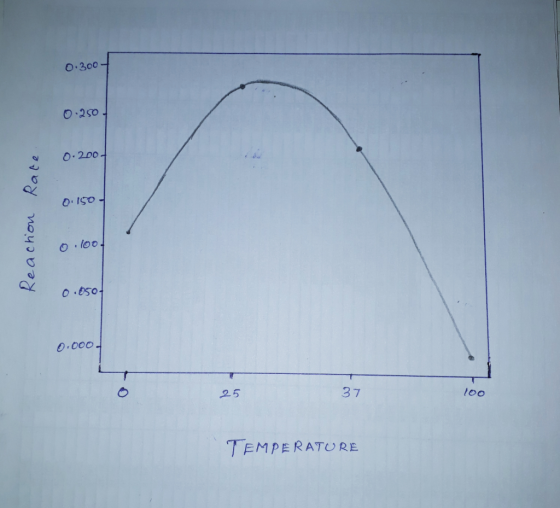
2. Effect of pH on enzyme activity
Alteration in the pH will disturb the activity of the enzyme. Here the Optimum pH is referred as the point at which the enzyme is extremely active and the pH is also a positive value.
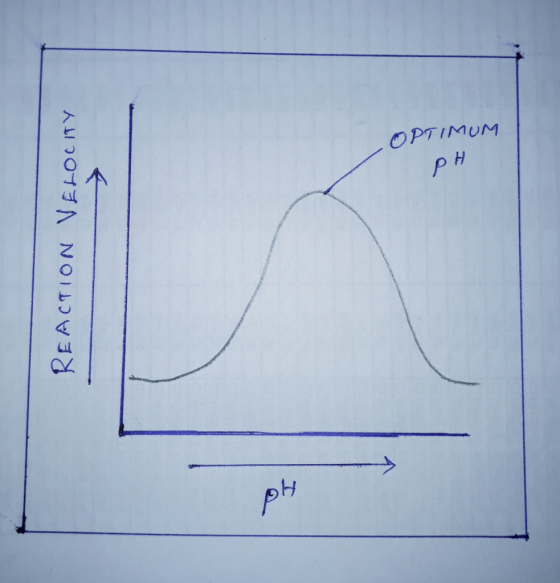
Enzyme Activity is extremely low, when the pH value is higher or lower to the extent. The stability of the enzyme is based on the pH value. For an enzyme along with activity, a region of pH optimal stability is possible. Optimum pH value will differ for each and every enzyme.
Ex. Pepsin has 1.5 - 1.6 Optimum pH, and Trypsin has 7. - 8.7, Urease has 7, Maltase has 6.1 - 6.8, Catalase has 7.0 Optimum pH
Apart from pH and temperature, ionic strength also play a role in fixing the reaction of the enzyme. For exact and consistent enzyme, these physical and chemical parameters should be examined and optimised.
Add Answer to:
1.
design a follow-up experiment to investigate the enzyme peroxidase
from plants.
2. investigate the effect...
An experiment was conducted to investigate enzyme activity. A small quantity of amylase solution was added...
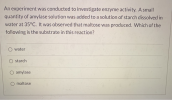 An experiment was conducted to investigate enzyme activity. A small quantity of amylase solution was added to a solution of starch dissolved in water at 35°C. It was observed that maltose was produced. Which of the following is the substrate in this reaction? water O starch O amylase O maltose
EFFECT OF pH: 1. Bubble height indicates the degree of enzyme activity. Based on the results...
 EFFECT OF pH:
1. Bubble height indicates the degree of enzyme activity. Based
on the results of your experiment, which tube had the highest
bubble column height?
What can you conclude about this pH? 2. Explain the results of
the other two tubes. What is your conclusion concerning the effect
of pH on enzyme activity?
Results: Table 5.1 - Catalase Activity Tube # Contents Bubble Column Height (mm) catalase/H202 dH20/H202 catalase/sucrose 27mm Omm | Omm E Table 5.2 - Effect...
EFFECT OF pH:
1. Bubble height indicates the degree of enzyme activity. Based
on the results of your experiment, which tube had the highest
bubble column height?
What can you conclude about this pH? 2. Explain the results of
the other two tubes. What is your conclusion concerning the effect
of pH on enzyme activity?
Results: Table 5.1 - Catalase Activity Tube # Contents Bubble Column Height (mm) catalase/H202 dH20/H202 catalase/sucrose 27mm Omm | Omm E Table 5.2 - Effect...
The effect of pH on the activity of an enzyme was examined. At its active site,...
 The effect of pH on the activity of an enzyme was examined. At its active site, the enzyme has an Ionizable group that must be positively charged for substrate binding and catalysis to take place. The Ionizable group has a pk of 6.0. The substrate is negatively charged throughout the pH range of the experiment At what pH=9. the enzyme will be operating at answer is either Vmax, 1/2 Vmax or less than 1/2 Vmax (type in one of the...
Does anyone know how to do this? Thanks in advance! Enzyme Activity (ml) Effect of pH...
 Does anyone know how to do this? Thanks in advance!
Enzyme Activity (ml) Effect of pH on (amylase) enzyme activity. For determination of optimum assay pH of the enzyme reaction, 0.05 M Na2HPO4-NaH2PO4 buffer was used. The reaction was carried out for 10 min at 50°C in a shaking water. The enzyme activity was measured and the results are presented on graph, Bars represent means standard deviations for three replicates. 1. What do the error bars in this graph represent?...
Does anyone know how to do this? Thanks in advance!
Enzyme Activity (ml) Effect of pH on (amylase) enzyme activity. For determination of optimum assay pH of the enzyme reaction, 0.05 M Na2HPO4-NaH2PO4 buffer was used. The reaction was carried out for 10 min at 50°C in a shaking water. The enzyme activity was measured and the results are presented on graph, Bars represent means standard deviations for three replicates. 1. What do the error bars in this graph represent?...
EFFECT OF TEMPERATURE: 1. Bubble height indicates the degree of enzyme activity. Based on the results...
 EFFECT OF TEMPERATURE:
1. Bubble height indicates the degree of enzyme activity. Based
on the results of your experiment, which tube had the highest
bubble column height? What can you conclude about this
temperature?
2. Compare the results of the tubes which were left on ice, at
25ºC, and at 37ºC. What can you conclude about the effect of
temperature on enzyme activity?
3. What happened in the tube with boiled catalase? Explain this
result.
Results: Table 5.1 - Catalase...
EFFECT OF TEMPERATURE:
1. Bubble height indicates the degree of enzyme activity. Based
on the results of your experiment, which tube had the highest
bubble column height? What can you conclude about this
temperature?
2. Compare the results of the tubes which were left on ice, at
25ºC, and at 37ºC. What can you conclude about the effect of
temperature on enzyme activity?
3. What happened in the tube with boiled catalase? Explain this
result.
Results: Table 5.1 - Catalase...
i need help with this lab report effects of temperture/ enzyme concetration/ and pH on enzyme...
 i
need help with this lab report effects of temperture/ enzyme
concetration/ and pH on enzyme activity
those are the experemint paper and results
Exercise 5: Factors Effecting Enzyme Activity A. Testing the Effect of Temperature on Enzyme Activity The purpose of this exercise is to determine the effect of temperature on enzyme activity Materials Large plastic bin Reaction chamber with rubber stopper and tube to bom 50 mL graduated cylinder beliet o bs Filter paper mot o r.com Liver...
i
need help with this lab report effects of temperture/ enzyme
concetration/ and pH on enzyme activity
those are the experemint paper and results
Exercise 5: Factors Effecting Enzyme Activity A. Testing the Effect of Temperature on Enzyme Activity The purpose of this exercise is to determine the effect of temperature on enzyme activity Materials Large plastic bin Reaction chamber with rubber stopper and tube to bom 50 mL graduated cylinder beliet o bs Filter paper mot o r.com Liver...
#). Use a 25-2 design to investigate the effect on process yield of A condensation temperature, B - amount of material 1, C- solvent volume D-condensation time, E amount of material 2. The result...
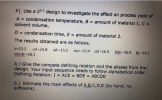 #). Use a 25-2 design to investigate the effect on process yield of A condensation temperature, B - amount of material 1, C- solvent volume D-condensation time, E amount of material 2. The results obtained are as follows. e-23.2 cd-23.8 ab -15.5 ace-23.4 ad -16.9 bde -16.8 bc-16.2 abcde -18.1 A.) Give the compete defining relation and the aliases from the design. Your input sequence needs to follow alphabetical order. Defining Relation: I ACE -BDE -ABCDE b.) Estimate the main...
how does changing saline concentration affect enzyme activity? (only saline not ph) what is the hypothesis...
 how
does changing saline concentration affect enzyme activity? (only
saline not ph)
what is the hypothesis
Enzyme Activity Design Investigation The compound hydrogen peroxide, Hou by product of the reaction in most living organisms. However, Hydrogen peroxide is damaging to delicate molecules inside ces As a result, nearly all organisms produce the enzyme catalase, which breaks down H,O, it is formed Potatoes are one source of catalase Catalase speeds up the breakdown of hydrogen peroxide into water and gaseoul sxygen...
how
does changing saline concentration affect enzyme activity? (only
saline not ph)
what is the hypothesis
Enzyme Activity Design Investigation The compound hydrogen peroxide, Hou by product of the reaction in most living organisms. However, Hydrogen peroxide is damaging to delicate molecules inside ces As a result, nearly all organisms produce the enzyme catalase, which breaks down H,O, it is formed Potatoes are one source of catalase Catalase speeds up the breakdown of hydrogen peroxide into water and gaseoul sxygen...
Keeping in mind the assays done in Lab 1/2, (a) how could you design a colorimetric...
 Keeping in mind the assays done in Lab 1/2, (a) how could you design a colorimetric method to measure alpha-amylase activity? (b) What would you use as a control? (c) At what wavelength should the spectrophotometer be set? (d) Sketch a graph like Plot 1 (from this lab) to represent the amylase activity you would observe using your method. You want to know whether alpha-amylase is more active in the stomach (pH 2) or the intestines (pH 7). (a) How...
Design an experiment in which you will test the effect of an acidic fluid on enzymatic...
Design an experiment in which you will test the effect of an acidic fluid on enzymatic activity. Recall: enzymes are proteins!
 An experiment was conducted to investigate enzyme activity. A small quantity of amylase solution was added to a solution of starch dissolved in water at 35°C. It was observed that maltose was produced. Which of the following is the substrate in this reaction? water O starch O amylase O maltose
 EFFECT OF pH:
1. Bubble height indicates the degree of enzyme activity. Based
on the results of your experiment, which tube had the highest
bubble column height?
What can you conclude about this pH? 2. Explain the results of
the other two tubes. What is your conclusion concerning the effect
of pH on enzyme activity?
Results: Table 5.1 - Catalase Activity Tube # Contents Bubble Column Height (mm) catalase/H202 dH20/H202 catalase/sucrose 27mm Omm | Omm E Table 5.2 - Effect...
EFFECT OF pH:
1. Bubble height indicates the degree of enzyme activity. Based
on the results of your experiment, which tube had the highest
bubble column height?
What can you conclude about this pH? 2. Explain the results of
the other two tubes. What is your conclusion concerning the effect
of pH on enzyme activity?
Results: Table 5.1 - Catalase Activity Tube # Contents Bubble Column Height (mm) catalase/H202 dH20/H202 catalase/sucrose 27mm Omm | Omm E Table 5.2 - Effect...
 The effect of pH on the activity of an enzyme was examined. At its active site, the enzyme has an Ionizable group that must be positively charged for substrate binding and catalysis to take place. The Ionizable group has a pk of 6.0. The substrate is negatively charged throughout the pH range of the experiment At what pH=9. the enzyme will be operating at answer is either Vmax, 1/2 Vmax or less than 1/2 Vmax (type in one of the...
 Does anyone know how to do this? Thanks in advance!
Enzyme Activity (ml) Effect of pH on (amylase) enzyme activity. For determination of optimum assay pH of the enzyme reaction, 0.05 M Na2HPO4-NaH2PO4 buffer was used. The reaction was carried out for 10 min at 50°C in a shaking water. The enzyme activity was measured and the results are presented on graph, Bars represent means standard deviations for three replicates. 1. What do the error bars in this graph represent?...
Does anyone know how to do this? Thanks in advance!
Enzyme Activity (ml) Effect of pH on (amylase) enzyme activity. For determination of optimum assay pH of the enzyme reaction, 0.05 M Na2HPO4-NaH2PO4 buffer was used. The reaction was carried out for 10 min at 50°C in a shaking water. The enzyme activity was measured and the results are presented on graph, Bars represent means standard deviations for three replicates. 1. What do the error bars in this graph represent?...
 EFFECT OF TEMPERATURE:
1. Bubble height indicates the degree of enzyme activity. Based
on the results of your experiment, which tube had the highest
bubble column height? What can you conclude about this
temperature?
2. Compare the results of the tubes which were left on ice, at
25ºC, and at 37ºC. What can you conclude about the effect of
temperature on enzyme activity?
3. What happened in the tube with boiled catalase? Explain this
result.
Results: Table 5.1 - Catalase...
EFFECT OF TEMPERATURE:
1. Bubble height indicates the degree of enzyme activity. Based
on the results of your experiment, which tube had the highest
bubble column height? What can you conclude about this
temperature?
2. Compare the results of the tubes which were left on ice, at
25ºC, and at 37ºC. What can you conclude about the effect of
temperature on enzyme activity?
3. What happened in the tube with boiled catalase? Explain this
result.
Results: Table 5.1 - Catalase...
 i
need help with this lab report effects of temperture/ enzyme
concetration/ and pH on enzyme activity
those are the experemint paper and results
Exercise 5: Factors Effecting Enzyme Activity A. Testing the Effect of Temperature on Enzyme Activity The purpose of this exercise is to determine the effect of temperature on enzyme activity Materials Large plastic bin Reaction chamber with rubber stopper and tube to bom 50 mL graduated cylinder beliet o bs Filter paper mot o r.com Liver...
i
need help with this lab report effects of temperture/ enzyme
concetration/ and pH on enzyme activity
those are the experemint paper and results
Exercise 5: Factors Effecting Enzyme Activity A. Testing the Effect of Temperature on Enzyme Activity The purpose of this exercise is to determine the effect of temperature on enzyme activity Materials Large plastic bin Reaction chamber with rubber stopper and tube to bom 50 mL graduated cylinder beliet o bs Filter paper mot o r.com Liver...
 #). Use a 25-2 design to investigate the effect on process yield of A condensation temperature, B - amount of material 1, C- solvent volume D-condensation time, E amount of material 2. The results obtained are as follows. e-23.2 cd-23.8 ab -15.5 ace-23.4 ad -16.9 bde -16.8 bc-16.2 abcde -18.1 A.) Give the compete defining relation and the aliases from the design. Your input sequence needs to follow alphabetical order. Defining Relation: I ACE -BDE -ABCDE b.) Estimate the main...
 how
does changing saline concentration affect enzyme activity? (only
saline not ph)
what is the hypothesis
Enzyme Activity Design Investigation The compound hydrogen peroxide, Hou by product of the reaction in most living organisms. However, Hydrogen peroxide is damaging to delicate molecules inside ces As a result, nearly all organisms produce the enzyme catalase, which breaks down H,O, it is formed Potatoes are one source of catalase Catalase speeds up the breakdown of hydrogen peroxide into water and gaseoul sxygen...
how
does changing saline concentration affect enzyme activity? (only
saline not ph)
what is the hypothesis
Enzyme Activity Design Investigation The compound hydrogen peroxide, Hou by product of the reaction in most living organisms. However, Hydrogen peroxide is damaging to delicate molecules inside ces As a result, nearly all organisms produce the enzyme catalase, which breaks down H,O, it is formed Potatoes are one source of catalase Catalase speeds up the breakdown of hydrogen peroxide into water and gaseoul sxygen...
 Keeping in mind the assays done in Lab 1/2, (a) how could you design a colorimetric method to measure alpha-amylase activity? (b) What would you use as a control? (c) At what wavelength should the spectrophotometer be set? (d) Sketch a graph like Plot 1 (from this lab) to represent the amylase activity you would observe using your method. You want to know whether alpha-amylase is more active in the stomach (pH 2) or the intestines (pH 7). (a) How...
Most questions answered within 3 hours.
-
Where is the error in this code sequence?
String s1 = "Hello";
String s2 = "ello";...
asked 11 months ago -
Financial data for Joel de Paris, Inc., for last year
follow:
Joel de Paris, Inc.
Balance...
asked 11 months ago -
Consider this reaction:
Al2(SO4)3 (aq)+ BaCl3
(aq) Al2Cl6 (aq)- +
3BaSO4(s) . What is the...
asked 11 months ago -
Suppose that Savneet is considering increasing her
recent random sample from 20 car rentals to 40...
asked 11 months ago -
Trucks arrive at an unloading terminal at an average rate of 120
per hour.
Trucks arrive...
asked 11 months ago -
Why are methanol and ethanol completely soluble in water while
octanol is not very little soluble....
asked 11 months ago -
A facilities manager at a university reads in a research report
that the mean amount of...
asked 11 months ago -
When the CuSO4 is rehydrated by adding water to the anhydrous
compound, is this an endothermic...
asked 11 months ago -
A ray of sunlight is passing from diamond into crown glass; the
angle of incidence is...
asked 11 months ago -
A block of mass 0.249 kg is placed on top of a light, vertical
spring of...
asked 11 months ago -
how do the kidneys compensate in the presences of acidosis
a) trigger hyperventilate
b) reserve acid...
asked 11 months ago -
Question 501 pts
The rental rate of capital to the firm increases. Which of the
following...
asked 11 months ago