
Homework Answers
1. In case the demand for money is relatively insensitive to the interest rate, the LM curve is nearly vertical
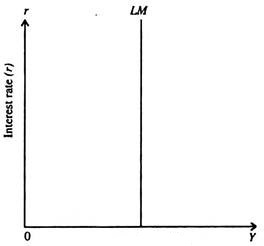
And the LM curve will shift left during panics, raising interest rates and decreasing output, because demand for money increases as economic agents scramble to get liquid in the face of the declining and volatile prices of other assets, particularly financial securities with positive default risk.
These are changes that are not related to output or interest rates, which merely indicate movements along the IS curve.
Add Answer to:
Suppose that MD is insensitive to the interest rate. What does the LM curve look like...
1. If AD is very sensitive to the interest rate. Draw an IS curve. 2. Interest...
1. If AD is very sensitive to the interest rate. Draw an IS curve. 2. Interest rate hardly effects AD. What does the IS curve look like
1. If the money demand does not depend on the interest rate, then the LM curve...
1. If the money demand does not depend on the interest rate, then the LM curve ______. a. is horizontal b. is vertical c. shifts up to the right d. shifts down to the right 2. If money demand becomes more income elastic, the LM curve will __________. a. become flatter b. shift to the right c. become stepper d. shift to the left 3. The labour force is defined as _________. a. the total number of working age individuals...
In deriving the LM curve, we assumed that money demand was negatively related to the interest...
In deriving the LM curve, we assumed that money demand was negatively related to the interest rate. Suppose instead that money demand depends only on the real value of transactions, Y . Draw the money demand curve for this case. What does the LM curve look like if money demand has this property? Explain. (Note: If money demand is independent of the interest rate, then we have the quantity theory of money.
If money demand does not depend on the interest rate, then the LM curve is ______...
If money demand does not depend on the interest rate, then the LM curve is ______ and ______ policy has no effect on output. A. horizontal; monetary B. vertical; monetary C. horizontal; fiscal D. vertical; fiscal
Q: Draw the IS??LM model. Label the short run output and equilibrium interest rate a) \Animal...
Q: Draw the IS??LM model. Label the short run output and equilibrium interest rate a) \Animal spirits" was Keynes' explanation for random shifts in the IS curve due to consumers' desire for consumption goods. An increase in consump- tion shifts the IS curve to the right. What happens to short run output and the equilibrium interest rate after this shift? What actions could the Federal reserve take to keep the interest rate xed at its original level?
Financial markets and the LM relation. a) Explain why the money demand curve is downward sloping...
 Financial markets and the LM relation. a) Explain why the money demand curve is downward sloping and what b) What types of policies can the central bank implement to reduce the interest c) Define the velocity of money. What effect does an increase in interest rate d) Illustrate graphically the effect of a drop in nominal income on the money e) Illustrate graphically the effect of a purchase of bonds by the Federal Reserve factor(s) cause shifts in the money...
What does the current Treasury Yield Curve look like today? What does this say about the...
What does the current Treasury Yield Curve look like today? What does this say about the expectation of interest rates in the future? What does it say about inflation? How does it compare to the yield curve a month ago? A year ago? Now look at the yield curve from November 20, 2006. What was this curve predicting?
Consider a closed economy that adheres to the standard Keynesian model. Let c0 > M. Suppose...
Consider a closed economy that adheres to the standard Keynesian model. Let c0 > M. Suppose that individuals’ demand to hold real money balances becomes more sensitive to changes in GDP and becomes less sensitive to changes in the interest rate. What impact will this have on the LM curve? A. LM curve becomes flatter, and it shifts down B. LM curve becomes flatter, and it shifts up C. LM curve becomes steeper, and its shift is indeterminate D. LM...
Advanced Macroeconoics II (41-434) Assignment 1 1. Consider the following IS/LM Model discussed in the class...
 Advanced Macroeconoics II (41-434) Assignment 1 1. Consider the following IS/LM Model discussed in the class (IS) (LM) rn-p-y-Ai, λ > 0. where π' is a expected inflation, g is a government spending, and m is money supply, respec tively. It is assumed that price level is fixed as p-p A. Calculate the equilibriu interest rate and output level. B. Assume that g is constant. Calculate the effect of the change in the money supply on the equilibrium interest rate...
1. Explain why the aggregate demand (AD) curve is downward slopping (on the two dimensional price...
 1. Explain why the aggregate demand (AD) curve is downward slopping (on the two dimensional price and output planes) in the neoclassical ASAD model. 2. Explain why the aggregate demand (AD) curve is downward slopping (on the two dimensional price and output planes) in the Post-Keynesian ASAD model. 3-4. In the neoclassical ASAD model, let us suppose that the interest rate has no effect on investment. What does this imply for (1) the slope of the IS curve, for (2)...
 Financial markets and the LM relation. a) Explain why the money demand curve is downward sloping and what b) What types of policies can the central bank implement to reduce the interest c) Define the velocity of money. What effect does an increase in interest rate d) Illustrate graphically the effect of a drop in nominal income on the money e) Illustrate graphically the effect of a purchase of bonds by the Federal Reserve factor(s) cause shifts in the money...
 Advanced Macroeconoics II (41-434) Assignment 1 1. Consider the following IS/LM Model discussed in the class (IS) (LM) rn-p-y-Ai, λ > 0. where π' is a expected inflation, g is a government spending, and m is money supply, respec tively. It is assumed that price level is fixed as p-p A. Calculate the equilibriu interest rate and output level. B. Assume that g is constant. Calculate the effect of the change in the money supply on the equilibrium interest rate...
 1. Explain why the aggregate demand (AD) curve is downward slopping (on the two dimensional price and output planes) in the neoclassical ASAD model. 2. Explain why the aggregate demand (AD) curve is downward slopping (on the two dimensional price and output planes) in the Post-Keynesian ASAD model. 3-4. In the neoclassical ASAD model, let us suppose that the interest rate has no effect on investment. What does this imply for (1) the slope of the IS curve, for (2)...
Most questions answered within 3 hours.
-
Where is the error in this code sequence?
String s1 = "Hello";
String s2 = "ello";...
asked 10 months ago -
Financial data for Joel de Paris, Inc., for last year
follow:
Joel de Paris, Inc.
Balance...
asked 10 months ago -
Consider this reaction:
Al2(SO4)3 (aq)+ BaCl3
(aq) Al2Cl6 (aq)- +
3BaSO4(s) . What is the...
asked 10 months ago -
Suppose that Savneet is considering increasing her
recent random sample from 20 car rentals to 40...
asked 10 months ago -
Trucks arrive at an unloading terminal at an average rate of 120
per hour.
Trucks arrive...
asked 10 months ago -
Why are methanol and ethanol completely soluble in water while
octanol is not very little soluble....
asked 10 months ago -
A facilities manager at a university reads in a research report
that the mean amount of...
asked 10 months ago -
When the CuSO4 is rehydrated by adding water to the anhydrous
compound, is this an endothermic...
asked 10 months ago -
A ray of sunlight is passing from diamond into crown glass; the
angle of incidence is...
asked 10 months ago -
A block of mass 0.249 kg is placed on top of a light, vertical
spring of...
asked 10 months ago -
how do the kidneys compensate in the presences of acidosis
a) trigger hyperventilate
b) reserve acid...
asked 10 months ago -
Question 501 pts
The rental rate of capital to the firm increases. Which of the
following...
asked 10 months ago