
Homework Answers
Consider reaction , Cu2S (s)  2 Cu + (aq) + S 2- (aq)
For above reaction, K sp = [ Cu + ] 2 [ S
2- ] = 1.0  10 -48 .
We know that, formation of solid takes place when Q = K sp.
Here , we have values of Q= K sp = 1.0
10 -48 & [ S 2- ]
= 2.0
10 -15 . We need to calculate [ Cu + ] which
is needed to begin precipitate.
we have , K sp = [ Cu + ] 2 [ S
2- ] = 1.0
10 -48
 [ Cu + ] 2 = 1.0
10 -48 / [ S 2- ]
[ Cu + ] 2 = 1.0
10 -48 / [ S 2- ]
[ Cu + ] 2 = 1.0
10 -48 / 2.0
10 -15
[ Cu + ] 2 = 5.0
10 -34
[ Cu + ] = 2.2
10 -17 M
ANSWER : Concentration of Cu (I) needed to begin precipitation
is 2.2
10 -17 M .
Add Answer to:
2. The Ksp of Cu2S is 1.0 x 10-48. What concentration of Cu+ (aq) is needed...
Copper(l) ions in aqueous solution react with NH3(aq) according to Cu(NH3);(aq) 10 Cu"(aq) +2NH3(aq) -> K,=6.3...
 Copper(l) ions in aqueous solution react with NH3(aq) according to Cu(NH3);(aq) 10 Cu"(aq) +2NH3(aq) -> K,=6.3 x 10 Calculate the solubility (in g. L-1) of CuBr(s) (Ksp = 6.3x10⁻⁹) in 0.64 M NH3(aq). Number g/L
What is the concentration of the Cu²⁺(aq) ion in a 0.015 M Cu(NO₃)₂ solution that is...
What is the concentration of the Cu²⁺(aq) ion in a 0.015 M Cu(NO₃)₂ solution that is also 1.0 M NH₃? The Kf for Cu(NH₃)₄²⁺ = 4.8 x 10¹² .
What is the minimum concentration of Cl- necessary to begin precipitation of AgCl(s) (Ksp = 1.77×10⁻¹)...
What is the minimum concentration of Cl- necessary to begin precipitation of AgCl(s) (Ksp = 1.77×10⁻¹) in a solution of 5.0×10⁻⁵M Ag+?
a. Using the Ksp value for Cu(OH)2 (1.6 x 10⁻¹⁹) and the overall formation constant for...
a. Using the Ksp value for Cu(OH)2 (1.6 x 10⁻¹⁹) and the overall formation constant for Cu(NH3)42+ (1.0 x 10¹³), calculate the value for the equilibrium constant for the following reaction: Cu(OH)2 (s) + 4NH3 (aq) ⇌ Cu(NH3)42+(aq) + 2OH -(aq) b. Use the value of the equilibrium constant you calculated in part a to calculate the solubility (in mol/L) of Cu(OH)2 in 5.0 M NH3. In 5.0 M NH3 the concentration of OH - is 0.0095 M.
Ksp of Ag2SO3 is 1.50×10⁻¹⁴ < Question 1 of 19 > What concentration of Soz- is...
 Ksp of Ag2SO3 is
1.50×10⁻¹⁴
< Question 1 of 19 > What concentration of Soz- is in equilibrium with Ag, Soz(s) and 9.30 x 10⁻³ M Ag+? The Ksp of Ag, Soz can be found in this table. C [502] = M M
Ksp of Ag2SO3 is
1.50×10⁻¹⁴
< Question 1 of 19 > What concentration of Soz- is in equilibrium with Ag, Soz(s) and 9.30 x 10⁻³ M Ag+? The Ksp of Ag, Soz can be found in this table. C [502] = M M
Given that, for AgI, at 25°C, Ksp = 1.5×10⁻¹⁶: From a 1.0×10⁻⁶-M NaI solution, precipitation of...
Given that, for AgI, at 25°C, Ksp = 1.5×10⁻¹⁶: From a 1.0×10⁻⁶-M NaI solution, precipitation of AgI just begins at what concentration of added Ag+?
Question 7 Determine the solubility of Cul(s) (Ksp = 1.1 x 10⁻¹²) in 0.15 M Cu(NO3)2(aq)...
 Question 7 Determine the solubility of Cul(s) (Ksp = 1.1 x 10⁻¹²) in 0.15 M Cu(NO3)2(aq) solution 1- 1- Ksp = (S+ 0.15). (25)?. S = (Ksp/0.6) 1/2, S = 1.35 x 10⁻⁶ M 2- 2- Ksp = S . (S + 0.30). S = (Ksp/0.30), S = 3.67 x 10⁻¹² M 3- 3- Ksp = (S + 0.15).S. S = (Ksp/0.15). S = 7.33 x 10⁻¹² M
The reaction Cu(s) + 2 AgNO_3(aq) rightarrow Cu(NO_3)_2 (aq) + 2Ag(s) is best classified as a(n)...
 The reaction Cu(s) + 2 AgNO_3(aq) rightarrow Cu(NO_3)_2 (aq) + 2Ag(s) is best classified as a(n) acid-base neutralization reaction. double replacement reaction. oxidation-reduction reaction. precipitation reaction. What is the concentration of sodium ions in 0.350 M Na_3PO_4 solution? 0.117 M 0.350 M 1.05 M 1.40 M What is the molecular geometry of BrF_4^-? seesaw square planar square pyramidal tetrahedral in the reaction the spectator ions are Ag^+ and NO_3^- Ag^+ and I^- H^+ and I^- H^+ and NO_3^-
Question 10 1 pts For the reaction Cu2S(s) =2Cu* (aq) +52-(aq), the equilibrium concentrations are as...
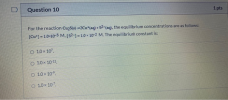 Question 10 1 pts For the reaction Cu2S(s) =2Cu* (aq) +52-(aq), the equilibrium concentrations are as follows: (Cut) = 1.0~10-5 M, [52-)- 10 x 10-2 M. The equilibrium constant is: 1.0 x 10⁷ 1.0 x 10⁻¹² O 1.0x 10 % 1.0 x 10⁷.
KNO, salt bridge Mg Zn Ag 1.0 M Mg 1.0 M Zn2 1.0 M Cu 1.0...
 KNO, salt bridge Mg Zn Ag 1.0 M Mg 1.0 M Zn2 1.0 M Cu 1.0 M Ag Reset Info 1.0 M ME LO M 2 1.0 MC 10 MA Reset Set up a cell that has a My electrode in a 1.0 M aqueous Mg? solution on the left side and a Ag electrode in a 1.0 M aqueous A solution on the right side. Add the salt bridge. What is the balanced net ionic equation for this reaction?...
 Copper(l) ions in aqueous solution react with NH3(aq) according to Cu(NH3);(aq) 10 Cu"(aq) +2NH3(aq) -> K,=6.3 x 10 Calculate the solubility (in g. L-1) of CuBr(s) (Ksp = 6.3x10⁻⁹) in 0.64 M NH3(aq). Number g/L
 Ksp of Ag2SO3 is
1.50×10⁻¹⁴
< Question 1 of 19 > What concentration of Soz- is in equilibrium with Ag, Soz(s) and 9.30 x 10⁻³ M Ag+? The Ksp of Ag, Soz can be found in this table. C [502] = M M
Ksp of Ag2SO3 is
1.50×10⁻¹⁴
< Question 1 of 19 > What concentration of Soz- is in equilibrium with Ag, Soz(s) and 9.30 x 10⁻³ M Ag+? The Ksp of Ag, Soz can be found in this table. C [502] = M M
 Question 7 Determine the solubility of Cul(s) (Ksp = 1.1 x 10⁻¹²) in 0.15 M Cu(NO3)2(aq) solution 1- 1- Ksp = (S+ 0.15). (25)?. S = (Ksp/0.6) 1/2, S = 1.35 x 10⁻⁶ M 2- 2- Ksp = S . (S + 0.30). S = (Ksp/0.30), S = 3.67 x 10⁻¹² M 3- 3- Ksp = (S + 0.15).S. S = (Ksp/0.15). S = 7.33 x 10⁻¹² M
 The reaction Cu(s) + 2 AgNO_3(aq) rightarrow Cu(NO_3)_2 (aq) + 2Ag(s) is best classified as a(n) acid-base neutralization reaction. double replacement reaction. oxidation-reduction reaction. precipitation reaction. What is the concentration of sodium ions in 0.350 M Na_3PO_4 solution? 0.117 M 0.350 M 1.05 M 1.40 M What is the molecular geometry of BrF_4^-? seesaw square planar square pyramidal tetrahedral in the reaction the spectator ions are Ag^+ and NO_3^- Ag^+ and I^- H^+ and I^- H^+ and NO_3^-
 Question 10 1 pts For the reaction Cu2S(s) =2Cu* (aq) +52-(aq), the equilibrium concentrations are as follows: (Cut) = 1.0~10-5 M, [52-)- 10 x 10-2 M. The equilibrium constant is: 1.0 x 10⁷ 1.0 x 10⁻¹² O 1.0x 10 % 1.0 x 10⁷.
 KNO, salt bridge Mg Zn Ag 1.0 M Mg 1.0 M Zn2 1.0 M Cu 1.0 M Ag Reset Info 1.0 M ME LO M 2 1.0 MC 10 MA Reset Set up a cell that has a My electrode in a 1.0 M aqueous Mg? solution on the left side and a Ag electrode in a 1.0 M aqueous A solution on the right side. Add the salt bridge. What is the balanced net ionic equation for this reaction?...
Most questions answered within 3 hours.
-
Where is the error in this code sequence?
String s1 = "Hello";
String s2 = "ello";...
asked 11 months ago -
Financial data for Joel de Paris, Inc., for last year
follow:
Joel de Paris, Inc.
Balance...
asked 11 months ago -
Consider this reaction:
Al2(SO4)3 (aq)+ BaCl3
(aq) Al2Cl6 (aq)- +
3BaSO4(s) . What is the...
asked 11 months ago -
Suppose that Savneet is considering increasing her
recent random sample from 20 car rentals to 40...
asked 11 months ago -
Trucks arrive at an unloading terminal at an average rate of 120
per hour.
Trucks arrive...
asked 11 months ago -
Why are methanol and ethanol completely soluble in water while
octanol is not very little soluble....
asked 11 months ago -
A facilities manager at a university reads in a research report
that the mean amount of...
asked 11 months ago -
When the CuSO4 is rehydrated by adding water to the anhydrous
compound, is this an endothermic...
asked 11 months ago -
A ray of sunlight is passing from diamond into crown glass; the
angle of incidence is...
asked 11 months ago -
A block of mass 0.249 kg is placed on top of a light, vertical
spring of...
asked 11 months ago -
how do the kidneys compensate in the presences of acidosis
a) trigger hyperventilate
b) reserve acid...
asked 11 months ago -
Question 501 pts
The rental rate of capital to the firm increases. Which of the
following...
asked 11 months ago