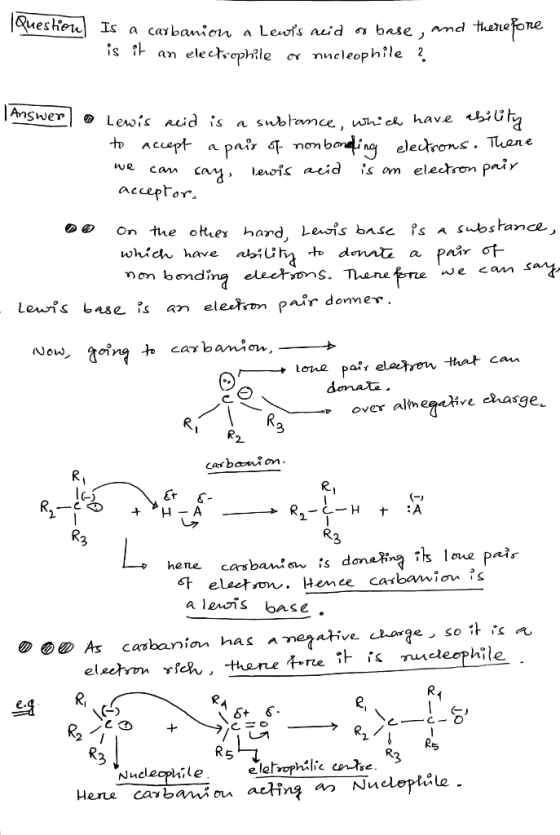
is a carbanion a Lewis acid or base, and therefore is it an electrophile or nucleophile?
Homework Answers
Add Answer to:
is a carbanion a Lewis acid or base, and therefore is it an
electrophile or nucleophile?
Draw the product of the Lewis acid-base reaction. Label the electrophile and nucleophile. H20 draw structure...
 Draw the product of the Lewis acid-base reaction. Label the electrophile and nucleophile. H20 draw structure . (select) (select) <>
3. Label the reactants as the Lewis base or the Lewis acid. How are these terms...
 3. Label the reactants as the Lewis base or the Lewis acid. How are these terms related to nucleophile and electrophile? C-A CHOHCH, C- 2-0-CH, CICH (C) (A) (B) 4. What order (1st, 2nd, 3rd...)/mechanism (SN1/SN2) would you propose if given this rate equation? Rate = k [CH3CH2Cl] [N3]
Draw the complete mechanism for the reaction if HBr with 2-methylcyclohepta-1,3-diene. Label the Lewis acid, Lewis...
Draw the complete mechanism for the reaction if HBr with 2-methylcyclohepta-1,3-diene. Label the Lewis acid, Lewis base, nucleophile and electrophile in each step. (PLEASE ANSWER QUICKLY I WILL RATE).
Write structure for the cabonyl electrophile and enolate nucleophile that reacts to a give the Aldol...
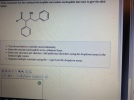 Write structure for the cabonyl electrophile and enolate
nucleophile that reacts to a give the Aldol below.
Write structures for the carbonyl electrophile and enolate nucleophile that react to below give the aldol . You do not have to consider stereochemistry . Draw the enolate nucleophile in its carbanion form. . Draw one structure per sketcher. Add additional sketchers using the dropdown menu in the bottom right corner. . Separate multiple reactants using the + sign from the dropdown menu.
Write structure for the cabonyl electrophile and enolate
nucleophile that reacts to a give the Aldol below.
Write structures for the carbonyl electrophile and enolate nucleophile that react to below give the aldol . You do not have to consider stereochemistry . Draw the enolate nucleophile in its carbanion form. . Draw one structure per sketcher. Add additional sketchers using the dropdown menu in the bottom right corner. . Separate multiple reactants using the + sign from the dropdown menu.
9.1 Alcohols Worksheet Prior Knowledge: ✓ Acid/base definitions and pka values. ✓ Nucleophile/electrophile definitions and roles....
 9.1 Alcohols Worksheet Prior Knowledge: ✓ Acid/base definitions and pka values. ✓ Nucleophile/electrophile definitions and roles. ✓ Substitution and elimination reactions and mechanisms using curved arrows. Leaving group ability. Learning Objectives After completing this activity students should be able to: ✓ Predict the role of an alcohol in the Williamson Ether Synthesis and Fisher Esterification. Determine that protonation of an alcohol affords stronger electrophiles because of better, more stabilized, leaving groups. Conversion of Alcohols to Electrophiles Protonation RCH,OH + H...
1. In the reaction between BF3 and NH3, NH3 is the A. Lewis base B. Lewis...
1. In the reaction between BF3 and NH3, NH3 is the A. Lewis base B. Lewis acid C. Lewis structure 2. HCl and HNO3 have the same strength in aqueous solutions. This is an example of the leveling effect. a) True b) False 3. In the reaction between BF3 and NH3, NH3 is the A. nucleophile B. electrophile C. protophile 4. An amphoteric substance can act as an acid or base a) True b) False 5. For a solution that...
Write structures for the carbonyl electrophile and enolate nucleophile that react to give the aldol below....
 Write structures for the carbonyl electrophile and enolate nucleophile that react to give the aldol below. • Draw the carbanion resonance structure for the enolate without a cation. • Draw one structure per sketcher. Add additional sketchers using the drop-down menu in the bottom right corner. • Separate structures with + signs from the drop-down menu. Co o 750/1000 []* ChemDoodle Previous Next Write structures for the carbonyl electrophile and enolate nucleophile that react to give the aldol below. CH3...
12. Which is the major product of the reaction shown? (a) (b) (c) (d) 13. What...
 12. Which is the major product of the reaction shown? (a) (b)
(c) (d) 13. What are all of the possible products formed in the
following reaction? (choose all correct answers) (a) (b) (c) (d)
(e) (f) 14. The three compounds below can form a carbocation in the
presence of H2O and H2SO4. Which ones will form the same
carbocation? (a) I and II (b) I and III (c) II and III (d) all
three will form the same carbocation...
12. Which is the major product of the reaction shown? (a) (b)
(c) (d) 13. What are all of the possible products formed in the
following reaction? (choose all correct answers) (a) (b) (c) (d)
(e) (f) 14. The three compounds below can form a carbocation in the
presence of H2O and H2SO4. Which ones will form the same
carbocation? (a) I and II (b) I and III (c) II and III (d) all
three will form the same carbocation...
Draw structures for the carbonyl electrophile and enolate nucleophile that react to give the aldol or...
 Draw structures for the carbonyl electrophile and enolate nucleophile that react to give the aldol or enone below. • You do not have to consider stereochemistry. • Draw the enolate ion in its carbanion form. • Draw one structure per sketcher. Add additional sketchers using the drop-down menu in the bottom right com • Separate multiple reactants using the + sign from the drop-down menu. C-@- .OOO-1 Draw structures for the carbonyl electrophile and enolate nucleophile that react to give...
Draw structures for the carbonyl electrophile and enolate nucleophile that react to give the aldol or...
 Draw structures for the carbonyl electrophile and enolate nucleophile that react to give the aldol or enone below. You do not have to consider stereochemistry. • Draw the enolate ion in its carbanion form. • Draw one structure per sketcher. Add additional sketchers using the drop-down menu in the bottom right comer. Separate multiple reactants using the + sign from the drop-down menu. C opy Р aste *** Previous Draw structures for the carbonyl electrophile and enolate nucleophile that react...
 Draw the product of the Lewis acid-base reaction. Label the electrophile and nucleophile. H20 draw structure . (select) (select) <>
 3. Label the reactants as the Lewis base or the Lewis acid. How are these terms related to nucleophile and electrophile? C-A CHOHCH, C- 2-0-CH, CICH (C) (A) (B) 4. What order (1st, 2nd, 3rd...)/mechanism (SN1/SN2) would you propose if given this rate equation? Rate = k [CH3CH2Cl] [N3]
 Write structure for the cabonyl electrophile and enolate
nucleophile that reacts to a give the Aldol below.
Write structures for the carbonyl electrophile and enolate nucleophile that react to below give the aldol . You do not have to consider stereochemistry . Draw the enolate nucleophile in its carbanion form. . Draw one structure per sketcher. Add additional sketchers using the dropdown menu in the bottom right corner. . Separate multiple reactants using the + sign from the dropdown menu.
Write structure for the cabonyl electrophile and enolate
nucleophile that reacts to a give the Aldol below.
Write structures for the carbonyl electrophile and enolate nucleophile that react to below give the aldol . You do not have to consider stereochemistry . Draw the enolate nucleophile in its carbanion form. . Draw one structure per sketcher. Add additional sketchers using the dropdown menu in the bottom right corner. . Separate multiple reactants using the + sign from the dropdown menu.
 9.1 Alcohols Worksheet Prior Knowledge: ✓ Acid/base definitions and pka values. ✓ Nucleophile/electrophile definitions and roles. ✓ Substitution and elimination reactions and mechanisms using curved arrows. Leaving group ability. Learning Objectives After completing this activity students should be able to: ✓ Predict the role of an alcohol in the Williamson Ether Synthesis and Fisher Esterification. Determine that protonation of an alcohol affords stronger electrophiles because of better, more stabilized, leaving groups. Conversion of Alcohols to Electrophiles Protonation RCH,OH + H...
 Write structures for the carbonyl electrophile and enolate nucleophile that react to give the aldol below. • Draw the carbanion resonance structure for the enolate without a cation. • Draw one structure per sketcher. Add additional sketchers using the drop-down menu in the bottom right corner. • Separate structures with + signs from the drop-down menu. Co o 750/1000 []* ChemDoodle Previous Next Write structures for the carbonyl electrophile and enolate nucleophile that react to give the aldol below. CH3...
 12. Which is the major product of the reaction shown? (a) (b)
(c) (d) 13. What are all of the possible products formed in the
following reaction? (choose all correct answers) (a) (b) (c) (d)
(e) (f) 14. The three compounds below can form a carbocation in the
presence of H2O and H2SO4. Which ones will form the same
carbocation? (a) I and II (b) I and III (c) II and III (d) all
three will form the same carbocation...
12. Which is the major product of the reaction shown? (a) (b)
(c) (d) 13. What are all of the possible products formed in the
following reaction? (choose all correct answers) (a) (b) (c) (d)
(e) (f) 14. The three compounds below can form a carbocation in the
presence of H2O and H2SO4. Which ones will form the same
carbocation? (a) I and II (b) I and III (c) II and III (d) all
three will form the same carbocation...
 Draw structures for the carbonyl electrophile and enolate nucleophile that react to give the aldol or enone below. • You do not have to consider stereochemistry. • Draw the enolate ion in its carbanion form. • Draw one structure per sketcher. Add additional sketchers using the drop-down menu in the bottom right com • Separate multiple reactants using the + sign from the drop-down menu. C-@- .OOO-1 Draw structures for the carbonyl electrophile and enolate nucleophile that react to give...
 Draw structures for the carbonyl electrophile and enolate nucleophile that react to give the aldol or enone below. You do not have to consider stereochemistry. • Draw the enolate ion in its carbanion form. • Draw one structure per sketcher. Add additional sketchers using the drop-down menu in the bottom right comer. Separate multiple reactants using the + sign from the drop-down menu. C opy Р aste *** Previous Draw structures for the carbonyl electrophile and enolate nucleophile that react...
Most questions answered within 3 hours.
-
Where is the error in this code sequence?
String s1 = "Hello";
String s2 = "ello";...
asked 11 months ago -
Financial data for Joel de Paris, Inc., for last year
follow:
Joel de Paris, Inc.
Balance...
asked 11 months ago -
Consider this reaction:
Al2(SO4)3 (aq)+ BaCl3
(aq) Al2Cl6 (aq)- +
3BaSO4(s) . What is the...
asked 11 months ago -
Suppose that Savneet is considering increasing her
recent random sample from 20 car rentals to 40...
asked 11 months ago -
Trucks arrive at an unloading terminal at an average rate of 120
per hour.
Trucks arrive...
asked 11 months ago -
Why are methanol and ethanol completely soluble in water while
octanol is not very little soluble....
asked 11 months ago -
A facilities manager at a university reads in a research report
that the mean amount of...
asked 11 months ago -
When the CuSO4 is rehydrated by adding water to the anhydrous
compound, is this an endothermic...
asked 11 months ago -
A ray of sunlight is passing from diamond into crown glass; the
angle of incidence is...
asked 11 months ago -
A block of mass 0.249 kg is placed on top of a light, vertical
spring of...
asked 11 months ago -
how do the kidneys compensate in the presences of acidosis
a) trigger hyperventilate
b) reserve acid...
asked 11 months ago -
Question 501 pts
The rental rate of capital to the firm increases. Which of the
following...
asked 11 months ago