![Consider the following reaction. Calculate the value of the rate constant. 4 A+B Trial 3C [A], 0.1 0.2 Rate (M/s) 4.884 [B] 0](http://img.homeworklib.com/questions/1339b950-75c2-11ea-a78b-d94362e6d832.png?x-oss-process=image/resize,w_560)
Homework Answers

Add Answer to:
please help, step by step and clear answer
Consider the following reaction. Calculate the value of...
please help Consider the following reaction. Calculate the value of the rate constant. 4 A+B 3C...
 please help
Consider the following reaction. Calculate the value of the rate constant. 4 A+B 3C Trial Alo [B] [C] Rate (M/s) 0.1 0.11 0.033 4.884 0.2 0.11 0.033, 9.768 0.1 0.22 0.033 19.536 0.1 0.12 0.033
please help
Consider the following reaction. Calculate the value of the rate constant. 4 A+B 3C Trial Alo [B] [C] Rate (M/s) 0.1 0.11 0.033 4.884 0.2 0.11 0.033, 9.768 0.1 0.22 0.033 19.536 0.1 0.12 0.033
please help!!! Consider the following reaction. Calculate the value of the rate constant.. 4 A+B +...
 please help!!!
Consider the following reaction. Calculate the value of the rate constant.. 4 A+B + 30 Trial [A] 0.1 0.2 [B] 0.11. 0.11 0.11 0.22 0.12 WN [C]. 0.033 0.033 0.033 0.033 Rate (M/s) 4.884 19.536 19.536 0.1 0.1
please help!!!
Consider the following reaction. Calculate the value of the rate constant.. 4 A+B + 30 Trial [A] 0.1 0.2 [B] 0.11. 0.11 0.11 0.22 0.12 WN [C]. 0.033 0.033 0.033 0.033 Rate (M/s) 4.884 19.536 19.536 0.1 0.1
Consider the following reaction. Calculate the value of the rate constant.. 2 A + B →→...
Consider the following reaction. Calculate the value of the rate constant.. 2 A + B →→ 2 C A B C Rate Trial 1: 0.64 0.56 0.012 7.463 Trial 2: 1.28 0.56 0.012 14.926 Trial 3: 0.64 1.12 0.012 14.926 Trial 4: 0.1 0.4 0.012 ?
please write step by step and clear extend answer (d) Consider two random variables X and...
 please write step by step and clear extend answer
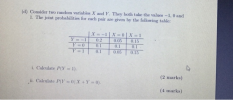
(d) Consider two random variables X and Y. They both take the values -1,0 and 1. The joint probabilities for each pair are given by the following table: Y = -1 Y=0 Y = 1 X = -1 X = 0 X = 1 0.2 0.05 0.15 0.1 0.1 0.1 0.1 0.05 0.15 i. Calculate P(Y = 1). ii. Calculate P(Y = 0 X + Y = 0). (2 marks) (4...
please write step by step and clear extend answer
(d) Consider two random variables X and Y. They both take the values -1,0 and 1. The joint probabilities for each pair are given by the following table: Y = -1 Y=0 Y = 1 X = -1 X = 0 X = 1 0.2 0.05 0.15 0.1 0.1 0.1 0.1 0.05 0.15 i. Calculate P(Y = 1). ii. Calculate P(Y = 0 X + Y = 0). (2 marks) (4...
Consider the following data to answer the next 4 questions. [A] initial (M) [B] initial (M)...
Consider the following data to answer the next 4 questions. [A] initial (M) [B] initial (M) Initial speed of the reaction (M / s) 0.2 0.1 5 0.2 0.2 10 0.6 0.2 30 3a. The order of the reaction with respect to [A] is__________. 3b. The order of the reaction with respect to [B] is__________. 3c. The net order of the reaction is__________. 3d. The value of k is (include units) is__________.
* Please show work step by step explaining how you got to the solution* Consider the...
* Please show work step by step explaining how you got to the solution* Consider the following data. Time (s) 0.0 5.0 10.0 15.0 20.0 [A] (M) 0.20 0.14 0.10 0.071 0.050 Graph the [A] vs. time, ln[A] vs time and 1/[A] vs. time. Determine the rate law and rate constant (including units) for the reaction. Determine the time at which the concentration of A at will be 0.12 M.
please help answer QUESTION 2 Calculate the value of the equilibrium constant for the following reaction...
 please help answer
QUESTION 2 Calculate the value of the equilibrium constant for the following reaction at the indicated conditions: H20H30 (0) OcT(aq) + + HOCI 0.004 M pH 1.044 OCT-0.00455 M (express the answer to 5 decimal places) QUESTION 3 Calculate the equilibrium constant for the following: PbClz (s)PbCl2 (aq) Use the equilibrium constants in appendix 10 and 12. (don't use other sources!!!) NOTE: the Ksp for PbCl2 is incorrect in the textbook tables, but the value for pKso...
please help answer
QUESTION 2 Calculate the value of the equilibrium constant for the following reaction at the indicated conditions: H20H30 (0) OcT(aq) + + HOCI 0.004 M pH 1.044 OCT-0.00455 M (express the answer to 5 decimal places) QUESTION 3 Calculate the equilibrium constant for the following: PbClz (s)PbCl2 (aq) Use the equilibrium constants in appendix 10 and 12. (don't use other sources!!!) NOTE: the Ksp for PbCl2 is incorrect in the textbook tables, but the value for pKso...
Please answer the question below in clear steps. Consider an elementary first order reaction found to...
 Please answer the question below in clear steps.
Consider an elementary first order reaction found to have an activation energy (EA) of 250 kJ/mole and a pre-exponential (A) of 1.7 x 10¹⁴ s. (a) Determine the rate constant at T = 750°C (b) At what temperature will the reaction be three times as fast as at 750°C? (c) What fraction of the reaction will be completed in a batch reactor at 300°C over a period of 3. 10 minutes?
Please answer the question below in clear steps.
Consider an elementary first order reaction found to have an activation energy (EA) of 250 kJ/mole and a pre-exponential (A) of 1.7 x 10¹⁴ s. (a) Determine the rate constant at T = 750°C (b) At what temperature will the reaction be three times as fast as at 750°C? (c) What fraction of the reaction will be completed in a batch reactor at 300°C over a period of 3. 10 minutes?
please help Consider the following reaction. 4A+B+ 4C 4D + E The following data was collected...
 please help
Consider the following reaction. 4A+B+ 4C 4D + E The following data was collected on the reaction. Trial Alo [B], (ClO Rate (M/s) 0.32 0.62 0.32 6.861 0.64 0.62 0.32 13.722 0.32 0.32 13.722 4 0.32 0.62 0.64 6.861 2 1.24 Rate law = K[A142[8]1[C]" O Knowing the rate which of the two mechanisms are proposed would be accurate: Mechanism 1: Mechanism 1 Mechanism 2 A+B DY AC Y+C YoBoc X+A+C Z+A Which mechanism best fits the data?...
please help
Consider the following reaction. 4A+B+ 4C 4D + E The following data was collected on the reaction. Trial Alo [B], (ClO Rate (M/s) 0.32 0.62 0.32 6.861 0.64 0.62 0.32 13.722 0.32 0.32 13.722 4 0.32 0.62 0.64 6.861 2 1.24 Rate law = K[A142[8]1[C]" O Knowing the rate which of the two mechanisms are proposed would be accurate: Mechanism 1: Mechanism 1 Mechanism 2 A+B DY AC Y+C YoBoc X+A+C Z+A Which mechanism best fits the data?...
Consider the following reaction. 4 A + B + 2 C →→ 4 D + E...
Consider the following reaction. 4 A + B + 2 C →→ 4 D + E The following data was collected on the reaction. Trial [A]0 [B]0 [C]0 Rate (M/s) 1 0.22 0.75 0.22 9.506 2 0.44 0.75 0.22 19.012 3 0.22 1.5 0.22 19.012 4 0.22 0.75 0.44 9.506 Two mechanisms are proposed: Mechanism 1: A + B →→ D + Y Y + C →→ X X + A + C →→ D + Z Z + A...
 please help
Consider the following reaction. Calculate the value of the rate constant. 4 A+B 3C Trial Alo [B] [C] Rate (M/s) 0.1 0.11 0.033 4.884 0.2 0.11 0.033, 9.768 0.1 0.22 0.033 19.536 0.1 0.12 0.033
please help
Consider the following reaction. Calculate the value of the rate constant. 4 A+B 3C Trial Alo [B] [C] Rate (M/s) 0.1 0.11 0.033 4.884 0.2 0.11 0.033, 9.768 0.1 0.22 0.033 19.536 0.1 0.12 0.033
 please help!!!
Consider the following reaction. Calculate the value of the rate constant.. 4 A+B + 30 Trial [A] 0.1 0.2 [B] 0.11. 0.11 0.11 0.22 0.12 WN [C]. 0.033 0.033 0.033 0.033 Rate (M/s) 4.884 19.536 19.536 0.1 0.1
please help!!!
Consider the following reaction. Calculate the value of the rate constant.. 4 A+B + 30 Trial [A] 0.1 0.2 [B] 0.11. 0.11 0.11 0.22 0.12 WN [C]. 0.033 0.033 0.033 0.033 Rate (M/s) 4.884 19.536 19.536 0.1 0.1
 please write step by step and clear extend answer
(d) Consider two random variables X and Y. They both take the values -1,0 and 1. The joint probabilities for each pair are given by the following table: Y = -1 Y=0 Y = 1 X = -1 X = 0 X = 1 0.2 0.05 0.15 0.1 0.1 0.1 0.1 0.05 0.15 i. Calculate P(Y = 1). ii. Calculate P(Y = 0 X + Y = 0). (2 marks) (4...
please write step by step and clear extend answer
(d) Consider two random variables X and Y. They both take the values -1,0 and 1. The joint probabilities for each pair are given by the following table: Y = -1 Y=0 Y = 1 X = -1 X = 0 X = 1 0.2 0.05 0.15 0.1 0.1 0.1 0.1 0.05 0.15 i. Calculate P(Y = 1). ii. Calculate P(Y = 0 X + Y = 0). (2 marks) (4...
 please help answer
QUESTION 2 Calculate the value of the equilibrium constant for the following reaction at the indicated conditions: H20H30 (0) OcT(aq) + + HOCI 0.004 M pH 1.044 OCT-0.00455 M (express the answer to 5 decimal places) QUESTION 3 Calculate the equilibrium constant for the following: PbClz (s)PbCl2 (aq) Use the equilibrium constants in appendix 10 and 12. (don't use other sources!!!) NOTE: the Ksp for PbCl2 is incorrect in the textbook tables, but the value for pKso...
please help answer
QUESTION 2 Calculate the value of the equilibrium constant for the following reaction at the indicated conditions: H20H30 (0) OcT(aq) + + HOCI 0.004 M pH 1.044 OCT-0.00455 M (express the answer to 5 decimal places) QUESTION 3 Calculate the equilibrium constant for the following: PbClz (s)PbCl2 (aq) Use the equilibrium constants in appendix 10 and 12. (don't use other sources!!!) NOTE: the Ksp for PbCl2 is incorrect in the textbook tables, but the value for pKso...
 Please answer the question below in clear steps.
Consider an elementary first order reaction found to have an activation energy (EA) of 250 kJ/mole and a pre-exponential (A) of 1.7 x 10¹⁴ s. (a) Determine the rate constant at T = 750°C (b) At what temperature will the reaction be three times as fast as at 750°C? (c) What fraction of the reaction will be completed in a batch reactor at 300°C over a period of 3. 10 minutes?
Please answer the question below in clear steps.
Consider an elementary first order reaction found to have an activation energy (EA) of 250 kJ/mole and a pre-exponential (A) of 1.7 x 10¹⁴ s. (a) Determine the rate constant at T = 750°C (b) At what temperature will the reaction be three times as fast as at 750°C? (c) What fraction of the reaction will be completed in a batch reactor at 300°C over a period of 3. 10 minutes?
 please help
Consider the following reaction. 4A+B+ 4C 4D + E The following data was collected on the reaction. Trial Alo [B], (ClO Rate (M/s) 0.32 0.62 0.32 6.861 0.64 0.62 0.32 13.722 0.32 0.32 13.722 4 0.32 0.62 0.64 6.861 2 1.24 Rate law = K[A142[8]1[C]" O Knowing the rate which of the two mechanisms are proposed would be accurate: Mechanism 1: Mechanism 1 Mechanism 2 A+B DY AC Y+C YoBoc X+A+C Z+A Which mechanism best fits the data?...
please help
Consider the following reaction. 4A+B+ 4C 4D + E The following data was collected on the reaction. Trial Alo [B], (ClO Rate (M/s) 0.32 0.62 0.32 6.861 0.64 0.62 0.32 13.722 0.32 0.32 13.722 4 0.32 0.62 0.64 6.861 2 1.24 Rate law = K[A142[8]1[C]" O Knowing the rate which of the two mechanisms are proposed would be accurate: Mechanism 1: Mechanism 1 Mechanism 2 A+B DY AC Y+C YoBoc X+A+C Z+A Which mechanism best fits the data?...
Most questions answered within 3 hours.
-
Where is the error in this code sequence?
String s1 = "Hello";
String s2 = "ello";...
asked 10 months ago -
Financial data for Joel de Paris, Inc., for last year
follow:
Joel de Paris, Inc.
Balance...
asked 10 months ago -
Consider this reaction:
Al2(SO4)3 (aq)+ BaCl3
(aq) Al2Cl6 (aq)- +
3BaSO4(s) . What is the...
asked 10 months ago -
Suppose that Savneet is considering increasing her
recent random sample from 20 car rentals to 40...
asked 10 months ago -
Trucks arrive at an unloading terminal at an average rate of 120
per hour.
Trucks arrive...
asked 10 months ago -
Why are methanol and ethanol completely soluble in water while
octanol is not very little soluble....
asked 10 months ago -
A facilities manager at a university reads in a research report
that the mean amount of...
asked 10 months ago -
When the CuSO4 is rehydrated by adding water to the anhydrous
compound, is this an endothermic...
asked 10 months ago -
A ray of sunlight is passing from diamond into crown glass; the
angle of incidence is...
asked 10 months ago -
A block of mass 0.249 kg is placed on top of a light, vertical
spring of...
asked 10 months ago -
how do the kidneys compensate in the presences of acidosis
a) trigger hyperventilate
b) reserve acid...
asked 10 months ago -
Question 501 pts
The rental rate of capital to the firm increases. Which of the
following...
asked 10 months ago