Please answer the question below in clear steps.

Homework Answers


Add Answer to:
Please answer the question below in clear steps.
Consider an elementary first order reaction found to...
Consider an elementary first order reaction found to have an activation energy (EA) of 250 kJ/mole...
Consider an elementary first order reaction found to have an activation energy (EA) of 250 kJ/mole and a pre-exponential (A) of 1.7 x 10¹⁴ s–1. (a) Determine the rate constant at T = 750°C. (b) At what temperature will the reaction be three times as fast as at 750°C? (c) What fraction of the reaction will be completed in a batch reactor at 300°C over a period of 10 minutes?
The first order elementary reaction: A + B + C was carried out in a constant...
 The first order elementary reaction: A + B + C was carried out in a constant volume batch reactor isothermally at 328 K. The concentrations of species A, CA, were recorded as a function of time, as given in the following table. The activation energy Ea=120 kJ/mol. 0.9 6 t (min) CA (mol/dm) 0 20 0.5 17.4 1.5 12.9 2.2 10.5 4 6.2 15.5 8.3 3.5 Based on integral method: b) Process the data using the above table and the...
The following elementary gas phase reaction A+2B—>C+D Feed is A/B= 1/3 mol A/I =4/1 (mole basis)...
 The
following elementary gas phase reaction
A+2B—>C+D
Feed is A/B= 1/3 mol A/I =4/1 (mole basis)
is to be carried out in an isothermal CSTR. Given that:
T=500C
P=5 atm
Ea=15500cal/gmol
A=1.5e4
K=A*exp^(-Ea/RT)
Qo= 100 L/s
Reactor volume= 20,000L
a) what are the exit molar flow rates? Fa, Fb, Fc, Fd,
Fi
b) what is the exit volumetric flow rate Q?
2. The following elementary irreversible gas-phase reaction: A+2B >C+D Is to carried out in an isothermal CSTR. Given that:...
The
following elementary gas phase reaction
A+2B—>C+D
Feed is A/B= 1/3 mol A/I =4/1 (mole basis)
is to be carried out in an isothermal CSTR. Given that:
T=500C
P=5 atm
Ea=15500cal/gmol
A=1.5e4
K=A*exp^(-Ea/RT)
Qo= 100 L/s
Reactor volume= 20,000L
a) what are the exit molar flow rates? Fa, Fb, Fc, Fd,
Fi
b) what is the exit volumetric flow rate Q?
2. The following elementary irreversible gas-phase reaction: A+2B >C+D Is to carried out in an isothermal CSTR. Given that:...
The data below was obtained for a reaction that was found to be first order. In...
 The data below was obtained for a reaction that was found to be first order. In k vs 1/T -16 -17 -18 -19 -20 In(k/s-) -21 -22 -23 y=-28047x + 65.8 -24 -25 -26 2.95E-03 3.00E-03 3.05E-03 3.15E-03 3.20E-03 3.10E-03 1/(T/K) What is the activation energy (Ea) for the rate-determining step of this reaction? Select one: a. It is not possible to calculate without knowing the reaction mechanism. O b. 28.0 kJ mol-1 O c. 3.37 kJ mol-1 O d....
Please, answer the following question with clear steps and hand writing. And please, take a clear...
 Please, answer the following question with clear steps and hand
writing. And please, take a clear picture of the answer.
I. A nonvolatile liquid contains 5.0 mol % methane and is being stripped by a gas in a stripping tray tower to reduce the methane content to 0.2%. The temperature is held constant at 422 K by internal heating in the tower at 2.026x10⁵ Pa pressure. A total of 11.42 kmol of gas is used for 300 kmol of total...
Please, answer the following question with clear steps and hand
writing. And please, take a clear picture of the answer.
I. A nonvolatile liquid contains 5.0 mol % methane and is being stripped by a gas in a stripping tray tower to reduce the methane content to 0.2%. The temperature is held constant at 422 K by internal heating in the tower at 2.026x10⁵ Pa pressure. A total of 11.42 kmol of gas is used for 300 kmol of total...
4. You are carrying out an experiment on the elementary first-order decomposition reaction A B. The...
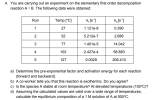 4. You are carrying out an experiment on the elementary first-order decomposition reaction A B. The following data were obtained k, [s1 1.121e-8 5.212e-7 1.401e-5 2.427e-4 0.0029 k, [s1 0.390 2.686 14.042 58.883 206.410 Run Temp [oC] 27 52 2 4 102 127 a) Determine the pre-exponential factor and activation energy for each reaction (forward and backward) b) A co-worker tells you that this reaction is exothermic. Do you agree? c) Is the species A stable at room temperature? At...
Ethyl chloride vapor decomposes by the first-order reaction C2H5Cl→C2H4+HCl The activation energy is 249 kJ/mol and...
Ethyl chloride vapor decomposes by the first-order reaction C2H5Cl→C2H4+HCl The activation energy is 249 kJ/mol and the frequency factor is 1.6×10^14 s^−1. A) Find the value of the specific rate constant at 710 K . B) Find the fraction of the ethyl chloride that decomposes in 20 minutes at this temperature. C) Find the temperature at which the rate of the reaction would be twice as fast.
Can you please answer the following questions? The rate constant, k for the reaction below A...
 Can you please answer the following questions?
The rate constant, k for the reaction below A - Products is 2.8 x 10 sat 80°C. If the initial concentration of A is 0.25M, what is the concentration after 50 s? The oxidation reaction of thallium (I) by cerium (IV) is believed to occur via three steps. The rate low for the reaction is: rate = k[Ce [Mn2") ce". Mne - Cen ! ce". Mn. Cell. Mn TI". Mn* - TI. Mn?...
Can you please answer the following questions?
The rate constant, k for the reaction below A - Products is 2.8 x 10 sat 80°C. If the initial concentration of A is 0.25M, what is the concentration after 50 s? The oxidation reaction of thallium (I) by cerium (IV) is believed to occur via three steps. The rate low for the reaction is: rate = k[Ce [Mn2") ce". Mne - Cen ! ce". Mn. Cell. Mn TI". Mn* - TI. Mn?...
Can you please answer the question. They are the same question but with clarification/requirements to go...
 Can you please answer the question. They are the same question
but with clarification/requirements to go with it.
36. The dissolution of quartz in H2O can be represented by the following reaction: SiO2 (s) + 2H2O → H4SiO4 (aq) Rimstidt and Barnes (1980) determined the reaction rate for the dissolution of quartz as a function of temperature. Their data are listed in the following table: Temperatures and Reaction Rates for the Dissolution of Quartz T(°C) k(sec-1) 65 105 145 170...
Can you please answer the question. They are the same question
but with clarification/requirements to go with it.
36. The dissolution of quartz in H2O can be represented by the following reaction: SiO2 (s) + 2H2O → H4SiO4 (aq) Rimstidt and Barnes (1980) determined the reaction rate for the dissolution of quartz as a function of temperature. Their data are listed in the following table: Temperatures and Reaction Rates for the Dissolution of Quartz T(°C) k(sec-1) 65 105 145 170...
10. Write a one-page summary of the attached paper? INTRODUCTION Many problems can develop in activated...
10. Write a one-page summary of the attached paper? INTRODUCTION Many problems can develop in activated sludge operation that adversely affect effluent quality with origins in the engineering, hydraulic and microbiological components of the process. The real "heart" of the activated sludge system is the development and maintenance of a mixed microbial culture (activated sludge) that treats wastewater and which can be managed. One definition of a wastewater treatment plant operator is a "bug farmer", one who controls the aeration...
 The first order elementary reaction: A + B + C was carried out in a constant volume batch reactor isothermally at 328 K. The concentrations of species A, CA, were recorded as a function of time, as given in the following table. The activation energy Ea=120 kJ/mol. 0.9 6 t (min) CA (mol/dm) 0 20 0.5 17.4 1.5 12.9 2.2 10.5 4 6.2 15.5 8.3 3.5 Based on integral method: b) Process the data using the above table and the...
 The
following elementary gas phase reaction
A+2B—>C+D
Feed is A/B= 1/3 mol A/I =4/1 (mole basis)
is to be carried out in an isothermal CSTR. Given that:
T=500C
P=5 atm
Ea=15500cal/gmol
A=1.5e4
K=A*exp^(-Ea/RT)
Qo= 100 L/s
Reactor volume= 20,000L
a) what are the exit molar flow rates? Fa, Fb, Fc, Fd,
Fi
b) what is the exit volumetric flow rate Q?
2. The following elementary irreversible gas-phase reaction: A+2B >C+D Is to carried out in an isothermal CSTR. Given that:...
The
following elementary gas phase reaction
A+2B—>C+D
Feed is A/B= 1/3 mol A/I =4/1 (mole basis)
is to be carried out in an isothermal CSTR. Given that:
T=500C
P=5 atm
Ea=15500cal/gmol
A=1.5e4
K=A*exp^(-Ea/RT)
Qo= 100 L/s
Reactor volume= 20,000L
a) what are the exit molar flow rates? Fa, Fb, Fc, Fd,
Fi
b) what is the exit volumetric flow rate Q?
2. The following elementary irreversible gas-phase reaction: A+2B >C+D Is to carried out in an isothermal CSTR. Given that:...
 The data below was obtained for a reaction that was found to be first order. In k vs 1/T -16 -17 -18 -19 -20 In(k/s-) -21 -22 -23 y=-28047x + 65.8 -24 -25 -26 2.95E-03 3.00E-03 3.05E-03 3.15E-03 3.20E-03 3.10E-03 1/(T/K) What is the activation energy (Ea) for the rate-determining step of this reaction? Select one: a. It is not possible to calculate without knowing the reaction mechanism. O b. 28.0 kJ mol-1 O c. 3.37 kJ mol-1 O d....
 Please, answer the following question with clear steps and hand
writing. And please, take a clear picture of the answer.
I. A nonvolatile liquid contains 5.0 mol % methane and is being stripped by a gas in a stripping tray tower to reduce the methane content to 0.2%. The temperature is held constant at 422 K by internal heating in the tower at 2.026x10⁵ Pa pressure. A total of 11.42 kmol of gas is used for 300 kmol of total...
Please, answer the following question with clear steps and hand
writing. And please, take a clear picture of the answer.
I. A nonvolatile liquid contains 5.0 mol % methane and is being stripped by a gas in a stripping tray tower to reduce the methane content to 0.2%. The temperature is held constant at 422 K by internal heating in the tower at 2.026x10⁵ Pa pressure. A total of 11.42 kmol of gas is used for 300 kmol of total...
 4. You are carrying out an experiment on the elementary first-order decomposition reaction A B. The following data were obtained k, [s1 1.121e-8 5.212e-7 1.401e-5 2.427e-4 0.0029 k, [s1 0.390 2.686 14.042 58.883 206.410 Run Temp [oC] 27 52 2 4 102 127 a) Determine the pre-exponential factor and activation energy for each reaction (forward and backward) b) A co-worker tells you that this reaction is exothermic. Do you agree? c) Is the species A stable at room temperature? At...
 Can you please answer the following questions?
The rate constant, k for the reaction below A - Products is 2.8 x 10 sat 80°C. If the initial concentration of A is 0.25M, what is the concentration after 50 s? The oxidation reaction of thallium (I) by cerium (IV) is believed to occur via three steps. The rate low for the reaction is: rate = k[Ce [Mn2") ce". Mne - Cen ! ce". Mn. Cell. Mn TI". Mn* - TI. Mn?...
Can you please answer the following questions?
The rate constant, k for the reaction below A - Products is 2.8 x 10 sat 80°C. If the initial concentration of A is 0.25M, what is the concentration after 50 s? The oxidation reaction of thallium (I) by cerium (IV) is believed to occur via three steps. The rate low for the reaction is: rate = k[Ce [Mn2") ce". Mne - Cen ! ce". Mn. Cell. Mn TI". Mn* - TI. Mn?...
 Can you please answer the question. They are the same question
but with clarification/requirements to go with it.
36. The dissolution of quartz in H2O can be represented by the following reaction: SiO2 (s) + 2H2O → H4SiO4 (aq) Rimstidt and Barnes (1980) determined the reaction rate for the dissolution of quartz as a function of temperature. Their data are listed in the following table: Temperatures and Reaction Rates for the Dissolution of Quartz T(°C) k(sec-1) 65 105 145 170...
Can you please answer the question. They are the same question
but with clarification/requirements to go with it.
36. The dissolution of quartz in H2O can be represented by the following reaction: SiO2 (s) + 2H2O → H4SiO4 (aq) Rimstidt and Barnes (1980) determined the reaction rate for the dissolution of quartz as a function of temperature. Their data are listed in the following table: Temperatures and Reaction Rates for the Dissolution of Quartz T(°C) k(sec-1) 65 105 145 170...
Most questions answered within 3 hours.
-
Where is the error in this code sequence?
String s1 = "Hello";
String s2 = "ello";...
asked 11 months ago -
Financial data for Joel de Paris, Inc., for last year
follow:
Joel de Paris, Inc.
Balance...
asked 11 months ago -
Consider this reaction:
Al2(SO4)3 (aq)+ BaCl3
(aq) Al2Cl6 (aq)- +
3BaSO4(s) . What is the...
asked 11 months ago -
Suppose that Savneet is considering increasing her
recent random sample from 20 car rentals to 40...
asked 11 months ago -
Trucks arrive at an unloading terminal at an average rate of 120
per hour.
Trucks arrive...
asked 11 months ago -
Why are methanol and ethanol completely soluble in water while
octanol is not very little soluble....
asked 11 months ago -
A facilities manager at a university reads in a research report
that the mean amount of...
asked 11 months ago -
When the CuSO4 is rehydrated by adding water to the anhydrous
compound, is this an endothermic...
asked 11 months ago -
A ray of sunlight is passing from diamond into crown glass; the
angle of incidence is...
asked 11 months ago -
A block of mass 0.249 kg is placed on top of a light, vertical
spring of...
asked 11 months ago -
how do the kidneys compensate in the presences of acidosis
a) trigger hyperventilate
b) reserve acid...
asked 11 months ago -
Question 501 pts
The rental rate of capital to the firm increases. Which of the
following...
asked 11 months ago