
Homework Answers
Add Answer to:
The
decay curve of a radioactive nuclide sample is shown. Its initial
activity is measured to...
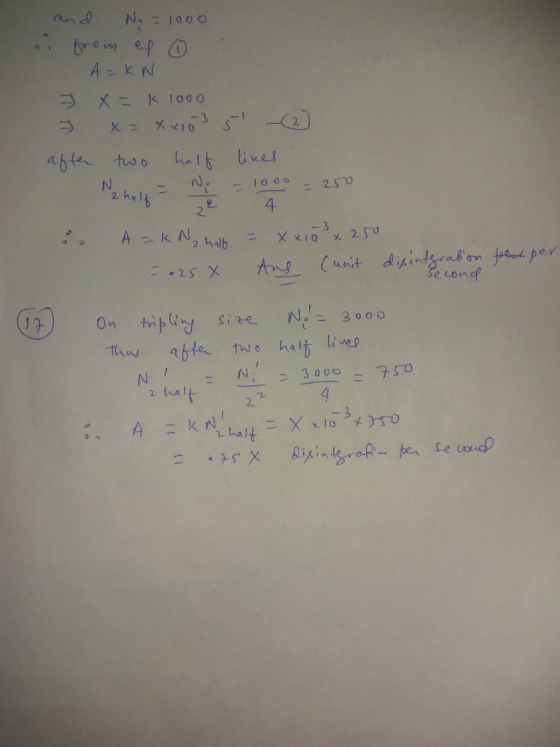
16. What will he the level of activity (in terms of X) after two half lives...
 16.
What will he the level of activity (in terms of X) after two half
lives have elapsed?
17. What would the activity of a the above sample be if we
tripled its size?
18. If the initial activity of 0.365 grams of the above sample
is Y Bq, what would the activity be if we increased the initial
sample to 0.950 grams?
The decay curve of a radioactive nuclide 1000 sample is shown. Its initial activity is measured to...
16.
What will he the level of activity (in terms of X) after two half
lives have elapsed?
17. What would the activity of a the above sample be if we
tripled its size?
18. If the initial activity of 0.365 grams of the above sample
is Y Bq, what would the activity be if we increased the initial
sample to 0.950 grams?
The decay curve of a radioactive nuclide 1000 sample is shown. Its initial activity is measured to...
The following question is about the fundamental forces. 13. List the four force interactions in the...
 The
following question is about the fundamental forces.
13. List the four force interactions in the universe (in order
from strongest to weakest)
The decay curve of a radioactive nuclide sample is shown. It’s
initial activity Is measured to be X Bq.
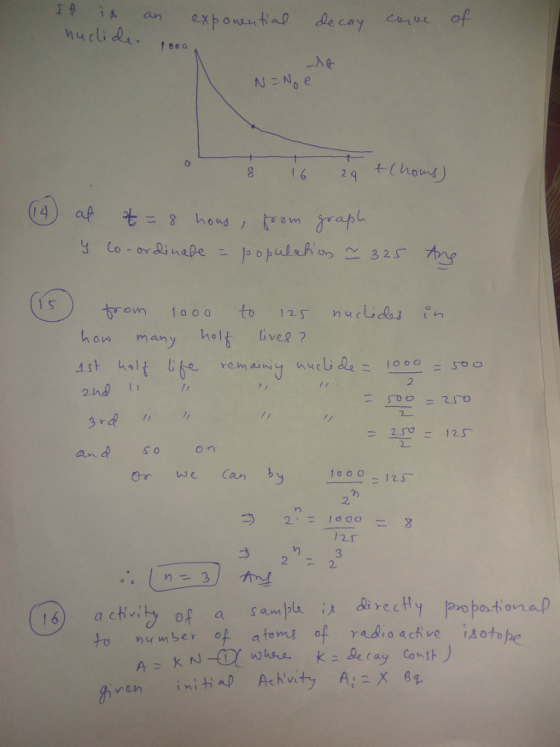
14. What is the population at t=8.0 hours?
15. After how many half lives will the population be 125
nuclides
16. What will be the level of activity (in terms of X) after
two half lives have elapsed?...
The
following question is about the fundamental forces.
13. List the four force interactions in the universe (in order
from strongest to weakest)
The decay curve of a radioactive nuclide sample is shown. It’s
initial activity Is measured to be X Bq.
14. What is the population at t=8.0 hours?
15. After how many half lives will the population be 125
nuclides
16. What will be the level of activity (in terms of X) after
two half lives have elapsed?...
Answers for questions 13-23 please. The following question is about the fundamental forces 13. List the...
 Answers for questions 13-23 please.
The following question is about the fundamental forces 13. List the four force interactions in the universe (in order from strongest to weakest) together with their associated particles The decay curve of a radioactive nuclide sample is shown. Its initial activity is measured to be X 6q 14. What is the population at t8.0 hours?14. 15. After how many half lives will the 0 population be 125 nuclides? 15. 16. What will be the level...
Answers for questions 13-23 please.
The following question is about the fundamental forces 13. List the four force interactions in the universe (in order from strongest to weakest) together with their associated particles The decay curve of a radioactive nuclide sample is shown. Its initial activity is measured to be X 6q 14. What is the population at t8.0 hours?14. 15. After how many half lives will the 0 population be 125 nuclides? 15. 16. What will be the level...
Topic 7.1 – Discrete energy and radioactivity
 The energy level diagram for a hydrogen atom is shown. The following questions are about the energylevels of the hydrogen atom. An electron jumps from the n = 5 level to the n = 1 level.1. Will this result in an emission line, or an absorption line in thespectrum of this atom? 1. _________________2. Which excited state did the electron start at?2. _________________3. What is the principal quantum number of the electron when it isat the level n = 1?...
A certain radioactive nuclide has a half life of 50.7 years. How long does it take for 87.5% of a sample of this substa...
 A certain radioactive nuclide has a half life of 50.7 years. How long does it take for 87.5% of a sample of this substance to decay? years Submit Hide Hints Hint 1 Hint 4 Hint 3 Hint 2 What percentage of the original sample has decayed after two half lives have elapsed?
A radioactive nuclide X having a mass of 65.0 grams is sealed in a container having...
 A
radioactive nuclide X having a mass of 65.0 grams is sealed in a
container having a mass of. 5.00 grams. The nuclide X decays into
the nuclide Y. The nuclide X has a half life of 6.00 hours.
19. What will the mass of nuclide Y be after 24 hours have
elapsed?
20. What will the mass of nuclide Y be after 24 hours have
elapsed?
21. What will the mass of the sealed container be after 24
hours...
A
radioactive nuclide X having a mass of 65.0 grams is sealed in a
container having a mass of. 5.00 grams. The nuclide X decays into
the nuclide Y. The nuclide X has a half life of 6.00 hours.
19. What will the mass of nuclide Y be after 24 hours have
elapsed?
20. What will the mass of nuclide Y be after 24 hours have
elapsed?
21. What will the mass of the sealed container be after 24
hours...
Radioactive Decay - Half-life and Activity 1 Radioactive decay - Half-life Time 0 1000 21 31...
 Radioactive Decay - Half-life and Activity 1 Radioactive decay - Half-life Time 0 1000 21 31 750 N 1.000.000 500,000 250,000 125,000 62,500 31.250 15.625 7813 3.506 1.953 977 51 6 500 7 BI . 101 250 125 0 tie 21.234.41516171819, 1012 Time in multiples of A radioactive sample's half-life is 30.2 years. 1 year = 365 days, 1 day = 24 hours, 1 hour - 60 minutes, 1 minute = 60 seconds (a) Find its decay constant in year...
Modeling radioactive decay in pennies MODELING RADIOACTIVE DECAY WITH PENNIES ADVANCED STUDY ASSIGNMENT MODEL 2: RADIONUCLIDE...
 Modeling radioactive decay in pennies
MODELING RADIOACTIVE DECAY WITH PENNIES ADVANCED STUDY ASSIGNMENT MODEL 2: RADIONUCLIDE HALF-LIFE The time required for half of a sample of a radionuclides (radioactive isotopes) to decay is called the half-life (units of time). Table 2 below illustrates the half-lives of several radioisotopes and the Table 2: Half-lives of some Radioisoto barium-131 carbon-14 chromium-51 cobalt-60 iodine-131 uranium-238 Radiation Half-life 11.6 days 5730 yrs 27.8 days 5.3 yrs 8.1 days 4.47. 109 yr Application detection of...
Modeling radioactive decay in pennies
MODELING RADIOACTIVE DECAY WITH PENNIES ADVANCED STUDY ASSIGNMENT MODEL 2: RADIONUCLIDE HALF-LIFE The time required for half of a sample of a radionuclides (radioactive isotopes) to decay is called the half-life (units of time). Table 2 below illustrates the half-lives of several radioisotopes and the Table 2: Half-lives of some Radioisoto barium-131 carbon-14 chromium-51 cobalt-60 iodine-131 uranium-238 Radiation Half-life 11.6 days 5730 yrs 27.8 days 5.3 yrs 8.1 days 4.47. 109 yr Application detection of...
The half life for the decay of carbon-14 is 5.73 x 10 years. Suppose the activity...
 The half life for the decay of carbon-14 is 5.73 x 10 years. Suppose the activity due to the radioactive decay of the carbon-14 in a tiny sample of an artifact made of wood from an archeological dig is measured to be 19. Bq. The activity in a similar-sized sample of fresh wood is measured to be 20. Bq. Calculate the age of the artifact. Round your answer to 2 significant digits. years X 5 ?
The half-life for the radioactive decay of calcium-47 is 4.5 d. if a sample has an...
The half-life for the radioactive decay of calcium-47 is 4.5 d. if a sample has an activity of 4.5 Ci after 9.0 d, what was the initial activity of the sample?
 16.
What will he the level of activity (in terms of X) after two half
lives have elapsed?
17. What would the activity of a the above sample be if we
tripled its size?
18. If the initial activity of 0.365 grams of the above sample
is Y Bq, what would the activity be if we increased the initial
sample to 0.950 grams?
The decay curve of a radioactive nuclide 1000 sample is shown. Its initial activity is measured to...
16.
What will he the level of activity (in terms of X) after two half
lives have elapsed?
17. What would the activity of a the above sample be if we
tripled its size?
18. If the initial activity of 0.365 grams of the above sample
is Y Bq, what would the activity be if we increased the initial
sample to 0.950 grams?
The decay curve of a radioactive nuclide 1000 sample is shown. Its initial activity is measured to...
 The
following question is about the fundamental forces.
13. List the four force interactions in the universe (in order
from strongest to weakest)
The decay curve of a radioactive nuclide sample is shown. It’s
initial activity Is measured to be X Bq.
14. What is the population at t=8.0 hours?
15. After how many half lives will the population be 125
nuclides
16. What will be the level of activity (in terms of X) after
two half lives have elapsed?...
The
following question is about the fundamental forces.
13. List the four force interactions in the universe (in order
from strongest to weakest)
The decay curve of a radioactive nuclide sample is shown. It’s
initial activity Is measured to be X Bq.
14. What is the population at t=8.0 hours?
15. After how many half lives will the population be 125
nuclides
16. What will be the level of activity (in terms of X) after
two half lives have elapsed?...
 Answers for questions 13-23 please.
The following question is about the fundamental forces 13. List the four force interactions in the universe (in order from strongest to weakest) together with their associated particles The decay curve of a radioactive nuclide sample is shown. Its initial activity is measured to be X 6q 14. What is the population at t8.0 hours?14. 15. After how many half lives will the 0 population be 125 nuclides? 15. 16. What will be the level...
Answers for questions 13-23 please.
The following question is about the fundamental forces 13. List the four force interactions in the universe (in order from strongest to weakest) together with their associated particles The decay curve of a radioactive nuclide sample is shown. Its initial activity is measured to be X 6q 14. What is the population at t8.0 hours?14. 15. After how many half lives will the 0 population be 125 nuclides? 15. 16. What will be the level...
 A certain radioactive nuclide has a half life of 50.7 years. How long does it take for 87.5% of a sample of this substance to decay? years Submit Hide Hints Hint 1 Hint 4 Hint 3 Hint 2 What percentage of the original sample has decayed after two half lives have elapsed?
 A
radioactive nuclide X having a mass of 65.0 grams is sealed in a
container having a mass of. 5.00 grams. The nuclide X decays into
the nuclide Y. The nuclide X has a half life of 6.00 hours.
19. What will the mass of nuclide Y be after 24 hours have
elapsed?
20. What will the mass of nuclide Y be after 24 hours have
elapsed?
21. What will the mass of the sealed container be after 24
hours...
A
radioactive nuclide X having a mass of 65.0 grams is sealed in a
container having a mass of. 5.00 grams. The nuclide X decays into
the nuclide Y. The nuclide X has a half life of 6.00 hours.
19. What will the mass of nuclide Y be after 24 hours have
elapsed?
20. What will the mass of nuclide Y be after 24 hours have
elapsed?
21. What will the mass of the sealed container be after 24
hours...
 Radioactive Decay - Half-life and Activity 1 Radioactive decay - Half-life Time 0 1000 21 31 750 N 1.000.000 500,000 250,000 125,000 62,500 31.250 15.625 7813 3.506 1.953 977 51 6 500 7 BI . 101 250 125 0 tie 21.234.41516171819, 1012 Time in multiples of A radioactive sample's half-life is 30.2 years. 1 year = 365 days, 1 day = 24 hours, 1 hour - 60 minutes, 1 minute = 60 seconds (a) Find its decay constant in year...
 Modeling radioactive decay in pennies
MODELING RADIOACTIVE DECAY WITH PENNIES ADVANCED STUDY ASSIGNMENT MODEL 2: RADIONUCLIDE HALF-LIFE The time required for half of a sample of a radionuclides (radioactive isotopes) to decay is called the half-life (units of time). Table 2 below illustrates the half-lives of several radioisotopes and the Table 2: Half-lives of some Radioisoto barium-131 carbon-14 chromium-51 cobalt-60 iodine-131 uranium-238 Radiation Half-life 11.6 days 5730 yrs 27.8 days 5.3 yrs 8.1 days 4.47. 109 yr Application detection of...
Modeling radioactive decay in pennies
MODELING RADIOACTIVE DECAY WITH PENNIES ADVANCED STUDY ASSIGNMENT MODEL 2: RADIONUCLIDE HALF-LIFE The time required for half of a sample of a radionuclides (radioactive isotopes) to decay is called the half-life (units of time). Table 2 below illustrates the half-lives of several radioisotopes and the Table 2: Half-lives of some Radioisoto barium-131 carbon-14 chromium-51 cobalt-60 iodine-131 uranium-238 Radiation Half-life 11.6 days 5730 yrs 27.8 days 5.3 yrs 8.1 days 4.47. 109 yr Application detection of...
 The half life for the decay of carbon-14 is 5.73 x 10 years. Suppose the activity due to the radioactive decay of the carbon-14 in a tiny sample of an artifact made of wood from an archeological dig is measured to be 19. Bq. The activity in a similar-sized sample of fresh wood is measured to be 20. Bq. Calculate the age of the artifact. Round your answer to 2 significant digits. years X 5 ?
Most questions answered within 3 hours.
-
Where is the error in this code sequence?
String s1 = "Hello";
String s2 = "ello";...
asked 11 months ago -
Financial data for Joel de Paris, Inc., for last year
follow:
Joel de Paris, Inc.
Balance...
asked 11 months ago -
Consider this reaction:
Al2(SO4)3 (aq)+ BaCl3
(aq) Al2Cl6 (aq)- +
3BaSO4(s) . What is the...
asked 11 months ago -
Suppose that Savneet is considering increasing her
recent random sample from 20 car rentals to 40...
asked 11 months ago -
Trucks arrive at an unloading terminal at an average rate of 120
per hour.
Trucks arrive...
asked 11 months ago -
Why are methanol and ethanol completely soluble in water while
octanol is not very little soluble....
asked 11 months ago -
A facilities manager at a university reads in a research report
that the mean amount of...
asked 11 months ago -
When the CuSO4 is rehydrated by adding water to the anhydrous
compound, is this an endothermic...
asked 11 months ago -
A ray of sunlight is passing from diamond into crown glass; the
angle of incidence is...
asked 11 months ago -
A block of mass 0.249 kg is placed on top of a light, vertical
spring of...
asked 11 months ago -
how do the kidneys compensate in the presences of acidosis
a) trigger hyperventilate
b) reserve acid...
asked 11 months ago -
Question 501 pts
The rental rate of capital to the firm increases. Which of the
following...
asked 11 months ago