

Homework Answers
Add Answer to:
Electric potential difference EM 105 B. Shown at right are four points near a positively charged...
Would appreciate your help with these problems. Thank you Electric potential difference EM 89 B. Shown...
 Would appreciate your help with
these problems. Thank you
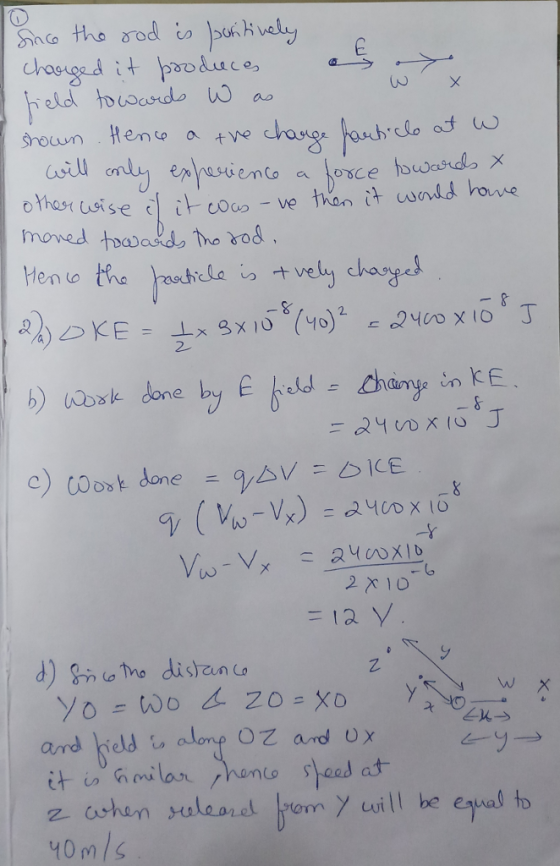
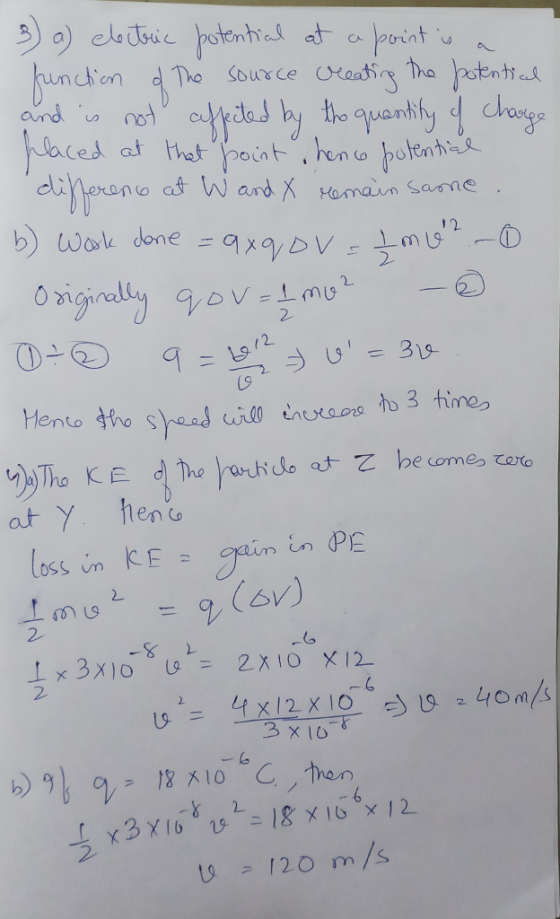
Electric potential difference EM 89 B. Shown at right are four points near a positively charged rod. Points W and Y are equidistant from the rod, as are points X and Z. A charged particle with mass m. = 3 X 10 kg is released from rest at point W and later is observed to pass point X 1. Is the particle positively or negatively charged? Explain. w х O 2....
Would appreciate your help with
these problems. Thank you
Electric potential difference EM 89 B. Shown at right are four points near a positively charged rod. Points W and Y are equidistant from the rod, as are points X and Z. A charged particle with mass m. = 3 X 10 kg is released from rest at point W and later is observed to pass point X 1. Is the particle positively or negatively charged? Explain. w х O 2....
r Noles Ask Your The potential at location A is 400 V. A positively charged when...
 r Noles Ask Your The potential at location A is 400 V. A positively charged when released from rest from this spot, the particle arrives at B w is released there from rest and arrives at location 8 with a speed ve The potential at location C is 783 V and th twice the speed it previously had, or 2vs. Find the potential at B.
Electric Potential Difference Homework Electric Potential Difference 1) Pages 85-87 in the homework tutorial do the...
 Electric Potential Difference
Homework Electric Potential Difference 1) Pages 85-87 in the homework tutorial do the problems 1 &2, skip problem 3 2) In the figure is an electric dipole, with-5 V applied to the negative conductor, shown on the left-side and + 5 V applied to the positive conductor, shown on the right-side. With the voltage applied between the conductors the resulting equipotential lines are mapped out a) Accurately draw the electric field lines between the two conductors 1.0...
Electric Potential Difference
Homework Electric Potential Difference 1) Pages 85-87 in the homework tutorial do the problems 1 &2, skip problem 3 2) In the figure is an electric dipole, with-5 V applied to the negative conductor, shown on the left-side and + 5 V applied to the positive conductor, shown on the right-side. With the voltage applied between the conductors the resulting equipotential lines are mapped out a) Accurately draw the electric field lines between the two conductors 1.0...
A 2.03 mm diameter glass bead is positively charged. The potential difference between the surface of...
 A 2.03 mm diameter glass bead is positively charged. The
potential difference between the surface of the bead and a point x
= 3.82 mm from the bead is ?=?
461 V
What is the charge on the bead?
Give your answer in nanocoulombs
A 2.03 mm diameter glass bead is positively charged. The
potential difference between the surface of the bead and a point x
= 3.82 mm from the bead is ?=?
461 V
What is the charge on the bead?
Give your answer in nanocoulombs
Chapter 19, Problem 09 on A is 380 V. A positively charged partiele is released there...
 Chapter 19, Problem 09 on A is 380 V. A positively charged partiele is released there from rest and arrives at location B with a speed va. The potential at location C is 907 V, and when rest from this spot, the particle arrives at 8 with twice the speed it previously had, or 2 v. Find the potential at B Number Units Chapter 19, Problem 12 A particle is uncharged and is thrown vertically upward from ground level with...
Pls answer 3-1 & 3-2 Activity 3-1: Electric Field Vectors from a Positively Charged Rod To...
 Pls answer 3-1 & 3-2
Activity 3-1: Electric Field Vectors from a Positively Charged Rod To investigate the vector nature of an electric field, you can use a piece of Magic tape with a positive charge on it as the test charge. Scotch arge a piece of tape (about 10 cm long) positively. To recall how to do this, refer back to Investigation 1. 2. Charge up the glass or acrylic rod (positively), and hold it pointing vertically. Assume that...
Pls answer 3-1 & 3-2
Activity 3-1: Electric Field Vectors from a Positively Charged Rod To investigate the vector nature of an electric field, you can use a piece of Magic tape with a positive charge on it as the test charge. Scotch arge a piece of tape (about 10 cm long) positively. To recall how to do this, refer back to Investigation 1. 2. Charge up the glass or acrylic rod (positively), and hold it pointing vertically. Assume that...
The cup experiment from tutorial is shown at right. Points A and B are within the...
 The cup experiment from tutorial is shown at right. Points A
and B are within the foil on the cup. The rod has been in place for
a long time.The rod is NEGATIVELY charged.
Electric properties of conductors Name EM HW-15 4. The cup experiment from tutorial is shown at right. Points A and B are within the foil on the cup. The rod has been in place for a long time. a. Consider the system consisting only of the...
The cup experiment from tutorial is shown at right. Points A
and B are within the foil on the cup. The rod has been in place for
a long time.The rod is NEGATIVELY charged.
Electric properties of conductors Name EM HW-15 4. The cup experiment from tutorial is shown at right. Points A and B are within the foil on the cup. The rod has been in place for a long time. a. Consider the system consisting only of the...
each with net charge -0, are held in place as shown in the top view diagram...
 each with net charge -0, are held in place as shown in the top view diagram EM Hw below small test charge -q, travels from point X to point Y along the circular arc shown. w an arrow on the diagram at each point (X and Y) to show the direction of the electric force on the test charge at that point. Explain why you drew the arrows as you did. i. Draw -0 i. Is the work done on...
8) A proton is placed at rest near a positively charged plate. The proton is released...
 8) A proton is placed at rest near a positively charged plate. The proton is released and travels in the positive x direction. The proton reaches a velocity of 85000 m/s at the point when the potential is zero. (mproton = 1.67 x 10⁻²⁷ kg, et = 1.6 x 10⁻¹⁹ C) a) What is the electric potential at the positively charged plate? A X b) The proton then enters a 9 T magnetic field directed into the page. Choose the...
A 2.2 mm -diameter glass bead is positively charged. The potential difference between a point 2.0...
A 2.2 mm -diameter glass bead is positively charged. The potential difference between a point 2.0 mm from the bead and a point 4.4 mm from the bead is 500 V. What is the charge on the bead?
 Would appreciate your help with
these problems. Thank you
Electric potential difference EM 89 B. Shown at right are four points near a positively charged rod. Points W and Y are equidistant from the rod, as are points X and Z. A charged particle with mass m. = 3 X 10 kg is released from rest at point W and later is observed to pass point X 1. Is the particle positively or negatively charged? Explain. w х O 2....
Would appreciate your help with
these problems. Thank you
Electric potential difference EM 89 B. Shown at right are four points near a positively charged rod. Points W and Y are equidistant from the rod, as are points X and Z. A charged particle with mass m. = 3 X 10 kg is released from rest at point W and later is observed to pass point X 1. Is the particle positively or negatively charged? Explain. w х O 2....
 r Noles Ask Your The potential at location A is 400 V. A positively charged when released from rest from this spot, the particle arrives at B w is released there from rest and arrives at location 8 with a speed ve The potential at location C is 783 V and th twice the speed it previously had, or 2vs. Find the potential at B.
 Electric Potential Difference
Homework Electric Potential Difference 1) Pages 85-87 in the homework tutorial do the problems 1 &2, skip problem 3 2) In the figure is an electric dipole, with-5 V applied to the negative conductor, shown on the left-side and + 5 V applied to the positive conductor, shown on the right-side. With the voltage applied between the conductors the resulting equipotential lines are mapped out a) Accurately draw the electric field lines between the two conductors 1.0...
Electric Potential Difference
Homework Electric Potential Difference 1) Pages 85-87 in the homework tutorial do the problems 1 &2, skip problem 3 2) In the figure is an electric dipole, with-5 V applied to the negative conductor, shown on the left-side and + 5 V applied to the positive conductor, shown on the right-side. With the voltage applied between the conductors the resulting equipotential lines are mapped out a) Accurately draw the electric field lines between the two conductors 1.0...
 A 2.03 mm diameter glass bead is positively charged. The
potential difference between the surface of the bead and a point x
= 3.82 mm from the bead is ?=?
461 V
What is the charge on the bead?
Give your answer in nanocoulombs
A 2.03 mm diameter glass bead is positively charged. The
potential difference between the surface of the bead and a point x
= 3.82 mm from the bead is ?=?
461 V
What is the charge on the bead?
Give your answer in nanocoulombs
 Chapter 19, Problem 09 on A is 380 V. A positively charged partiele is released there from rest and arrives at location B with a speed va. The potential at location C is 907 V, and when rest from this spot, the particle arrives at 8 with twice the speed it previously had, or 2 v. Find the potential at B Number Units Chapter 19, Problem 12 A particle is uncharged and is thrown vertically upward from ground level with...
 Pls answer 3-1 & 3-2
Activity 3-1: Electric Field Vectors from a Positively Charged Rod To investigate the vector nature of an electric field, you can use a piece of Magic tape with a positive charge on it as the test charge. Scotch arge a piece of tape (about 10 cm long) positively. To recall how to do this, refer back to Investigation 1. 2. Charge up the glass or acrylic rod (positively), and hold it pointing vertically. Assume that...
Pls answer 3-1 & 3-2
Activity 3-1: Electric Field Vectors from a Positively Charged Rod To investigate the vector nature of an electric field, you can use a piece of Magic tape with a positive charge on it as the test charge. Scotch arge a piece of tape (about 10 cm long) positively. To recall how to do this, refer back to Investigation 1. 2. Charge up the glass or acrylic rod (positively), and hold it pointing vertically. Assume that...
 The cup experiment from tutorial is shown at right. Points A
and B are within the foil on the cup. The rod has been in place for
a long time.The rod is NEGATIVELY charged.
Electric properties of conductors Name EM HW-15 4. The cup experiment from tutorial is shown at right. Points A and B are within the foil on the cup. The rod has been in place for a long time. a. Consider the system consisting only of the...
The cup experiment from tutorial is shown at right. Points A
and B are within the foil on the cup. The rod has been in place for
a long time.The rod is NEGATIVELY charged.
Electric properties of conductors Name EM HW-15 4. The cup experiment from tutorial is shown at right. Points A and B are within the foil on the cup. The rod has been in place for a long time. a. Consider the system consisting only of the...
 each with net charge -0, are held in place as shown in the top view diagram EM Hw below small test charge -q, travels from point X to point Y along the circular arc shown. w an arrow on the diagram at each point (X and Y) to show the direction of the electric force on the test charge at that point. Explain why you drew the arrows as you did. i. Draw -0 i. Is the work done on...
 8) A proton is placed at rest near a positively charged plate. The proton is released and travels in the positive x direction. The proton reaches a velocity of 85000 m/s at the point when the potential is zero. (mproton = 1.67 x 10⁻²⁷ kg, et = 1.6 x 10⁻¹⁹ C) a) What is the electric potential at the positively charged plate? A X b) The proton then enters a 9 T magnetic field directed into the page. Choose the...
Most questions answered within 3 hours.
-
Where is the error in this code sequence?
String s1 = "Hello";
String s2 = "ello";...
asked 10 months ago -
Financial data for Joel de Paris, Inc., for last year
follow:
Joel de Paris, Inc.
Balance...
asked 10 months ago -
Consider this reaction:
Al2(SO4)3 (aq)+ BaCl3
(aq) Al2Cl6 (aq)- +
3BaSO4(s) . What is the...
asked 10 months ago -
Suppose that Savneet is considering increasing her
recent random sample from 20 car rentals to 40...
asked 10 months ago -
Trucks arrive at an unloading terminal at an average rate of 120
per hour.
Trucks arrive...
asked 10 months ago -
Why are methanol and ethanol completely soluble in water while
octanol is not very little soluble....
asked 10 months ago -
A facilities manager at a university reads in a research report
that the mean amount of...
asked 10 months ago -
When the CuSO4 is rehydrated by adding water to the anhydrous
compound, is this an endothermic...
asked 10 months ago -
A ray of sunlight is passing from diamond into crown glass; the
angle of incidence is...
asked 10 months ago -
A block of mass 0.249 kg is placed on top of a light, vertical
spring of...
asked 10 months ago -
how do the kidneys compensate in the presences of acidosis
a) trigger hyperventilate
b) reserve acid...
asked 10 months ago -
Question 501 pts
The rental rate of capital to the firm increases. Which of the
following...
asked 10 months ago