
Homework Answers
Add Answer to:
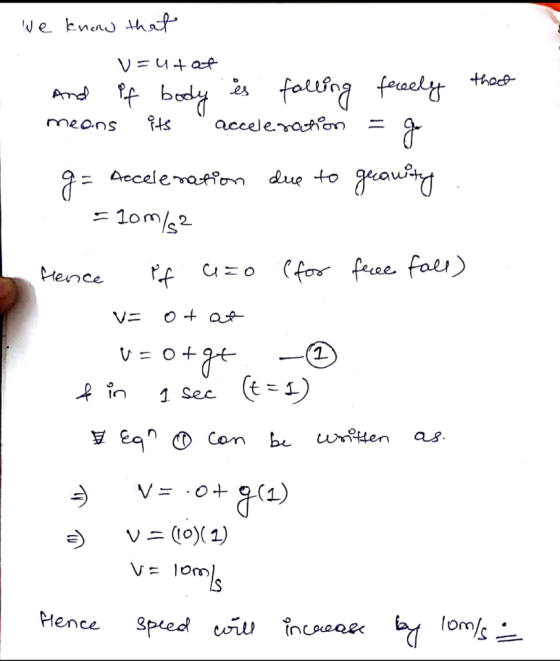
8) If a freely falling object were somehow equipped with a speedometer, its speed reading would...
2-7 Freely Falling Objects Example 2-15: Thrown down from a tower Galileo now throws the ball...
 2-7 Freely Falling Objects Example 2-15: Thrown down from a tower Galileo now throws the ball downward with an initial velocity of 3.00 m/s (a) What then would be its position after 1.00 s and 2.00 s? (b) What would its speed be after 1.0 s and 2.0 s? Compare with the speeds of a dropped ball.
Calculate the final speed of an object if its initial speed is 10 m / s....
Calculate the final speed of an object if its initial speed is 10 m / s. The object has a mass of 5 kg. Initially, it has a height of 20 meters, and it goes down to a height of 15 m. There are no dissipative forces on the object.
Learning Goal To understand how the trajectory of an object depends on its initial velocity, and...
 Learning Goal To understand how the trajectory of an object depends on its initial velocity, and to understand how air resistance affects the trajectory. For this problem, use the PhET simulation Projectiie Motion. This simulation allows you to fire an object from a cannon, see its trajectory, and measure its height, range, and hang time (the amount of time in the air) 驵瘦. พี่ PHET Piojectile Motion Start the simulation by selecting the option labeled "Intro". Press the red Fire...
Question 9 You should be able to answer this question after studying Unit 8. An object moves along a straight line, and its speed v (in metres per second) when at a position r (in metres) from its st...
 Question 9 You should be able to answer this question after studying Unit 8. An object moves along a straight line, and its speed v (in metres per second) when at a position r (in metres) from its starting point can be modelled by the differential equation 10 marks 0 dr0, 20), where k is a positive constant (a) Find the general solution of this differential equation in explicit form (b) The speed of the object at its starting point...
Done 6 of 17 25. Speed is the rate at which what happens? a. The rate...
 Done 6 of 17 25. Speed is the rate at which what happens? a. The rate at which you pick your nose in class. Yes, I've seen you do it. b. The rate at which you run out of class when the bell rings for your next period. c. The rate at which your position changes. d. The rate at which your velocity changes. e. The rate at which your acceleration changes. 26. What is the meaning of free fall?...
Police Report: There were two individuals involved in the accident. No other passengers were pres...
 Police Report: There were two individuals involved in the accident. No other passengers were present and no other vehicles were involved. There was a truck of mass 1,936 kg traveling Southbound on H and a compact car of mass 1,077 kg travelling Northbound on HWY 26. A bystander claims to have watched the vehicles collide and slide Southbound off the road into a tall grassy ditch. The grass was determined to have a coeficient of friction of 0.6, while the...
Where would be the final image and what is its magnification? Please check my work. 3....
 Where would be the final image and what is its
magnification? Please check my work.
3. (a) An object is placed 15 cm in front of a convex lens of focal length 10 cm. 10 cm past the first lens is a concave lens of focal length 10 cm. 50 cm past the second lens is a convex lens of focal length 20 cm. With respect to the initial object, where would be the final image and what is its...
Where would be the final image and what is its
magnification? Please check my work.
3. (a) An object is placed 15 cm in front of a convex lens of focal length 10 cm. 10 cm past the first lens is a concave lens of focal length 10 cm. 50 cm past the second lens is a convex lens of focal length 20 cm. With respect to the initial object, where would be the final image and what is its...
if you could be as detailed as possible, that would be great. I'm having touble knowing...
 if you could be as detailed as possible, that would be
great. I'm having touble knowing which equations to use, showing
the equation and why would also be appreciated.
Question 13 (2 points) A particle moving with a constant acceleration has a velocity of 20 cm/s when its position is x 10 cm. Its later is r--30 cm. What is the acceleration of the particle? position 7.0 s -7.3 cm/s -8.9 cm/s2 -11 cm/s2 -15 cm/s2 -13 cm/s2 Question 14...
if you could be as detailed as possible, that would be
great. I'm having touble knowing which equations to use, showing
the equation and why would also be appreciated.
Question 13 (2 points) A particle moving with a constant acceleration has a velocity of 20 cm/s when its position is x 10 cm. Its later is r--30 cm. What is the acceleration of the particle? position 7.0 s -7.3 cm/s -8.9 cm/s2 -11 cm/s2 -15 cm/s2 -13 cm/s2 Question 14...
You discover a new microbe while working on a citizen scientist project. The mic in their...
 You discover a new microbe while working on a citizen scientist project. The mic in their correct phylogenic niche. In order to determine its evolutionary relatednes 2113 hw 1. launch and fall 45. A all is thrown vertically upward with a speed of 25.0 m/s.tal How high does it rise? (b) How long does it take to reach its highest point? (c) How long does the all take to hit the ground after it reaches its highest point? (d) What...
thanks you so much for your help in advance, if you could do both that would...
 thanks you so much for your help in advance, if you could do
both that would be so helpful as i am out of questions, thank you
ill be sure to rate
My Notes 4. -/1 points SERPSE 10 24.1.OP.005.MI. An electron moving parallel to the x axis has an initial speed of 4.14 x 10 m/s at the origin. Its speed is reduced to 1.50 x 10 m/s at the point x = 2.00 cm. (a) Calculate the electric...
thanks you so much for your help in advance, if you could do
both that would be so helpful as i am out of questions, thank you
ill be sure to rate
My Notes 4. -/1 points SERPSE 10 24.1.OP.005.MI. An electron moving parallel to the x axis has an initial speed of 4.14 x 10 m/s at the origin. Its speed is reduced to 1.50 x 10 m/s at the point x = 2.00 cm. (a) Calculate the electric...
 2-7 Freely Falling Objects Example 2-15: Thrown down from a tower Galileo now throws the ball downward with an initial velocity of 3.00 m/s (a) What then would be its position after 1.00 s and 2.00 s? (b) What would its speed be after 1.0 s and 2.0 s? Compare with the speeds of a dropped ball.
 Learning Goal To understand how the trajectory of an object depends on its initial velocity, and to understand how air resistance affects the trajectory. For this problem, use the PhET simulation Projectiie Motion. This simulation allows you to fire an object from a cannon, see its trajectory, and measure its height, range, and hang time (the amount of time in the air) 驵瘦. พี่ PHET Piojectile Motion Start the simulation by selecting the option labeled "Intro". Press the red Fire...
 Question 9 You should be able to answer this question after studying Unit 8. An object moves along a straight line, and its speed v (in metres per second) when at a position r (in metres) from its starting point can be modelled by the differential equation 10 marks 0 dr0, 20), where k is a positive constant (a) Find the general solution of this differential equation in explicit form (b) The speed of the object at its starting point...
 Done 6 of 17 25. Speed is the rate at which what happens? a. The rate at which you pick your nose in class. Yes, I've seen you do it. b. The rate at which you run out of class when the bell rings for your next period. c. The rate at which your position changes. d. The rate at which your velocity changes. e. The rate at which your acceleration changes. 26. What is the meaning of free fall?...
 Police Report: There were two individuals involved in the accident. No other passengers were present and no other vehicles were involved. There was a truck of mass 1,936 kg traveling Southbound on H and a compact car of mass 1,077 kg travelling Northbound on HWY 26. A bystander claims to have watched the vehicles collide and slide Southbound off the road into a tall grassy ditch. The grass was determined to have a coeficient of friction of 0.6, while the...
 Where would be the final image and what is its
magnification? Please check my work.
3. (a) An object is placed 15 cm in front of a convex lens of focal length 10 cm. 10 cm past the first lens is a concave lens of focal length 10 cm. 50 cm past the second lens is a convex lens of focal length 20 cm. With respect to the initial object, where would be the final image and what is its...
Where would be the final image and what is its
magnification? Please check my work.
3. (a) An object is placed 15 cm in front of a convex lens of focal length 10 cm. 10 cm past the first lens is a concave lens of focal length 10 cm. 50 cm past the second lens is a convex lens of focal length 20 cm. With respect to the initial object, where would be the final image and what is its...
 if you could be as detailed as possible, that would be
great. I'm having touble knowing which equations to use, showing
the equation and why would also be appreciated.
Question 13 (2 points) A particle moving with a constant acceleration has a velocity of 20 cm/s when its position is x 10 cm. Its later is r--30 cm. What is the acceleration of the particle? position 7.0 s -7.3 cm/s -8.9 cm/s2 -11 cm/s2 -15 cm/s2 -13 cm/s2 Question 14...
if you could be as detailed as possible, that would be
great. I'm having touble knowing which equations to use, showing
the equation and why would also be appreciated.
Question 13 (2 points) A particle moving with a constant acceleration has a velocity of 20 cm/s when its position is x 10 cm. Its later is r--30 cm. What is the acceleration of the particle? position 7.0 s -7.3 cm/s -8.9 cm/s2 -11 cm/s2 -15 cm/s2 -13 cm/s2 Question 14...
 You discover a new microbe while working on a citizen scientist project. The mic in their correct phylogenic niche. In order to determine its evolutionary relatednes 2113 hw 1. launch and fall 45. A all is thrown vertically upward with a speed of 25.0 m/s.tal How high does it rise? (b) How long does it take to reach its highest point? (c) How long does the all take to hit the ground after it reaches its highest point? (d) What...
 thanks you so much for your help in advance, if you could do
both that would be so helpful as i am out of questions, thank you
ill be sure to rate
My Notes 4. -/1 points SERPSE 10 24.1.OP.005.MI. An electron moving parallel to the x axis has an initial speed of 4.14 x 10 m/s at the origin. Its speed is reduced to 1.50 x 10 m/s at the point x = 2.00 cm. (a) Calculate the electric...
thanks you so much for your help in advance, if you could do
both that would be so helpful as i am out of questions, thank you
ill be sure to rate
My Notes 4. -/1 points SERPSE 10 24.1.OP.005.MI. An electron moving parallel to the x axis has an initial speed of 4.14 x 10 m/s at the origin. Its speed is reduced to 1.50 x 10 m/s at the point x = 2.00 cm. (a) Calculate the electric...
Most questions answered within 3 hours.
-
Where is the error in this code sequence?
String s1 = "Hello";
String s2 = "ello";...
asked 10 months ago -
Financial data for Joel de Paris, Inc., for last year
follow:
Joel de Paris, Inc.
Balance...
asked 10 months ago -
Consider this reaction:
Al2(SO4)3 (aq)+ BaCl3
(aq) Al2Cl6 (aq)- +
3BaSO4(s) . What is the...
asked 10 months ago -
Suppose that Savneet is considering increasing her
recent random sample from 20 car rentals to 40...
asked 10 months ago -
Trucks arrive at an unloading terminal at an average rate of 120
per hour.
Trucks arrive...
asked 10 months ago -
Why are methanol and ethanol completely soluble in water while
octanol is not very little soluble....
asked 10 months ago -
A facilities manager at a university reads in a research report
that the mean amount of...
asked 10 months ago -
When the CuSO4 is rehydrated by adding water to the anhydrous
compound, is this an endothermic...
asked 10 months ago -
A ray of sunlight is passing from diamond into crown glass; the
angle of incidence is...
asked 10 months ago -
A block of mass 0.249 kg is placed on top of a light, vertical
spring of...
asked 10 months ago -
how do the kidneys compensate in the presences of acidosis
a) trigger hyperventilate
b) reserve acid...
asked 10 months ago -
Question 501 pts
The rental rate of capital to the firm increases. Which of the
following...
asked 10 months ago