Let X be the random variable with the geometric distribution with parameter 0 < p <...
Let X be the random variable with the geometric distribution with parameter 0 < p < 1.
(1) For any integer n ≥ 0, find P(X > n).
(2) Show that for any integers m ≥ 0 and n ≥ 0, P(X > n + m|X > m) = P(X > n) (This is called memoryless property since this conditional probability does not depend on m.)
Homework Answers

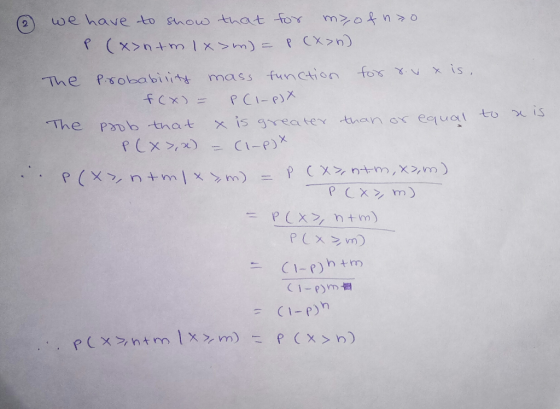
Add Answer to:
Let X be the random variable with the geometric
distribution with parameter 0 < p <...
Problem 8 (10 points). Let X be the random variable with the geometric distribution with parameter...
 Problem 8 (10 points). Let X be the random variable with the geometric distribution with parameter 0 <p <1. (1) For any integer n > 0, find P(X >n). (2) Show that for any integers m > 0 and n > 0, P(X n + m X > m) = P(X>n) (This is called memoryless property since this conditional probability does not depend on m. Dobs inta T obabilita ndomlu abonn liaht bulb indofootin W
Question 1: 1a) Let the random variable X have a geometric distribution with parameter p ,...
 Question 1: 1a) Let the random variable X have a geometric distribution with parameter p , i.e., P(X = x) = pq??, x=1,2,... i) Show that P(X > m)=q" , where m is a positive integer. (5 points) ii) Show that P(X > m+n X > m) = P(X>n), where m and n are positive integers. (5 points) 1b) Suppose the random variable X takes non-negative integer values, i.e., X is a count random variable. Prove that (6 points) E(X)=...
3. Let X be a geometric random variable with parameter p. Prove that P(X >k+r|X >...
 3. Let X be a geometric random variable with parameter p. Prove that P(X >k+r|X > k) = P(X > r). This is called the memoryless property of the geometric random variable.
A discrete random variable X follows the geometric distribution with parameter p, written X ∼ Geom(p),...
 A discrete random variable X follows the geometric distribution
with parameter p, written X ∼ Geom(p), if its distribution function
is
A discrete random variable X follows the geometric distribution with parameter p, written X Geom(p), if its distribution function is 1x(z) = p(1-P)"-1, ze(1, 2, 3, ). The Geometric distribution is used to model the number of flips needed before a coin with probability p of showing Heads actually shows Heads. a) Show that fx(x) is indeed a probability...
A discrete random variable X follows the geometric distribution
with parameter p, written X ∼ Geom(p), if its distribution function
is
A discrete random variable X follows the geometric distribution with parameter p, written X Geom(p), if its distribution function is 1x(z) = p(1-P)"-1, ze(1, 2, 3, ). The Geometric distribution is used to model the number of flips needed before a coin with probability p of showing Heads actually shows Heads. a) Show that fx(x) is indeed a probability...
1) let X follows a geometric distribution, Geo(p). Find P(X=an even number). 2) let X follows...
1) let X follows a geometric distribution, Geo(p). Find P(X=an even number). 2) let X follows a geometric distribution. For positive integers, n, m, show that a). P(X>n) = (1-p)^n b). P(X>n+m|X>n) = (1-p)^m = P(X>m). hint: this property is called the memory-less property of the geometric distribution.
4. (9 pts) Suppose the random variable Y has a geometric distribution with parameter p. Let...
 4. (9 pts) Suppose the random variable Y has a geometric
distribution with parameter p. Let ?? = √?? 3 3 . Find the
probability distribution of V
3 4. (9 pts) Suppose the random variable Y has a geometric distribution with parameter p. Let V 3 Find the probability distribution of.
4. (9 pts) Suppose the random variable Y has a geometric
distribution with parameter p. Let ?? = √?? 3 3 . Find the
probability distribution of V
3 4. (9 pts) Suppose the random variable Y has a geometric distribution with parameter p. Let V 3 Find the probability distribution of.
3. Let X be a random variable from a geometric distribution with parameter p (P(X- k...
 3. Let X be a random variable from a geometric distribution with parameter p (P(X- k p(1-P)"-, } k-1 k-1, 2, ...). Find Emin{X, 100
Let X be a discrete random variable with values in N = {1, 2,...}. Prove that...
Let X be a discrete random variable with values in N = {1, 2,...}. Prove that X is geometric with parameter p = P(X = 1) if and only if the memoryless property P(X = n + m | X > n) = P(X = m) holds. To show that the memoryless property implies that X is geometric, you need to prove that the p.m.f. of X has to be P(X = k) = p(1 - p)^(k-1). For this, use...
[Probability] Let N be a geometric random variable with parameter p. Given N,generate N many i.i.d....
[Probability] Let N be a geometric random variable with parameter p. Given N,generate N many i.i.d. random numbers U1, U2, . . . , UN uniformly from [0,1]. Let M= max 1≤i≤N Ui. Find the cdf of M, i.e., find P(M≤x).
Let X, Y, and Z be three i.i.d. geometric random variables with parameter p, i.e., the...
Let X, Y, and Z be three i.i.d. geometric random variables with parameter p, i.e., the probability mass function of X is PX(k) = (1 − p) k−1p, k = 1, 2, . . . Find the conditional probability distribution of X + Y given X + Y + Z, i.e., find: P(X + Y = i|X + Y + Z = j).
 Problem 8 (10 points). Let X be the random variable with the geometric distribution with parameter 0 <p <1. (1) For any integer n > 0, find P(X >n). (2) Show that for any integers m > 0 and n > 0, P(X n + m X > m) = P(X>n) (This is called memoryless property since this conditional probability does not depend on m. Dobs inta T obabilita ndomlu abonn liaht bulb indofootin W
 Question 1: 1a) Let the random variable X have a geometric distribution with parameter p , i.e., P(X = x) = pq??, x=1,2,... i) Show that P(X > m)=q" , where m is a positive integer. (5 points) ii) Show that P(X > m+n X > m) = P(X>n), where m and n are positive integers. (5 points) 1b) Suppose the random variable X takes non-negative integer values, i.e., X is a count random variable. Prove that (6 points) E(X)=...
 3. Let X be a geometric random variable with parameter p. Prove that P(X >k+r|X > k) = P(X > r). This is called the memoryless property of the geometric random variable.
 A discrete random variable X follows the geometric distribution
with parameter p, written X ∼ Geom(p), if its distribution function
is
A discrete random variable X follows the geometric distribution with parameter p, written X Geom(p), if its distribution function is 1x(z) = p(1-P)"-1, ze(1, 2, 3, ). The Geometric distribution is used to model the number of flips needed before a coin with probability p of showing Heads actually shows Heads. a) Show that fx(x) is indeed a probability...
A discrete random variable X follows the geometric distribution
with parameter p, written X ∼ Geom(p), if its distribution function
is
A discrete random variable X follows the geometric distribution with parameter p, written X Geom(p), if its distribution function is 1x(z) = p(1-P)"-1, ze(1, 2, 3, ). The Geometric distribution is used to model the number of flips needed before a coin with probability p of showing Heads actually shows Heads. a) Show that fx(x) is indeed a probability...
 4. (9 pts) Suppose the random variable Y has a geometric
distribution with parameter p. Let ?? = √?? 3 3 . Find the
probability distribution of V
3 4. (9 pts) Suppose the random variable Y has a geometric distribution with parameter p. Let V 3 Find the probability distribution of.
4. (9 pts) Suppose the random variable Y has a geometric
distribution with parameter p. Let ?? = √?? 3 3 . Find the
probability distribution of V
3 4. (9 pts) Suppose the random variable Y has a geometric distribution with parameter p. Let V 3 Find the probability distribution of.
 3. Let X be a random variable from a geometric distribution with parameter p (P(X- k p(1-P)"-, } k-1 k-1, 2, ...). Find Emin{X, 100
Most questions answered within 3 hours.
-
Where is the error in this code sequence?
String s1 = "Hello";
String s2 = "ello";...
asked 1 year ago -
Financial data for Joel de Paris, Inc., for last year
follow:
Joel de Paris, Inc.
Balance...
asked 1 year ago -
Consider this reaction:
Al2(SO4)3 (aq)+ BaCl3
(aq) Al2Cl6 (aq)- +
3BaSO4(s) . What is the...
asked 1 year ago -
Suppose that Savneet is considering increasing her
recent random sample from 20 car rentals to 40...
asked 1 year ago -
Trucks arrive at an unloading terminal at an average rate of 120
per hour.
Trucks arrive...
asked 1 year ago -
Why are methanol and ethanol completely soluble in water while
octanol is not very little soluble....
asked 1 year ago -
A facilities manager at a university reads in a research report
that the mean amount of...
asked 1 year ago -
When the CuSO4 is rehydrated by adding water to the anhydrous
compound, is this an endothermic...
asked 1 year ago -
A ray of sunlight is passing from diamond into crown glass; the
angle of incidence is...
asked 1 year ago -
A block of mass 0.249 kg is placed on top of a light, vertical
spring of...
asked 1 year ago -
how do the kidneys compensate in the presences of acidosis
a) trigger hyperventilate
b) reserve acid...
asked 1 year ago -
Question 501 pts
The rental rate of capital to the firm increases. Which of the
following...
asked 1 year ago