Let X, Y, and Z be three i.i.d. geometric random variables with parameter p, i.e., the...
Let X, Y, and Z be three i.i.d. geometric random variables with parameter p, i.e., the probability mass function of X is PX(k) = (1 − p) k−1p, k = 1, 2, . . .
Find the conditional probability distribution of X + Y given X + Y + Z, i.e., find: P(X + Y = i|X + Y + Z = j).
Homework Answers
 Note-if
there is any understanding problem regarding this please feel free
to ask via comment box..thank you
Note-if
there is any understanding problem regarding this please feel free
to ask via comment box..thank you
Add Answer to:
Let X, Y, and Z be three i.i.d. geometric random variables with
parameter p, i.e., the...
Suppose U and V are independent geometric random variables with parameter p. Let Z = U...
Suppose U and V are independent geometric random variables with parameter p. Let Z = U + V . Determine the conditional probability mass function of pU|Z(·| n) of U given that Z = n.
2. Suppose U and V are independent geometric random variables with parameter p. Let Z-U+V. Determine...
 2. Suppose U and V are independent geometric random variables with parameter p. Let Z-U+V. Determine the conditional probability mass function of pujz(-In) of U given that Z- n
[Probability] Let N be a geometric random variable with parameter p. Given N,generate N many i.i.d....
[Probability] Let N be a geometric random variable with parameter p. Given N,generate N many i.i.d. random numbers U1, U2, . . . , UN uniformly from [0,1]. Let M= max 1≤i≤N Ui. Find the cdf of M, i.e., find P(M≤x).
2. Let X and Y be two independent discrete random variables with the probability mass functions...
 2. Let X and Y be two independent discrete random variables with the probability mass functions PX- = i) = (e-1)e-i and P(Y = j-11' for i,j = 1, 2, Let {Uni2 1} of i.i.d. uniform random variables on [0, 1]. Assume the sequence {U i independent of X and Y. Define M-max(UhUn Ud. Find the distribution
Problem 41.3 Let X and Y be independent random variables each geometrically distributed with parameter p,...
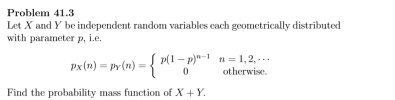 Problem 41.3 Let X and Y be independent random variables each geometrically distributed with parameter p, i.e. p(1- p otherwise. Find the probability mass function of X +Y
A discrete random variable X follows the geometric distribution with parameter p, written X ∼ Geom(p),...
 A discrete random variable X follows the geometric distribution
with parameter p, written X ∼ Geom(p), if its distribution function
is
A discrete random variable X follows the geometric distribution with parameter p, written X Geom(p), if its distribution function is 1x(z) = p(1-P)"-1, ze(1, 2, 3, ). The Geometric distribution is used to model the number of flips needed before a coin with probability p of showing Heads actually shows Heads. a) Show that fx(x) is indeed a probability...
A discrete random variable X follows the geometric distribution
with parameter p, written X ∼ Geom(p), if its distribution function
is
A discrete random variable X follows the geometric distribution with parameter p, written X Geom(p), if its distribution function is 1x(z) = p(1-P)"-1, ze(1, 2, 3, ). The Geometric distribution is used to model the number of flips needed before a coin with probability p of showing Heads actually shows Heads. a) Show that fx(x) is indeed a probability...
4. (3 points) Let X,.., X be an i.i.d. Bernoulli random variables with parameter p. Is it reasona...
 4. (3 points) Let X,.., X be an i.i.d. Bernoulli random variables with parameter p. Is it reasonable to use the exponential distribution to describe the prior distribution of p? Answer 'yes' or 'no ad exain
4. (3 points) Let X,.., X be an i.i.d. Bernoulli random variables with parameter p. Is it reasonable to use the exponential distribution to describe the prior distribution of p? Answer 'yes' or 'no ad exain
4. (3 points) Let X,.., X be an i.i.d. Bernoulli random variables with parameter p. Is it reasonable to use the exponential distribution to describe the prior distribution of p? Answer 'yes' or 'no ad exain
Problem 4 Let X and y be independent Poisson(A) and Poisson(A2) random variables, respectively. i. Write...
 Problem 4 Let X and y be independent Poisson(A) and Poisson(A2) random variables, respectively. i. Write an expression for the PMF of Z -X + Y. i.e.. pz[n] for all possible n. ii. Write an expression for the conditional PMF of X given that Z-n, i.e.. pxjz[kn for all possible k. Which random variable has the same PMF, i.e., is this PMF that of a Bernoulli, binomial, Poisson, geometric, or uniform random variable (which assumes all possible values with equal...
PLEASE MAKE YOUR HAND WRITING CLEAR AND READABLE . THANK YOU! O Let X and Y be independent random variables with a discrete uniform distribution, i.e., with probability mass functions for k = 1, px(k...
 PLEASE MAKE YOUR HAND WRITING CLEAR AND READABLE . THANK
YOU!
O Let X and Y be independent random variables with a discrete uniform distribution, i.e., with probability mass functions for k = 1, px(k) = py (k) =-, N. Use the addition rule for discrete random variables on page 152 to determine the probability mass function of Z -X+Y for the following two cases. a. Suppose N = 6, so that X and Y represent two throws with a...
PLEASE MAKE YOUR HAND WRITING CLEAR AND READABLE . THANK
YOU!
O Let X and Y be independent random variables with a discrete uniform distribution, i.e., with probability mass functions for k = 1, px(k) = py (k) =-, N. Use the addition rule for discrete random variables on page 152 to determine the probability mass function of Z -X+Y for the following two cases. a. Suppose N = 6, so that X and Y represent two throws with a...
Let X be the random variable with the geometric distribution with parameter 0 < p <...
Let X be the random variable with the geometric distribution with parameter 0 < p < 1. (1) For any integer n ≥ 0, find P(X > n). (2) Show that for any integers m ≥ 0 and n ≥ 0, P(X > n + m|X > m) = P(X > n) (This is called memoryless property since this conditional probability does not depend on m.)
 2. Suppose U and V are independent geometric random variables with parameter p. Let Z-U+V. Determine the conditional probability mass function of pujz(-In) of U given that Z- n
 2. Let X and Y be two independent discrete random variables with the probability mass functions PX- = i) = (e-1)e-i and P(Y = j-11' for i,j = 1, 2, Let {Uni2 1} of i.i.d. uniform random variables on [0, 1]. Assume the sequence {U i independent of X and Y. Define M-max(UhUn Ud. Find the distribution
 Problem 41.3 Let X and Y be independent random variables each geometrically distributed with parameter p, i.e. p(1- p otherwise. Find the probability mass function of X +Y
 A discrete random variable X follows the geometric distribution
with parameter p, written X ∼ Geom(p), if its distribution function
is
A discrete random variable X follows the geometric distribution with parameter p, written X Geom(p), if its distribution function is 1x(z) = p(1-P)"-1, ze(1, 2, 3, ). The Geometric distribution is used to model the number of flips needed before a coin with probability p of showing Heads actually shows Heads. a) Show that fx(x) is indeed a probability...
A discrete random variable X follows the geometric distribution
with parameter p, written X ∼ Geom(p), if its distribution function
is
A discrete random variable X follows the geometric distribution with parameter p, written X Geom(p), if its distribution function is 1x(z) = p(1-P)"-1, ze(1, 2, 3, ). The Geometric distribution is used to model the number of flips needed before a coin with probability p of showing Heads actually shows Heads. a) Show that fx(x) is indeed a probability...
 4. (3 points) Let X,.., X be an i.i.d. Bernoulli random variables with parameter p. Is it reasonable to use the exponential distribution to describe the prior distribution of p? Answer 'yes' or 'no ad exain
4. (3 points) Let X,.., X be an i.i.d. Bernoulli random variables with parameter p. Is it reasonable to use the exponential distribution to describe the prior distribution of p? Answer 'yes' or 'no ad exain
4. (3 points) Let X,.., X be an i.i.d. Bernoulli random variables with parameter p. Is it reasonable to use the exponential distribution to describe the prior distribution of p? Answer 'yes' or 'no ad exain
 Problem 4 Let X and y be independent Poisson(A) and Poisson(A2) random variables, respectively. i. Write an expression for the PMF of Z -X + Y. i.e.. pz[n] for all possible n. ii. Write an expression for the conditional PMF of X given that Z-n, i.e.. pxjz[kn for all possible k. Which random variable has the same PMF, i.e., is this PMF that of a Bernoulli, binomial, Poisson, geometric, or uniform random variable (which assumes all possible values with equal...
 PLEASE MAKE YOUR HAND WRITING CLEAR AND READABLE . THANK
YOU!
O Let X and Y be independent random variables with a discrete uniform distribution, i.e., with probability mass functions for k = 1, px(k) = py (k) =-, N. Use the addition rule for discrete random variables on page 152 to determine the probability mass function of Z -X+Y for the following two cases. a. Suppose N = 6, so that X and Y represent two throws with a...
PLEASE MAKE YOUR HAND WRITING CLEAR AND READABLE . THANK
YOU!
O Let X and Y be independent random variables with a discrete uniform distribution, i.e., with probability mass functions for k = 1, px(k) = py (k) =-, N. Use the addition rule for discrete random variables on page 152 to determine the probability mass function of Z -X+Y for the following two cases. a. Suppose N = 6, so that X and Y represent two throws with a...
Most questions answered within 3 hours.
-
Where is the error in this code sequence?
String s1 = "Hello";
String s2 = "ello";...
asked 10 months ago -
Financial data for Joel de Paris, Inc., for last year
follow:
Joel de Paris, Inc.
Balance...
asked 10 months ago -
Consider this reaction:
Al2(SO4)3 (aq)+ BaCl3
(aq) Al2Cl6 (aq)- +
3BaSO4(s) . What is the...
asked 10 months ago -
Suppose that Savneet is considering increasing her
recent random sample from 20 car rentals to 40...
asked 10 months ago -
Trucks arrive at an unloading terminal at an average rate of 120
per hour.
Trucks arrive...
asked 10 months ago -
Why are methanol and ethanol completely soluble in water while
octanol is not very little soluble....
asked 10 months ago -
A facilities manager at a university reads in a research report
that the mean amount of...
asked 10 months ago -
When the CuSO4 is rehydrated by adding water to the anhydrous
compound, is this an endothermic...
asked 10 months ago -
A ray of sunlight is passing from diamond into crown glass; the
angle of incidence is...
asked 10 months ago -
A block of mass 0.249 kg is placed on top of a light, vertical
spring of...
asked 10 months ago -
how do the kidneys compensate in the presences of acidosis
a) trigger hyperventilate
b) reserve acid...
asked 10 months ago -
Question 501 pts
The rental rate of capital to the firm increases. Which of the
following...
asked 10 months ago