Stage 2:Vasodilation, flushing of wound with serous fluid, phagocytosis;
Homework Answers
M
stages of wound healing proceed in an organized way and follow four processes: hemostasis, inflammation, proliferation and maturation. Although the stages of wound healing are linear, wounds can progress backward or forward depending on internal and external patient conditions. The four stages of wound healing are:Hemostasis Phase
Hemostasis is the process of the wound being closed by clotting. Hemostasis starts when blood leaks out of the body. The first step of hemostasis is when blood vessels constrict to restrict the blood flow. Next, platelets stick together in order to seal the break in the wall of the blood vessel. Finally, coagulation occurs and reinforces the platelet plug with threads of fibrin which are like a molecular binding agent. The hemostasis stage of wound healing happens very quickly. The platelets adhere to the sub-endothelium surface within seconds of the rupture of a blood vessel's epithelial wall. After that, the first fibrin strands begin to adhere in about sixty seconds. As the fibrin mesh begins, the blood is transformed from liquid to gel through pro-coagulants and the release of prothrombin. The formation of a thrombus or clot keeps the platelets and blood cells trapped in the wound area. The thrombus is generally important in the stages of wound healing but becomes a problem if it detaches from the vessel wall and goes through the circulatory system, possibly causing a stroke, pulmonary embolism or heart attack.
Inflammatory Phase
Inflammation is the second stage of wound healing and begins right after the injury when the injured blood vessels leak transudate (made of water, salt, and protein) causing localized swelling. Inflammation both controls bleeding and prevents infection. The fluid engorgement allows healing and repair cells to move to the site of the wound. During the inflammatory phase, damaged cells, pathogens, and bacteria are removed from the wound area. These white blood cells, growth factors, nutrients and enzymes create the swelling, heat, pain and redness commonly seen during this stage of wound healing. Inflammation is a natural part of the wound healing process and only problematic if prolonged or excessive.
Proliferative Phase
The proliferative phase of wound healing is when the wound is rebuilt with new tissue made up of collagen and extracellular matrix. In the proliferative phase, the wound contracts as new tissues are built. In addition, a new network of blood vessels must be constructed so that the granulation tissue can be healthy and receive sufficient oxygen and nutrients. Myofibroblasts cause the wound to contract by gripping the wound edges and pulling them together using a mechanism similar to that of smooth muscle cells. In healthy stages of wound healing, granulation tissue is pink or red and uneven in texture. Moreover, healthy granulation tissue does not bleed easily. Dark granulation tissue can be a sign of infection, ischemia, or poor perfusion. In the final phase of the proliferative stage of wound healing, epithelial cells resurface the injury. It is important to remember that epithelialization happens faster when wounds are kept moist and hydrated. Generally, when occlusive or semiocclusive dressings are applied within 48 hours after injury, they will maintain correct tissue humidity to optimize epithelialization.
Maturation Phase
Also called the remodeling stage of wound healing, the maturation phase is when collagen is remodeled from type III to type I and the wound fully closes. The cells that had been used to repair the wound but which are no longer needed are removed by apoptosis, or programmed cell death. When collagen is laid down during the proliferative phase, it is disorganized and the wound is thick. During the maturation phase, collagen is aligned along tension lines and water is reabsorbed so the collagen fibers can lie closer together and cross-link. Cross-linking of collagen reduces scar thickness and also makes the skin area of the wound stronger. Generally, remodeling begins about 21 days after an injury and can continue for a year or more. Even with cross-linking, healed wound areas continue to be weaker than uninjured skin, generally only having 80% of the tensile strength of unwounded skin.
The stages of wound healing are a complex and fragile process. Failure to progress in the stages of wound healing can lead to chronic wounds. Factors that lead up to chronic wounds are venous disease, infection, diabetes and metabolic deficiencies of the elderly. Careful wound care can speed up the stages of wound healing by keeping wounds moist, clean and protected from reinjury and infection.
The inflammatory phase begins with hemostasis and chemotaxis. Both the white cells and thrombocytes speed up the inflammatory process by releasing more mediators and cytokines. Besides platelet-derived growth factor, there are other factors which promote collagen degradation, the transformation of fibroblasts, growth of new vessels, and re-epithelialization. All of the processes occur at the same time but in a synchronized fashion. Mediators like serotonin and histamine are released from platelets and increase cellular permeability. The platelet-derived growth factor attracts fibroblasts and, along with transforming growth factor, enhance division and multiplication of fibroblasts. The fibroblasts, in turn, synthesize collagen.
Inflammatory cells, such as neutrophils, monocytes, and endothelial cells, adhere to a fibrin scaffold that is formed by platelet activation. The neutrophils enable phagocytosis of cellular debris and bacteria, allowing for decontamination of the wound
Add Answer to:
Stage 2:Vasodilation, flushing of wound with serous fluid,
phagocytosis;
Wound Management Match the following terms with the different stages of wound healing: Inflammation, Haemostasis, Epithelialisation,...
Wound Management Match the following terms with the different stages of wound healing: Inflammation, Haemostasis, Epithelialisation, Maturation and Proliferation and granulation Stages/Physiological and biochemical actions Stages 1.1) Stage1: Vasoconstriction, Platelet aggregation and activation of fibrin 1.2) Stage 2:Vasodilation, flushing of wound with serous fluid, phagocytosis; 1.3) Stage 3:Angiogenesis, deposition of collagen, formation of new tissue and wound contraction 1.4) Stage 4: Realignment of collagen, regaining normal tissue strength
A cell count was performed on a serous fluid specimen. As the fluid was cloudy, a...
A cell count was performed on a serous fluid specimen. As the fluid was cloudy, a 1:5 dilution was prepared. The counts were: 41 and 43; 5 squares on each side were counted. What is the average cell count per L?
Why doesn't the dorsal body cavity have any serous fluid at all?
Why doesn't the dorsal body cavity have any serous fluid at all?
As the nurse you are caring for a patient with stage 2 wound on their coccyx....
As the nurse you are caring for a patient with stage 2 wound on their coccyx. How as the nurse would you care for this patient? ( Include a description of the wound, nursing care-nutrition, dressing care for the wound, turning of the patient, etc. Maximum 2 pages.
what stage of phagocytosis is this and why? Can't decide if its the beginning of maturation...
 what stage of phagocytosis is this and why?
Can't decide if its the beginning of maturation or the end of
opsonization.
We were unable to transcribe this imageWe were unable to transcribe this image
what stage of phagocytosis is this and why?
Can't decide if its the beginning of maturation or the end of
opsonization.
We were unable to transcribe this imageWe were unable to transcribe this image
give one example of a wound care product or strategy that helps with each stage of...
give one example of a wound care product or strategy that helps with each stage of wound healing. 2.1) hameostasis primary health care principles for wound management briefly describe how to apply below mentioned primary health care principles in wound management
A client is prescribed 25 mL of intravenous fluid for every 50 mL of wound drainage....
A client is prescribed 25 mL of intravenous fluid for every 50 mL of wound drainage. Over the last 8 hours the client’s wound drainage was 125 mL. How much fluid will the nurse replace?
Give one example of a wound care product or strategy that helps with each stage of...
Give one example of a wound care product or strategy that helps with each stage of wound healing. Stages Wound care product or strategy 2.1) Haemostasis 2.2) Inflammation 2.3) Proliferation and granulation 2.4) Ephitelialisation and Maturation
1.31. examination procedure 1.32. fluid, such as pus, that leaks out of an infected wound 1.33....
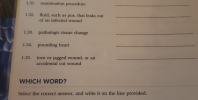 1.31. examination procedure 1.32. fluid, such as pus, that leaks out of an infected wound 1.33. pathologic tissue change 1.34. pounding heart 1.35. torn or jagged wound, or an accidental cut wound WHICH WORD? Select the correct answer, and write it on the line provided.
A client has an extensive stage III pressure ulcer whith considerable tissue loss.the wound edge are:...
A client has an extensive stage III pressure ulcer whith considerable tissue loss.the wound edge are: irregular and not approximated.Whuch type of wound healing would you expect for this patient? a) primary intention healing b)secondary intention healing c) primary union healing d) delayed primary intention healing
 what stage of phagocytosis is this and why?
Can't decide if its the beginning of maturation or the end of
opsonization.
We were unable to transcribe this imageWe were unable to transcribe this image
what stage of phagocytosis is this and why?
Can't decide if its the beginning of maturation or the end of
opsonization.
We were unable to transcribe this imageWe were unable to transcribe this image
 1.31. examination procedure 1.32. fluid, such as pus, that leaks out of an infected wound 1.33. pathologic tissue change 1.34. pounding heart 1.35. torn or jagged wound, or an accidental cut wound WHICH WORD? Select the correct answer, and write it on the line provided.
Most questions answered within 3 hours.
-
Where is the error in this code sequence?
String s1 = "Hello";
String s2 = "ello";...
asked 10 months ago -
Financial data for Joel de Paris, Inc., for last year
follow:
Joel de Paris, Inc.
Balance...
asked 10 months ago -
Consider this reaction:
Al2(SO4)3 (aq)+ BaCl3
(aq) Al2Cl6 (aq)- +
3BaSO4(s) . What is the...
asked 10 months ago -
Suppose that Savneet is considering increasing her
recent random sample from 20 car rentals to 40...
asked 10 months ago -
Trucks arrive at an unloading terminal at an average rate of 120
per hour.
Trucks arrive...
asked 10 months ago -
Why are methanol and ethanol completely soluble in water while
octanol is not very little soluble....
asked 10 months ago -
A facilities manager at a university reads in a research report
that the mean amount of...
asked 10 months ago -
When the CuSO4 is rehydrated by adding water to the anhydrous
compound, is this an endothermic...
asked 10 months ago -
A ray of sunlight is passing from diamond into crown glass; the
angle of incidence is...
asked 10 months ago -
A block of mass 0.249 kg is placed on top of a light, vertical
spring of...
asked 10 months ago -
how do the kidneys compensate in the presences of acidosis
a) trigger hyperventilate
b) reserve acid...
asked 10 months ago -
Question 501 pts
The rental rate of capital to the firm increases. Which of the
following...
asked 10 months ago