functions of interest group ( short explain ) 1- participation 2- representation 3- political education 4-motivation
Homework Answers
Ans) Interest group:
- An organization of people sharing common objectives who actively attempt to influence government policymakers through direct and indirect methods.
1) Participation:
- Interest groups provide an avenue for political participation by individuals.
- By volunteering time, being involved in the interest group, and contributing money, individuals can participate in collective power and voice to effect change.
- Interest groups educate the public about specific issues.
2) Representation:
- The representation function stems from the reason interest groups are created in the first place: Collective action is the most effective way of influencing policymaking and bringing issues to a large audience.
- Interest groups are concerned with maintaining and expanding their membership.
3) Political education:
- Interest groups work hard to educate the public at large, government officials, their own members, and potential interest group members. Mobilizing various publics.
- To influence policy-making, many groups rely on the efforts of people who are motivated to act on behalf of their issues and causes.
4) Motivation:
- Solidary incentives
• motivation to join an interest group based on the
companionship and the satisfaction derived from socializing with
others that it offers.
•ex. A person might join the sierra club because he/she wants to
participate in activities with other people who enjoy hiking or
care deeply about wilderness protection
- Purposive incentives
• Motivation to join an interest group based on the belief in
the group's cause from an idealogical or moral standpoint
•ex. someone might want to join PETA because they strongly object
to animal abuse and want to work with others to prevent cruelty to
animals
- Economic incentives
•Motivation to join an interest group because the group works
for policies that will provide members with material benefits
•ex. Many Americans over age 50 join AARP because of the discounts
members receive on hotels, airfares, and car rentals
Add Answer to:
functions of interest group ( short explain )
1- participation
2- representation
3- political education
4-motivation
1. Explain total participation and partial participation in ER diagram. 2. Explain disjointness constraints and co...
 1. Explain total participation and partial participation in ER diagram. 2. Explain disjointness constraints and completeness constraints in EER modeling. 3. Map the following conceptual schema in ER to logical database schema 1 1Page 11 BANK-BRANCH BANK BRANCHES> Branch no Addr CodeNameAddr LOANS ACCTS Loan no Amount Acct no Balance Type LOAN Type ACCOUNT L_C AC Name Ssn CUSTOMER Phone
1. Explain total participation and partial participation in ER diagram. 2. Explain disjointness constraints and completeness constraints in EER modeling....
1. Explain total participation and partial participation in ER diagram. 2. Explain disjointness constraints and completeness constraints in EER modeling. 3. Map the following conceptual schema in ER to logical database schema 1 1Page 11 BANK-BRANCH BANK BRANCHES> Branch no Addr CodeNameAddr LOANS ACCTS Loan no Amount Acct no Balance Type LOAN Type ACCOUNT L_C AC Name Ssn CUSTOMER Phone
1. Explain total participation and partial participation in ER diagram. 2. Explain disjointness constraints and completeness constraints in EER modeling....
Short Essay Questions 1. What is money? Explain in terms of the functions of money. (2...
 Short Essay Questions 1. What is money? Explain in terms of the functions of money. (2 points) 2. Why are financial institutions required to keep reserves? (2 points) 3. What are the four principal tools of monetary policy? Explain how they can be used. (6 points) w
1) Short Answer: a) Explain why a reference cannot be NULL (as opposed to a pointer...
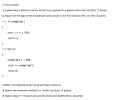 1) Short Answer: a) Explain why a reference cannot be NULL (as opposed to a pointer which can be NULL). (2 points) b) Argue how the type of the variable (as static) results in the final value as 595, not 599. (3 points) int & examplebC) static int x - 599; return x; int mainC exampleb O 595; cout <examplebO; return 0 c) What is boxing/unboxing in programming? (2 points) d) Explain the motivation behind C++ "inline" functions. (3 points)...
1. Which one is an example to aggressive organizational political involvement? Organizational Lobbyist Executive participation Employee...
1. Which one is an example to aggressive organizational political involvement? Organizational Lobbyist Executive participation Employee grassroots involvement Contribution to political action committee Support of trade association 2. Which from the below includes reasons why businesses should NOT be involved in Politics? A. Businesses counterbalance other social interests B. Economic Stakes are high for firms C. Business is too bog, too powerful - an elephant dancing among chickens D. Business is a vital stakeholder of government E. A pluralistic system...
Short note on the following; 1. Growth vs Equity 2. Education and economic growth 3. Private...
Short note on the following; 1. Growth vs Equity 2. Education and economic growth 3. Private Foreign Investment; Some pros and cons for development 4. Three basic types of planning models
Explain Nursing Assessments, Interventions and Patient Education for Ostomy Care 1. 2. 3. 4. 5. 7....
 Explain Nursing Assessments, Interventions and Patient Education for Ostomy Care 1. 2. 3. 4. 5. 7. 8. 9. 10
4. Find a power series representation for each of the following functions. Give the radius of...
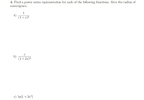 4. Find a power series representation for each of the following functions. Give the radius of convergence. a) (1 + r) b) (1 +2452 c) In(1 + 3.rº)
A political polling organization wishes to select a smaller focus group from a group of 12...
A political polling organization wishes to select a smaller focus group from a group of 12 Republicans, 3 Democrats, and 2 Independents. In how many ways can the group be chosen under each of the following conditions. a) It must consist of 4 Republicans and 2 Democrats? b) It must consist of 2 Republicans, 3 Democrats, and 1 Independent?
Chapter 7-Vitamins Chapter 7 Short Answer Questions 1. List the 5 general functions of vitamins. Explain...
 Chapter 7-Vitamins Chapter 7 Short Answer Questions 1. List the 5 general functions of vitamins. Explain the 3 other functions of vitamins. 2. Explain why vitamins A, D, E, and K are called fat-soluble vitamins, and why B and C are called water- soluble 3. Which vitamin is considered the sunshine vitamin? 4. Which vitamin is given to newborns to prevent hemorrhage after the umbilical cord is cut? 5. Which vitamin is considered the "iron enhancer"? 6. Identify 4 functions...
Researchers are often interested in the rate of political participation based on neighborhood economic conditions. Create a scatter plot of the variables and estimate the correlation between these tw...
Researchers are often interested in the rate of political participation based on neighborhood economic conditions. Create a scatter plot of the variables and estimate the correlation between these two variables (assume each is continuous). Neighborhood Economic Conditions Political Participation 1 36.3 16.4 2 29.4 14.8 3 45.6 68.7 4 65.3 78.8 5 66.8 77.4 6 98.4 65.1 7 41.3 55.4 8 12.6 9.6 9 9.5 22.1 10 89.6 98.6 11 62.1 45.6 12 45.6 37.3 13 68.5 56.4 14 72.5...
 1. Explain total participation and partial participation in ER diagram. 2. Explain disjointness constraints and completeness constraints in EER modeling. 3. Map the following conceptual schema in ER to logical database schema 1 1Page 11 BANK-BRANCH BANK BRANCHES> Branch no Addr CodeNameAddr LOANS ACCTS Loan no Amount Acct no Balance Type LOAN Type ACCOUNT L_C AC Name Ssn CUSTOMER Phone
1. Explain total participation and partial participation in ER diagram. 2. Explain disjointness constraints and completeness constraints in EER modeling....
1. Explain total participation and partial participation in ER diagram. 2. Explain disjointness constraints and completeness constraints in EER modeling. 3. Map the following conceptual schema in ER to logical database schema 1 1Page 11 BANK-BRANCH BANK BRANCHES> Branch no Addr CodeNameAddr LOANS ACCTS Loan no Amount Acct no Balance Type LOAN Type ACCOUNT L_C AC Name Ssn CUSTOMER Phone
1. Explain total participation and partial participation in ER diagram. 2. Explain disjointness constraints and completeness constraints in EER modeling....
 Short Essay Questions 1. What is money? Explain in terms of the functions of money. (2 points) 2. Why are financial institutions required to keep reserves? (2 points) 3. What are the four principal tools of monetary policy? Explain how they can be used. (6 points) w
 1) Short Answer: a) Explain why a reference cannot be NULL (as opposed to a pointer which can be NULL). (2 points) b) Argue how the type of the variable (as static) results in the final value as 595, not 599. (3 points) int & examplebC) static int x - 599; return x; int mainC exampleb O 595; cout <examplebO; return 0 c) What is boxing/unboxing in programming? (2 points) d) Explain the motivation behind C++ "inline" functions. (3 points)...
 Explain Nursing Assessments, Interventions and Patient Education for Ostomy Care 1. 2. 3. 4. 5. 7. 8. 9. 10
 4. Find a power series representation for each of the following functions. Give the radius of convergence. a) (1 + r) b) (1 +2452 c) In(1 + 3.rº)
 Chapter 7-Vitamins Chapter 7 Short Answer Questions 1. List the 5 general functions of vitamins. Explain the 3 other functions of vitamins. 2. Explain why vitamins A, D, E, and K are called fat-soluble vitamins, and why B and C are called water- soluble 3. Which vitamin is considered the sunshine vitamin? 4. Which vitamin is given to newborns to prevent hemorrhage after the umbilical cord is cut? 5. Which vitamin is considered the "iron enhancer"? 6. Identify 4 functions...
Most questions answered within 3 hours.
-
Where is the error in this code sequence?
String s1 = "Hello";
String s2 = "ello";...
asked 10 months ago -
Financial data for Joel de Paris, Inc., for last year
follow:
Joel de Paris, Inc.
Balance...
asked 10 months ago -
Consider this reaction:
Al2(SO4)3 (aq)+ BaCl3
(aq) Al2Cl6 (aq)- +
3BaSO4(s) . What is the...
asked 10 months ago -
Suppose that Savneet is considering increasing her
recent random sample from 20 car rentals to 40...
asked 10 months ago -
Trucks arrive at an unloading terminal at an average rate of 120
per hour.
Trucks arrive...
asked 10 months ago -
Why are methanol and ethanol completely soluble in water while
octanol is not very little soluble....
asked 10 months ago -
A facilities manager at a university reads in a research report
that the mean amount of...
asked 10 months ago -
When the CuSO4 is rehydrated by adding water to the anhydrous
compound, is this an endothermic...
asked 10 months ago -
A ray of sunlight is passing from diamond into crown glass; the
angle of incidence is...
asked 10 months ago -
A block of mass 0.249 kg is placed on top of a light, vertical
spring of...
asked 10 months ago -
how do the kidneys compensate in the presences of acidosis
a) trigger hyperventilate
b) reserve acid...
asked 10 months ago -
Question 501 pts
The rental rate of capital to the firm increases. Which of the
following...
asked 10 months ago