

11 BANK-BRANCH BANK BRANCHES> Branch no Addr CodeNameAddr LOANS ACCTS Loan no Amount Acct no Balance Type LOAN Type ACCOUNT L_C AC Name Ssn CUSTOMER Phone
Homework Answers
Add Answer to:
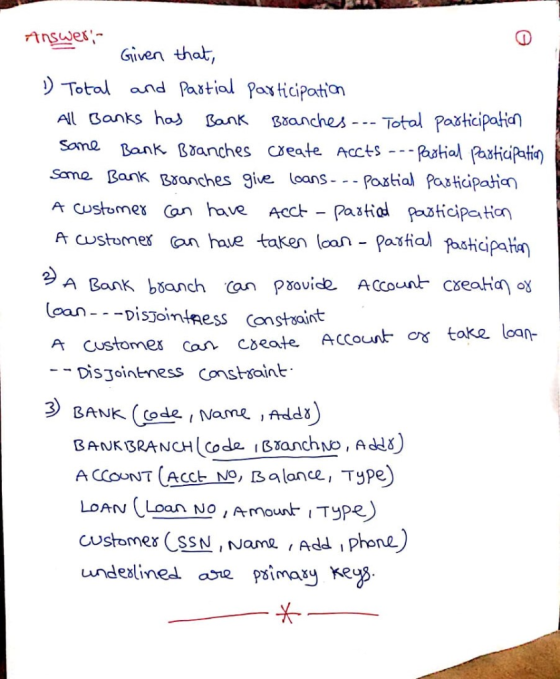
1. Explain total participation and partial participation in ER diagram. 2. Explain disjointness constraints and co...
Let us use the conceptual schema diagram below to answer the question parts. It is about...
 Let us use the conceptual schema diagram below to answer the question parts. It is about a database for banks and their branches. BANK HAS BANK BRANCH Code Name Addr Addr Branch_no Acct_no Loan_no ISSUES ACCTS ISSUES LOANS Balance Type Type Amount 0: n 0: n Name Phone CUSTOMER Addr Ssn
This is how i mapped the relational schema diagram. would this be correct? i feel like...
 This is how i mapped the relational schema diagram. would this
be correct? i feel like i am missing something.
ud bundle at the start of the class on the due date. ment. 1. (10 pts) Use the ER-to-relational mapping algorithm to map the BANK ER diagram to a relational schema diagram. Prepare the diagram using ERDPlus and make sure to specify all primary keys and foreign keys. (Position the relations so that the arcs from the foreign keys to...
This is how i mapped the relational schema diagram. would this
be correct? i feel like i am missing something.
ud bundle at the start of the class on the due date. ment. 1. (10 pts) Use the ER-to-relational mapping algorithm to map the BANK ER diagram to a relational schema diagram. Prepare the diagram using ERDPlus and make sure to specify all primary keys and foreign keys. (Position the relations so that the arcs from the foreign keys to...
2. Design an ER-diagram for a bank that implements the following requirements. The database you design...
2. Design an ER-diagram for a bank that implements the following requirements. The database you design should store information about customers, accounts, branches and employees • Customer: Customers are identified by their SSN. For each customer we store a name, multiple phone numbers (one or more), and an occupation. • Account: Accounts are identified by an account number and the branch they belong to. For each account we store a balance and the type of account (e.g., savings). – An...
c) Write an ER Diagram for the following Library database. Identify all the Entities, Relationships and Attributes. Underline the primary keys and mark the different constraints. You can add an I att...
 c) Write an ER Diagram for the following Library database. Identify all the Entities, Relationships and Attributes. Underline the primary keys and mark the different constraints. You can add an I attribute as a primary key for an entity to make t unique if necessary. Library has a number of branches in the city, each branch having a name, address and librarian. Books have title, authors and publisher. A book can have multiple authors but a single publisher. Note that same...
Q1.a) Based on the business rules, you are expected to construct an Entity-Relationship (ER) diagram. The...
 Q1.a) Based on the business rules, you are expected to construct
an Entity-Relationship (ER) diagram. The ER diagram should include
entities, attributes (if there are less than three specified in the
business statements, please add some extra attributes), identifiers
and corresponding data types, the relationships among entities with
cardinality and associative entities.
.b) Extend Q1.a) to apply generalization/specialization
technique to construct an Enhanced-ER (EER) diagram. The EER
diagram should specify the complete (total) and disjoint
(mutuallyexclusive) constraints on the
generalization/specialization....
Q1.a) Based on the business rules, you are expected to construct
an Entity-Relationship (ER) diagram. The ER diagram should include
entities, attributes (if there are less than three specified in the
business statements, please add some extra attributes), identifiers
and corresponding data types, the relationships among entities with
cardinality and associative entities.
.b) Extend Q1.a) to apply generalization/specialization
technique to construct an Enhanced-ER (EER) diagram. The EER
diagram should specify the complete (total) and disjoint
(mutuallyexclusive) constraints on the
generalization/specialization....
 Let us use the conceptual schema diagram below to answer the question parts. It is about a database for banks and their branches. BANK HAS BANK BRANCH Code Name Addr Addr Branch_no Acct_no Loan_no ISSUES ACCTS ISSUES LOANS Balance Type Type Amount 0: n 0: n Name Phone CUSTOMER Addr Ssn
 This is how i mapped the relational schema diagram. would this
be correct? i feel like i am missing something.
ud bundle at the start of the class on the due date. ment. 1. (10 pts) Use the ER-to-relational mapping algorithm to map the BANK ER diagram to a relational schema diagram. Prepare the diagram using ERDPlus and make sure to specify all primary keys and foreign keys. (Position the relations so that the arcs from the foreign keys to...
This is how i mapped the relational schema diagram. would this
be correct? i feel like i am missing something.
ud bundle at the start of the class on the due date. ment. 1. (10 pts) Use the ER-to-relational mapping algorithm to map the BANK ER diagram to a relational schema diagram. Prepare the diagram using ERDPlus and make sure to specify all primary keys and foreign keys. (Position the relations so that the arcs from the foreign keys to...
 c) Write an ER Diagram for the following Library database. Identify all the Entities, Relationships and Attributes. Underline the primary keys and mark the different constraints. You can add an I attribute as a primary key for an entity to make t unique if necessary. Library has a number of branches in the city, each branch having a name, address and librarian. Books have title, authors and publisher. A book can have multiple authors but a single publisher. Note that same...
 Q1.a) Based on the business rules, you are expected to construct
an Entity-Relationship (ER) diagram. The ER diagram should include
entities, attributes (if there are less than three specified in the
business statements, please add some extra attributes), identifiers
and corresponding data types, the relationships among entities with
cardinality and associative entities.
.b) Extend Q1.a) to apply generalization/specialization
technique to construct an Enhanced-ER (EER) diagram. The EER
diagram should specify the complete (total) and disjoint
(mutuallyexclusive) constraints on the
generalization/specialization....
Q1.a) Based on the business rules, you are expected to construct
an Entity-Relationship (ER) diagram. The ER diagram should include
entities, attributes (if there are less than three specified in the
business statements, please add some extra attributes), identifiers
and corresponding data types, the relationships among entities with
cardinality and associative entities.
.b) Extend Q1.a) to apply generalization/specialization
technique to construct an Enhanced-ER (EER) diagram. The EER
diagram should specify the complete (total) and disjoint
(mutuallyexclusive) constraints on the
generalization/specialization....
Most questions answered within 3 hours.
-
Where is the error in this code sequence?
String s1 = "Hello";
String s2 = "ello";...
asked 11 months ago -
Financial data for Joel de Paris, Inc., for last year
follow:
Joel de Paris, Inc.
Balance...
asked 11 months ago -
Consider this reaction:
Al2(SO4)3 (aq)+ BaCl3
(aq) Al2Cl6 (aq)- +
3BaSO4(s) . What is the...
asked 11 months ago -
Suppose that Savneet is considering increasing her
recent random sample from 20 car rentals to 40...
asked 11 months ago -
Trucks arrive at an unloading terminal at an average rate of 120
per hour.
Trucks arrive...
asked 11 months ago -
Why are methanol and ethanol completely soluble in water while
octanol is not very little soluble....
asked 11 months ago -
A facilities manager at a university reads in a research report
that the mean amount of...
asked 11 months ago -
When the CuSO4 is rehydrated by adding water to the anhydrous
compound, is this an endothermic...
asked 11 months ago -
A ray of sunlight is passing from diamond into crown glass; the
angle of incidence is...
asked 11 months ago -
A block of mass 0.249 kg is placed on top of a light, vertical
spring of...
asked 11 months ago -
how do the kidneys compensate in the presences of acidosis
a) trigger hyperventilate
b) reserve acid...
asked 11 months ago -
Question 501 pts
The rental rate of capital to the firm increases. Which of the
following...
asked 11 months ago