2. Design an ER-diagram for a bank that implements the following requirements. The database you design...
2. Design an ER-diagram for a bank that implements the following requirements. The database you design should store information about customers, accounts, branches and employees
• Customer: Customers are identified by their SSN. For each customer we store a name, multiple phone numbers (one or more), and an occupation.
• Account: Accounts are identified by an account number and the branch they belong to. For each account we store a balance and the type of account (e.g., savings).
– An account belongs to one or more customers. A customer can have any number of accounts.
– An account belongs to exactly one branch. Obviously, branches can have multiple accounts (branches are not required to have accounts).
• Branch: A branch is identified by a unique branch code. For each branch we want to store a location and number of employees.
• Employee: Employees are identified by their SSN. For each employee we store a name and salary.
– An employee works for exactly one branch. Branches have one or more employees.
– An employee is the contact for zero or more customers. Every customer has at most one employee as a contact. [20 marks]
Homework Answers
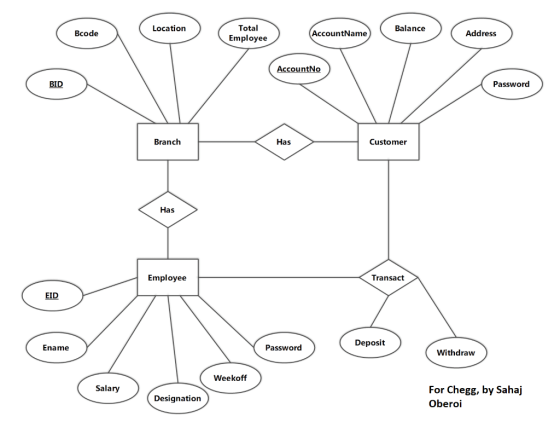
Above is the ER Diagram for a Bank Management system as per the requirements mentioned in the question.
Add Answer to:
2. Design an ER-diagram for a bank that implements the following
requirements. The database you design...
Lab 4 – Logical Design Introduction: This lab is designed to practice database design concepts. Submission:...
Lab 4 – Logical Design Introduction: This lab is designed to practice database design concepts. Submission: For the scenario below, draw a logical design draft on the paper, and then draw the design in the computer using PG Modeler software. After that, export the model to PNG photo. Submit to Brightspace a word file that has a photo of the draft design (on the paper) and the PNG photo that is produced from the PG modeler. Database scenario: Assume that...
DATABASE Draw an ER diagram according to the following requirements. The bank application keeps track of...
DATABASE Draw an ER diagram according to the following requirements. The bank application keeps track of the following information. As a customer of the bank, he/she must either own an account or borrow a loan. The banking application does not require a customer to both own account and borrow a loan. Customer information includes a SSN (unique), a name, and an address. A customer can borrow at most one loan. A loan has a loan number (unique) and an amount....
Create an Entity relationship diagram and write a databased design outline for the following: 1. You...
Create an Entity relationship diagram and write a databased design outline for the following: 1. You want to keep track of sales team’s current sales activity. For each salesperson, you want to store unique employee ID, first name, last name, home address information, phone number, and email address. Your customers are typically retails stores and, for each customer, you want to store customer ID, name of business, phone number, address information and salesperson’s information. Also, for each customer, you want...
Write following queries given these schemas: (FK stands for Foreign Key) Customer = {customerID, firstName, lastName,...
Write following queries given these schemas: (FK stands for Foreign Key) Customer = {customerID, firstName, lastName, income, birthDate} Account = {accNumber, type, balance, branchNumberFK-Branch} Owns = {customerIDFK-Customer, accNumberFK-Account} Transactions = {transNumber, accNumberFK-Account, amount} Employee = {sin, firstName, lastName, salary, branchNumberFK-Branch} Branch = {branchNumber, branchName, managerSINFK-Employee, budget} Focus should be on using: Order By to sort data Set Operators to union/intersect multiple tables Join Operator to join multiple tables Aggregations and Group By to aggregate data Subqueries 3.8 SIN, first name,...
Draw an ER diagram according to the following requirements. The bank application keeps track of the...
Draw an ER diagram according to the following requirements. The bank application keeps track of the following information. As a customer of the bank, he/she must either own an account or borrow a loan. The banking application does not require a customer to both own account and borrow a loan. Customer information includes a SSN (unique), a name, and an address. A customer can borrow at most one loan. A loan has a loan number (unique) and an amount. A...
Q1.a) Based on the business rules, you are expected to construct an Entity-Relationship (ER) diagram. The...
 Q1.a) Based on the business rules, you are expected to construct
an Entity-Relationship (ER) diagram. The ER diagram should include
entities, attributes (if there are less than three specified in the
business statements, please add some extra attributes), identifiers
and corresponding data types, the relationships among entities with
cardinality and associative entities.
.b) Extend Q1.a) to apply generalization/specialization
technique to construct an Enhanced-ER (EER) diagram. The EER
diagram should specify the complete (total) and disjoint
(mutuallyexclusive) constraints on the
generalization/specialization....
Q1.a) Based on the business rules, you are expected to construct
an Entity-Relationship (ER) diagram. The ER diagram should include
entities, attributes (if there are less than three specified in the
business statements, please add some extra attributes), identifiers
and corresponding data types, the relationships among entities with
cardinality and associative entities.
.b) Extend Q1.a) to apply generalization/specialization
technique to construct an Enhanced-ER (EER) diagram. The EER
diagram should specify the complete (total) and disjoint
(mutuallyexclusive) constraints on the
generalization/specialization....
Database Analysis and Design (ER diagram) After the requirement collection and analysis phase the software project...
Database Analysis and Design (ER diagram) After the requirement collection and analysis phase the software project of a database application about a company is described as follows: 1. The company is organized into departments. Each department has a name, an unique number, and a particular employee who manages the department. We keep track of the start date when the employee began managing the dept. A dept may have several locations. 2. A dept controls several projects, each of which has...
TM-315 DATABASE SYSTEMS Please help me to draw an ERD and the Relational Schema and please...
 TM-315 DATABASE SYSTEMS
Please help me to draw an ERD and the Relational Schema and
please mark the Primary and Foreign Key .....
Deliverable:
Word document with grade sheet followed by Part 1 ERD and the
Part 2 relational schema.
Part 1: Draw the ERD for the following situation. 8 pts
Be sure to:
Convert all many-to-many relationships to associative
entities.
Make sure each regular entity has an appropriate identifier.
Make sure attribute names are unique within the ERD
Wally...
TM-315 DATABASE SYSTEMS
Please help me to draw an ERD and the Relational Schema and
please mark the Primary and Foreign Key .....
Deliverable:
Word document with grade sheet followed by Part 1 ERD and the
Part 2 relational schema.
Part 1: Draw the ERD for the following situation. 8 pts
Be sure to:
Convert all many-to-many relationships to associative
entities.
Make sure each regular entity has an appropriate identifier.
Make sure attribute names are unique within the ERD
Wally...
Make an ERD including all entities, attributes, relations, and constraints. Please upload as a doc based...
Make an ERD including all entities, attributes, relations, and constraints. Please upload as a doc based on everything listed below University Bookstore •University Bookstore has several branches throughout Bloomington, and employees may be assigned to work at any of the branches. •Employees are identified by an ID and have a full name, date of birth, SSN, address, multiple phone numbers, a gender, and a hire date. •A Manager runs a branch and is responsible for all operations at that branch....
Entity relationship diagram (ERD) question: An online food delivery company hires you to design a small...
Entity relationship diagram (ERD) question: An online food delivery company hires you to design a small database to store information about the online orders. You’re given the following requirements: ⚫ A customer is uniquely identified by his/her email. For each customer, we also record his/her name, phone number and address. The address is composed of suburb and street. ⚫ A rider is uniquely identified by his/her ID. We will keep record of the rider’s age, gender, phone number and available...
 Q1.a) Based on the business rules, you are expected to construct
an Entity-Relationship (ER) diagram. The ER diagram should include
entities, attributes (if there are less than three specified in the
business statements, please add some extra attributes), identifiers
and corresponding data types, the relationships among entities with
cardinality and associative entities.
.b) Extend Q1.a) to apply generalization/specialization
technique to construct an Enhanced-ER (EER) diagram. The EER
diagram should specify the complete (total) and disjoint
(mutuallyexclusive) constraints on the
generalization/specialization....
Q1.a) Based on the business rules, you are expected to construct
an Entity-Relationship (ER) diagram. The ER diagram should include
entities, attributes (if there are less than three specified in the
business statements, please add some extra attributes), identifiers
and corresponding data types, the relationships among entities with
cardinality and associative entities.
.b) Extend Q1.a) to apply generalization/specialization
technique to construct an Enhanced-ER (EER) diagram. The EER
diagram should specify the complete (total) and disjoint
(mutuallyexclusive) constraints on the
generalization/specialization....
 TM-315 DATABASE SYSTEMS
Please help me to draw an ERD and the Relational Schema and
please mark the Primary and Foreign Key .....
Deliverable:
Word document with grade sheet followed by Part 1 ERD and the
Part 2 relational schema.
Part 1: Draw the ERD for the following situation. 8 pts
Be sure to:
Convert all many-to-many relationships to associative
entities.
Make sure each regular entity has an appropriate identifier.
Make sure attribute names are unique within the ERD
Wally...
TM-315 DATABASE SYSTEMS
Please help me to draw an ERD and the Relational Schema and
please mark the Primary and Foreign Key .....
Deliverable:
Word document with grade sheet followed by Part 1 ERD and the
Part 2 relational schema.
Part 1: Draw the ERD for the following situation. 8 pts
Be sure to:
Convert all many-to-many relationships to associative
entities.
Make sure each regular entity has an appropriate identifier.
Make sure attribute names are unique within the ERD
Wally...
Most questions answered within 3 hours.
-
Where is the error in this code sequence?
String s1 = "Hello";
String s2 = "ello";...
asked 11 months ago -
Financial data for Joel de Paris, Inc., for last year
follow:
Joel de Paris, Inc.
Balance...
asked 11 months ago -
Consider this reaction:
Al2(SO4)3 (aq)+ BaCl3
(aq) Al2Cl6 (aq)- +
3BaSO4(s) . What is the...
asked 11 months ago -
Suppose that Savneet is considering increasing her
recent random sample from 20 car rentals to 40...
asked 11 months ago -
Trucks arrive at an unloading terminal at an average rate of 120
per hour.
Trucks arrive...
asked 11 months ago -
Why are methanol and ethanol completely soluble in water while
octanol is not very little soluble....
asked 11 months ago -
A facilities manager at a university reads in a research report
that the mean amount of...
asked 11 months ago -
When the CuSO4 is rehydrated by adding water to the anhydrous
compound, is this an endothermic...
asked 11 months ago -
A ray of sunlight is passing from diamond into crown glass; the
angle of incidence is...
asked 11 months ago -
A block of mass 0.249 kg is placed on top of a light, vertical
spring of...
asked 11 months ago -
how do the kidneys compensate in the presences of acidosis
a) trigger hyperventilate
b) reserve acid...
asked 11 months ago -
Question 501 pts
The rental rate of capital to the firm increases. Which of the
following...
asked 11 months ago