
Homework Answers
Add Answer to:
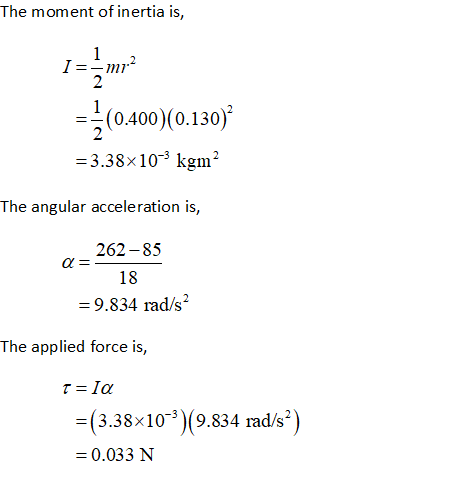
A flat, uniform disk of mass 0.400 kg has a radius of 0.130 m. It accelerates...
E17. A uniform disk with a mass of 7 kg and a radius of 0.4 m is rotating with a rotational veloc...
 E17. A uniform disk with a mass of 7 kg and a radius of 0.4 m is rotating with a rotational velocity of 15 rad/s. a. What is the rotational inertia of the disk? (See fig. 8.15.) b. What is the angular momentum of the disk?
E17. A uniform disk with a mass of 7 kg and a radius of 0.4 m is rotating with a rotational velocity of 15 rad/s. a. What is the rotational inertia of the disk?...
E17. A uniform disk with a mass of 7 kg and a radius of 0.4 m is rotating with a rotational velocity of 15 rad/s. a. What is the rotational inertia of the disk? (See fig. 8.15.) b. What is the angular momentum of the disk?
E17. A uniform disk with a mass of 7 kg and a radius of 0.4 m is rotating with a rotational velocity of 15 rad/s. a. What is the rotational inertia of the disk?...
Platform Applied Mass (Kg) 0.054962 Varying the Torque via Changing the Radius Axle step pulley radius...
 Platform Applied Mass (Kg) 0.054962 Varying the Torque via Changing the Radius Axle step pulley radius Angular Acceleration Standard Deviation (m) (rad/s) (rad/s) 0.018685 0.96054 0.0019 0.054962 0.054962 Platform with Hoop Applied Mass (Kg) 0.054962 0.012490 0.55920 1.0x10 0.008265 0.37194 0.0012 Varying the Torque via Changing the Radius Axle step pulley radius Angular Acceleration Standard Deviation (m ) (rad/s) (rad/s) 0.018685 0.60334 0.0017 0.054962 0.012490 0.34505 7.0x10⁴ 0.054962 Platform Applied Mass (Kg) 0.064984 0.008265 0.20975 8.6x10- Varying the Torque via...
A uniform disk of radius 0.2 m and mass m = 16 kg is mounted on...
A uniform disk of radius 0.2 m and mass m = 16 kg is mounted on a nearly frictionless axle. A string is wrapped tightly around the disk and pulled with a constant force of F = 1 N. After a while the disk has reached an angular speed of ω0 = 2.3 rad/s. What is its angular speed 1.5 s later?
A disk with mass m = 8.6 kg and radius R = 0.35 m begins at...
A disk with mass m = 8.6 kg and radius R = 0.35 m begins at rest and accelerates uniformly for t = 18.9 s, to a final angular speed of ω = 29 rad/s. (answer all parts of this question please, thank you so so much) 1) What is the angular acceleration of the disk? 2) What is the angular displacement over the 18.9 s? 3) What is the moment of inertia of the disk? 4) What is the...
A string is wrapped around a uniform disk of mass M = 2.2 kg and radius R = 0.1 m. (Recall that the moment of inertia of a uniform disk is (1/2) MR2.)
 A string is wrapped around a uniform disk of mass M = 2.2 kg and radius R = 0.1 m. (Recall that the moment of inertia of a uniform disk is (1/2) MR2.) Attached to the disk are four low-mass rods of radius b = 0.13 m, each with a small mass m = 0.7 kg at the end. The device is initially at rest on a nearly frictionless surface. Then you pull the string with a constant force F...
A constant torque is applied to the rim of a grindstone (disk) whose radius is 0.6...
A constant torque is applied to the rim of a grindstone (disk) whose radius is 0.6 m and mass is 2.5 kg. a) What is the grindstone's initial moment of inertia? b) Find the angular speed after the grind stone has made 12.0 revolutions if: i. the magnitude of the torque is uniform 36.0 N·m, and the grindstone starts at rest, then initially speeds up. ii. the magnitude of the torque is uniform 4.00 N·m, and the grindstone starts at...
Problem 1 A 10 kg disk of radius R with a uniform mass density has a...
 Problem 1
A 10 kg disk of radius R with a uniform mass density has a
square hole of side length s cut out of its
center. Suppose the disk radius R is 26 cm and the square side
length s is 6.5 cm.
1. Calculate the rotational inertia of the disk.
2. Draw a force diagram of the disk.
3. Write the force and torque equations that describe your
diagram.
4. Calculate the angular acceleration of the disk along...
Problem 1
A 10 kg disk of radius R with a uniform mass density has a
square hole of side length s cut out of its
center. Suppose the disk radius R is 26 cm and the square side
length s is 6.5 cm.
1. Calculate the rotational inertia of the disk.
2. Draw a force diagram of the disk.
3. Write the force and torque equations that describe your
diagram.
4. Calculate the angular acceleration of the disk along...
A solid, uniform disk of radius 0.250 m and mass 53.7 kg rolls down a ramp...
A solid, uniform disk of radius 0.250 m and mass 53.7 kg rolls down a ramp of length 4.20 m that makes an angle of 12.0° with the horizontal. The disk starts from rest from the top of the ramp. (a) Find the speed of the disk's center of mass when it reaches the bottom of the ramp. m/s (b) Find the angular speed of the disk at the bottom of the ramp. rad/s
Problem 3: A merry-go-round can be considered a uniform disk of mass 145 kg and radius...
 Problem 3: A merry-go-round can be considered a uniform disk of mass 145 kg and radius 2.10 m free to rotate about a frictionless axis through its center. A 40.0 kg child stands at the edge and the system is initially rotating at 0.300 rad/sec. The child begins to walk around the edge of the merry-go-round with a velocity of 0.250 m/s relative to the ground in the direction of the rotation. What is the angular velocity of the merry-go-round...
A large wooden turntable in the shape of a flat uniform disk has a radius of...
A large wooden turntable in the shape of a flat uniform disk has a radius of 2.05 m and a total mass of 130 kg. The turntable is initially rotating at 3.40 rad/s about a vertical axis through its center. Suddenly, a 72.5-kg parachutist makes a soft landing on the turntable at a point near the outer edge. (a) Find the angular speed of the turntable after the parachutist lands. (Assume that you can treat the parachutist as a particle.)...
 E17. A uniform disk with a mass of 7 kg and a radius of 0.4 m is rotating with a rotational velocity of 15 rad/s. a. What is the rotational inertia of the disk? (See fig. 8.15.) b. What is the angular momentum of the disk?
E17. A uniform disk with a mass of 7 kg and a radius of 0.4 m is rotating with a rotational velocity of 15 rad/s. a. What is the rotational inertia of the disk?...
E17. A uniform disk with a mass of 7 kg and a radius of 0.4 m is rotating with a rotational velocity of 15 rad/s. a. What is the rotational inertia of the disk? (See fig. 8.15.) b. What is the angular momentum of the disk?
E17. A uniform disk with a mass of 7 kg and a radius of 0.4 m is rotating with a rotational velocity of 15 rad/s. a. What is the rotational inertia of the disk?...
 Platform Applied Mass (Kg) 0.054962 Varying the Torque via Changing the Radius Axle step pulley radius Angular Acceleration Standard Deviation (m) (rad/s) (rad/s) 0.018685 0.96054 0.0019 0.054962 0.054962 Platform with Hoop Applied Mass (Kg) 0.054962 0.012490 0.55920 1.0x10 0.008265 0.37194 0.0012 Varying the Torque via Changing the Radius Axle step pulley radius Angular Acceleration Standard Deviation (m ) (rad/s) (rad/s) 0.018685 0.60334 0.0017 0.054962 0.012490 0.34505 7.0x10⁴ 0.054962 Platform Applied Mass (Kg) 0.064984 0.008265 0.20975 8.6x10- Varying the Torque via...
 Problem 1
A 10 kg disk of radius R with a uniform mass density has a
square hole of side length s cut out of its
center. Suppose the disk radius R is 26 cm and the square side
length s is 6.5 cm.
1. Calculate the rotational inertia of the disk.
2. Draw a force diagram of the disk.
3. Write the force and torque equations that describe your
diagram.
4. Calculate the angular acceleration of the disk along...
Problem 1
A 10 kg disk of radius R with a uniform mass density has a
square hole of side length s cut out of its
center. Suppose the disk radius R is 26 cm and the square side
length s is 6.5 cm.
1. Calculate the rotational inertia of the disk.
2. Draw a force diagram of the disk.
3. Write the force and torque equations that describe your
diagram.
4. Calculate the angular acceleration of the disk along...
 Problem 3: A merry-go-round can be considered a uniform disk of mass 145 kg and radius 2.10 m free to rotate about a frictionless axis through its center. A 40.0 kg child stands at the edge and the system is initially rotating at 0.300 rad/sec. The child begins to walk around the edge of the merry-go-round with a velocity of 0.250 m/s relative to the ground in the direction of the rotation. What is the angular velocity of the merry-go-round...
Most questions answered within 3 hours.
-
Where is the error in this code sequence?
String s1 = "Hello";
String s2 = "ello";...
asked 11 months ago -
Financial data for Joel de Paris, Inc., for last year
follow:
Joel de Paris, Inc.
Balance...
asked 11 months ago -
Consider this reaction:
Al2(SO4)3 (aq)+ BaCl3
(aq) Al2Cl6 (aq)- +
3BaSO4(s) . What is the...
asked 11 months ago -
Suppose that Savneet is considering increasing her
recent random sample from 20 car rentals to 40...
asked 11 months ago -
Trucks arrive at an unloading terminal at an average rate of 120
per hour.
Trucks arrive...
asked 11 months ago -
Why are methanol and ethanol completely soluble in water while
octanol is not very little soluble....
asked 11 months ago -
A facilities manager at a university reads in a research report
that the mean amount of...
asked 11 months ago -
When the CuSO4 is rehydrated by adding water to the anhydrous
compound, is this an endothermic...
asked 11 months ago -
A ray of sunlight is passing from diamond into crown glass; the
angle of incidence is...
asked 11 months ago -
A block of mass 0.249 kg is placed on top of a light, vertical
spring of...
asked 11 months ago -
how do the kidneys compensate in the presences of acidosis
a) trigger hyperventilate
b) reserve acid...
asked 11 months ago -
Question 501 pts
The rental rate of capital to the firm increases. Which of the
following...
asked 11 months ago