
Homework Answers
Add Answer to:
I have to solve the following problem but ONLY using
Euler-Lagrange.. I also know that a)...
Question: A block with mass of m = 3.78 kg is attached to springs with spring...
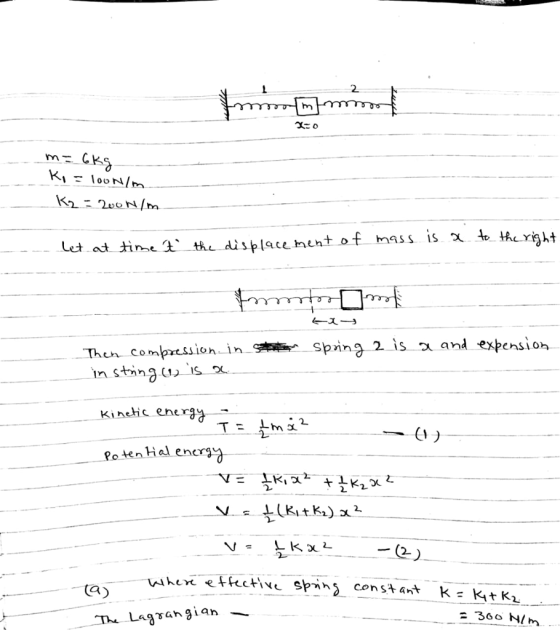
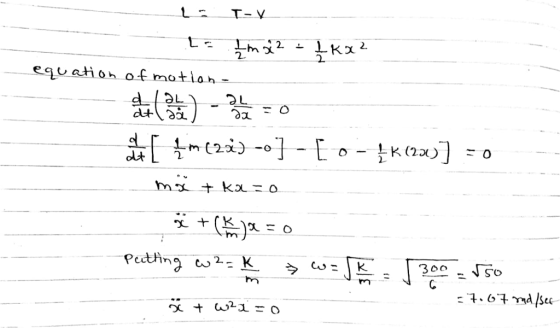
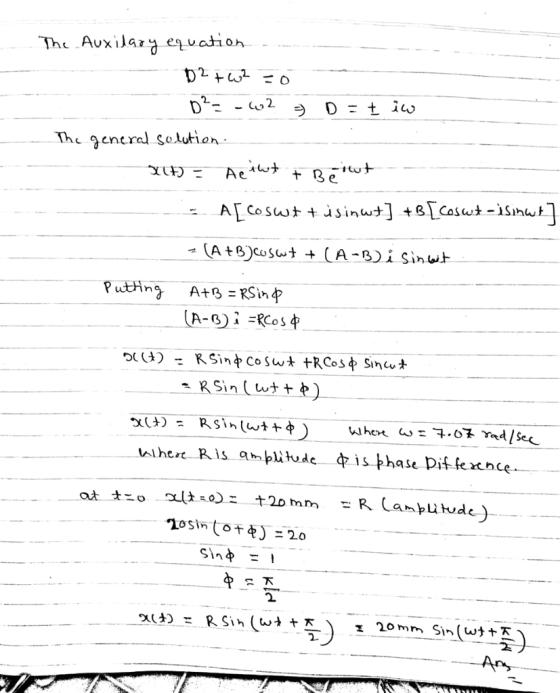
 Question: A block with mass of m = 3.78 kg is attached to springs with spring constants of ki = 18.1 N/m and k = 25.6 N/m, in different configurations shown in the figures below. Assume in all these cases that friction is negligible. Part 1) You will need to calculate the period of oscillations for each situation In this situation the mass is connected between the two springs which are each connected to opposite walls (Figure 1). What is...
Please show all work. For this question. Also I would like to know if this is...
 Please show all work. For this question. Also I would like to
know if this is considered an easy problem.
2. A 10 kg block is released from a point A in the figure below. The track is frie- tionless except for the portion between points B and C, which has a length of d m. The block travels down the track, hits a spring of force constant 2250 and compresses the spring 0.3 m from its equilibrium position before...
Please show all work. For this question. Also I would like to
know if this is considered an easy problem.
2. A 10 kg block is released from a point A in the figure below. The track is frie- tionless except for the portion between points B and C, which has a length of d m. The block travels down the track, hits a spring of force constant 2250 and compresses the spring 0.3 m from its equilibrium position before...
A 2.00-kg object is free to slide on a horizontal surface. The object is attached to...
A 2.00-kg object is free to slide on a horizontal surface. The object is attached to a spring of spring constant 300 N/ m, and the other end of the spring is attached to a wall. The object is pulled in the direction away from the wall until the spring is stretched 50.0 mm from its relaxed position. The object is not released from rest but is instead given an initial velocity of 2.50 m/s away from the wall. Ignore...
I came across a kinetics question and tried to solve it but I do not know know how to determine w...
 I came across a kinetics question and tried to solve it but I do
not know know how to determine which direction the motion proceeds.
I checked the solution and it does not show how the direction of
the motion is decided. Just wondering how I can determine/ solve
for which direction the motion proceeds before I even write the
equations of motion. Here is the question:
In this problem it seems to be assumed that A moves up and...
I came across a kinetics question and tried to solve it but I do
not know know how to determine which direction the motion proceeds.
I checked the solution and it does not show how the direction of
the motion is decided. Just wondering how I can determine/ solve
for which direction the motion proceeds before I even write the
equations of motion. Here is the question:
In this problem it seems to be assumed that A moves up and...
Physics I. Unit : potential energy and conservation of energy. A,B,C, please In the figure, a...
 Physics I. Unit : potential energy and conservation of energy.
A,B,C, please
In the figure, a 3.9 kg block is accelerated from rest by a compressed spring of spring constant 630 N/m. The block leaves the spring at the spring's relaxed length and travels over a horizontal floor with a coefficient of kinetic friction mu_k = 0.215. The frictional force stops the block in distance D = 7.7 m. What are (a) the increase in the thermal energy of the...
Physics I. Unit : potential energy and conservation of energy.
A,B,C, please
In the figure, a 3.9 kg block is accelerated from rest by a compressed spring of spring constant 630 N/m. The block leaves the spring at the spring's relaxed length and travels over a horizontal floor with a coefficient of kinetic friction mu_k = 0.215. The frictional force stops the block in distance D = 7.7 m. What are (a) the increase in the thermal energy of the...
I know the answer is 0.425 m, but I don't know how to get there. Also...
 I know the answer is 0.425 m, but I don't know how to
get there. Also if possible to solve by using Energy that method
would be preferred.
02. 3/104 from the book (just part b). The system shown in the figure below has a spring two masses and two massless pulleys. The pulley cords are massless and inextensible. The system is released from rest and with the spring stretched 200 mm. Determine the distances traveled by the 4 kg...
I know the answer is 0.425 m, but I don't know how to
get there. Also if possible to solve by using Energy that method
would be preferred.
02. 3/104 from the book (just part b). The system shown in the figure below has a spring two masses and two massless pulleys. The pulley cords are massless and inextensible. The system is released from rest and with the spring stretched 200 mm. Determine the distances traveled by the 4 kg...
Please help with the following problem A. 5.X kg block is attached to a massless spring...
 Please help with the following problem
A. 5.X kg block is attached to a massless spring with the spring constant of 220 N/m and is at rest on a horizontal surface with the coefficient of kinetic friction of mu_k = 0.1. The block is struck by a 1.1 kg stone traveling horizontally at 5.5 m/s as shown in the figure. The stone rebounds back at 2 m/s. Note that the friction must be taken into account. Find: (a) the speed...
Please help with the following problem
A. 5.X kg block is attached to a massless spring with the spring constant of 220 N/m and is at rest on a horizontal surface with the coefficient of kinetic friction of mu_k = 0.1. The block is struck by a 1.1 kg stone traveling horizontally at 5.5 m/s as shown in the figure. The stone rebounds back at 2 m/s. Note that the friction must be taken into account. Find: (a) the speed...
1. Solve the following problem on a clean sheet of paper. A package of mass 2.00...
 1. Solve the following problem on a clean sheet of paper. A package of mass 2.00 kg is released on a 58.2° incline, a distance D-2.5 m from a long spring with spring constant k= 150 N/m that is attached to the bottom of the incline, as shown. The coefficient of kinetic friction is 0.200 between the block and the incline. WWWKO- a. Calculate the maximum compression of the spring. b. What is the total work done on the mass...
For the following problem, show all work. Circle your answers. A box of mass m =...
 For the following problem, show all work. Circle your answers. A box of mass m = 5.0 kg is sitting on a ramp, which is elevated at an angle 0 = 20°, compressing a spring Ar = 0.5 m. The spring is released, causing the box to slide up the ramp. At some point, the spring becomes detached from the box. The total length of the ramp is L = 4.0 m and it has a coefficient of kinetic friction...
Fall I- 2017 Exam2-GeneralPhysics」 00 5 of 6 problems,A 6" problem will count towards extra credit,...
 Fall I- 2017 Exam2-GeneralPhysics」 00 5 of 6 problems,A 6" problem will count towards extra credit, 1. Conservation of Linear Momentum gure 1. A pendulum of string length 20 cm and bob mass of 1 kg at its end, starts from rest. The pendulum -on with a block of mass 2 kg, initially at rest. The collision is swings down a quarter of a circle and collides head elastic. Neglect the mass of the string. (a) Find the speed of...
 Question: A block with mass of m = 3.78 kg is attached to springs with spring constants of ki = 18.1 N/m and k = 25.6 N/m, in different configurations shown in the figures below. Assume in all these cases that friction is negligible. Part 1) You will need to calculate the period of oscillations for each situation In this situation the mass is connected between the two springs which are each connected to opposite walls (Figure 1). What is...
 Please show all work. For this question. Also I would like to
know if this is considered an easy problem.
2. A 10 kg block is released from a point A in the figure below. The track is frie- tionless except for the portion between points B and C, which has a length of d m. The block travels down the track, hits a spring of force constant 2250 and compresses the spring 0.3 m from its equilibrium position before...
Please show all work. For this question. Also I would like to
know if this is considered an easy problem.
2. A 10 kg block is released from a point A in the figure below. The track is frie- tionless except for the portion between points B and C, which has a length of d m. The block travels down the track, hits a spring of force constant 2250 and compresses the spring 0.3 m from its equilibrium position before...
 I came across a kinetics question and tried to solve it but I do
not know know how to determine which direction the motion proceeds.
I checked the solution and it does not show how the direction of
the motion is decided. Just wondering how I can determine/ solve
for which direction the motion proceeds before I even write the
equations of motion. Here is the question:
In this problem it seems to be assumed that A moves up and...
I came across a kinetics question and tried to solve it but I do
not know know how to determine which direction the motion proceeds.
I checked the solution and it does not show how the direction of
the motion is decided. Just wondering how I can determine/ solve
for which direction the motion proceeds before I even write the
equations of motion. Here is the question:
In this problem it seems to be assumed that A moves up and...
 Physics I. Unit : potential energy and conservation of energy.
A,B,C, please
In the figure, a 3.9 kg block is accelerated from rest by a compressed spring of spring constant 630 N/m. The block leaves the spring at the spring's relaxed length and travels over a horizontal floor with a coefficient of kinetic friction mu_k = 0.215. The frictional force stops the block in distance D = 7.7 m. What are (a) the increase in the thermal energy of the...
Physics I. Unit : potential energy and conservation of energy.
A,B,C, please
In the figure, a 3.9 kg block is accelerated from rest by a compressed spring of spring constant 630 N/m. The block leaves the spring at the spring's relaxed length and travels over a horizontal floor with a coefficient of kinetic friction mu_k = 0.215. The frictional force stops the block in distance D = 7.7 m. What are (a) the increase in the thermal energy of the...
 I know the answer is 0.425 m, but I don't know how to
get there. Also if possible to solve by using Energy that method
would be preferred.
02. 3/104 from the book (just part b). The system shown in the figure below has a spring two masses and two massless pulleys. The pulley cords are massless and inextensible. The system is released from rest and with the spring stretched 200 mm. Determine the distances traveled by the 4 kg...
I know the answer is 0.425 m, but I don't know how to
get there. Also if possible to solve by using Energy that method
would be preferred.
02. 3/104 from the book (just part b). The system shown in the figure below has a spring two masses and two massless pulleys. The pulley cords are massless and inextensible. The system is released from rest and with the spring stretched 200 mm. Determine the distances traveled by the 4 kg...
 Please help with the following problem
A. 5.X kg block is attached to a massless spring with the spring constant of 220 N/m and is at rest on a horizontal surface with the coefficient of kinetic friction of mu_k = 0.1. The block is struck by a 1.1 kg stone traveling horizontally at 5.5 m/s as shown in the figure. The stone rebounds back at 2 m/s. Note that the friction must be taken into account. Find: (a) the speed...
Please help with the following problem
A. 5.X kg block is attached to a massless spring with the spring constant of 220 N/m and is at rest on a horizontal surface with the coefficient of kinetic friction of mu_k = 0.1. The block is struck by a 1.1 kg stone traveling horizontally at 5.5 m/s as shown in the figure. The stone rebounds back at 2 m/s. Note that the friction must be taken into account. Find: (a) the speed...
 1. Solve the following problem on a clean sheet of paper. A package of mass 2.00 kg is released on a 58.2° incline, a distance D-2.5 m from a long spring with spring constant k= 150 N/m that is attached to the bottom of the incline, as shown. The coefficient of kinetic friction is 0.200 between the block and the incline. WWWKO- a. Calculate the maximum compression of the spring. b. What is the total work done on the mass...
 For the following problem, show all work. Circle your answers. A box of mass m = 5.0 kg is sitting on a ramp, which is elevated at an angle 0 = 20°, compressing a spring Ar = 0.5 m. The spring is released, causing the box to slide up the ramp. At some point, the spring becomes detached from the box. The total length of the ramp is L = 4.0 m and it has a coefficient of kinetic friction...
 Fall I- 2017 Exam2-GeneralPhysics」 00 5 of 6 problems,A 6" problem will count towards extra credit, 1. Conservation of Linear Momentum gure 1. A pendulum of string length 20 cm and bob mass of 1 kg at its end, starts from rest. The pendulum -on with a block of mass 2 kg, initially at rest. The collision is swings down a quarter of a circle and collides head elastic. Neglect the mass of the string. (a) Find the speed of...
Most questions answered within 3 hours.
-
Where is the error in this code sequence?
String s1 = "Hello";
String s2 = "ello";...
asked 10 months ago -
Financial data for Joel de Paris, Inc., for last year
follow:
Joel de Paris, Inc.
Balance...
asked 10 months ago -
Consider this reaction:
Al2(SO4)3 (aq)+ BaCl3
(aq) Al2Cl6 (aq)- +
3BaSO4(s) . What is the...
asked 10 months ago -
Suppose that Savneet is considering increasing her
recent random sample from 20 car rentals to 40...
asked 10 months ago -
Trucks arrive at an unloading terminal at an average rate of 120
per hour.
Trucks arrive...
asked 10 months ago -
Why are methanol and ethanol completely soluble in water while
octanol is not very little soluble....
asked 10 months ago -
A facilities manager at a university reads in a research report
that the mean amount of...
asked 10 months ago -
When the CuSO4 is rehydrated by adding water to the anhydrous
compound, is this an endothermic...
asked 10 months ago -
A ray of sunlight is passing from diamond into crown glass; the
angle of incidence is...
asked 10 months ago -
A block of mass 0.249 kg is placed on top of a light, vertical
spring of...
asked 10 months ago -
how do the kidneys compensate in the presences of acidosis
a) trigger hyperventilate
b) reserve acid...
asked 10 months ago -
Question 501 pts
The rental rate of capital to the firm increases. Which of the
following...
asked 10 months ago