 An aluminum wire, of length l1
= 60.0cm, cross sectional area 1.00 × 10 cm , density
waves(from(the(sun(just(outs3ide(the(atmospheres(of(Venus,(the(earth,(and(Mars.((valu3es(can(be(
of 2.60g/cm , is connected to a steel wire of density 7.80g/cm and
the same cross sectional found(in(the(appendix(of(your(textbook)( (
Problem(2:( area. The compound wire, loaded with a block of mass m
= 10.0kg, is arranged as shown below so that the distance l2 from
the joint to the supporting pulley is 86.6cm. Transverse waves are
set up in the wire by an external source of variable frequency. (a)
Find the lowest frequency of excitation for which standing waves
are observed such that the joint in the wire is a node. (b) How
many nodes are observed at this frequency?
An aluminum wire, of length l1
= 60.0cm, cross sectional area 1.00 × 10 cm , density
waves(from(the(sun(just(outs3ide(the(atmospheres(of(Venus,(the(earth,(and(Mars.((valu3es(can(be(
of 2.60g/cm , is connected to a steel wire of density 7.80g/cm and
the same cross sectional found(in(the(appendix(of(your(textbook)( (
Problem(2:( area. The compound wire, loaded with a block of mass m
= 10.0kg, is arranged as shown below so that the distance l2 from
the joint to the supporting pulley is 86.6cm. Transverse waves are
set up in the wire by an external source of variable frequency. (a)
Find the lowest frequency of excitation for which standing waves
are observed such that the joint in the wire is a node. (b) How
many nodes are observed at this frequency?
Homework Answers
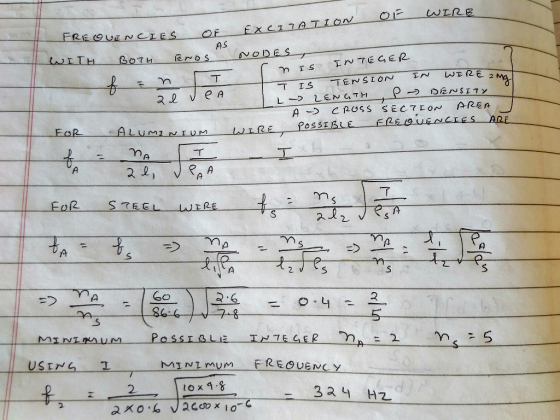
Number of nodes in the wire, excluding end points are (n-1).
Nodes in Aluminium wire = 2-1 =1
Nodes in steel wire = 5-1 =4
One node is at junction. Total number of nodes are 6, excluding end point nodes.
Add Answer to:
An aluminum wire, of length l1
= 60.0cm, cross sectional area 1.00 × 10 cm ,...
In the figure, an aluminum wire, of length L1-1.26x103 cm, cross-sectional area 1.00x102 cm2, and density...
 In the figure, an aluminum wire, of length L1-1.26x103 cm, cross-sectional area 1.00x102 cm2, and density 2.60 g/cm3, is joined to a steel wire of density 7.80 g/cm3 and the same cross-sectional area. The compound wire, loaded with a block of mass m 5.00 kg, is arranged so that the distance from the joint to the supporting pulley is L2 1.09x103 cm Transverse waves are set up on the wire by an external source of variable frequency; a node is...
Chapter 16, Problem 059 GO In the figure, an aluminum wire, of length L 55.3 cm,...
 Chapter 16, Problem 059 GO In the figure, an aluminum wire, of length L 55.3 cm, cross-sectional area 1.81 x 10 cm2, and density 2.60 g/cm, is joined to a steel wire, of density 7.80 g/cm and the same cross-sectional area. The compound wire, loaded with a block of mass m 15 kg, is amranged so that the distance L2 from the joint to the supporting pulley is 39.9 cm. Transverse waves are set up in the wire by using...
An aluminum wire having a cross-sectional area of 2.50 ✕ 10−6 m2 carries a current of...
An aluminum wire having a cross-sectional area of 2.50 ✕ 10−6 m2 carries a current of 3.00 A. The density of aluminum is 2.70 g/cm3. Assume each aluminum atom supplies one conduction electron per atom. Find the drift speed of the electrons in the wire.
An aluminum wire having a cross-sectional area of 6.00 ✕ 10-6 m2 carries a current of...
An aluminum wire having a cross-sectional area of 6.00 ✕ 10-6 m2 carries a current of 8.00 A. Find the drift speed of the electrons in the wire. The density of aluminum is 2.70 g/cm3. Assume each aluminum atom supplies one conduction electron. mm/s
An aluminum wire having a cross-sectional area of 4.70 ✕ 10−6 m2 carries a current of...
An aluminum wire having a cross-sectional area of 4.70 ✕ 10−6 m2 carries a current of 4.50 A. The density of aluminum is 2.70 g/cm3. Assume each aluminum atom supplies one conduction electron per atom. Find the drift speed of the electrons in the wire. mm/s
An aluminum wire carrying a current of 1.80 A has a cross-sectional area of 2.5x10⁻⁶ m2....
An aluminum wire carrying a current of 1.80 A has a cross-sectional area of 2.5x10⁻⁶ m2. The density of aluminum is 2.7 g/cm3. (Assume three electrons are supplied by each atom.) (a) Find the charge density, n, for aluminum?
An aluminum wire having a cross-sectional area equal to 4.90 10-6 m2 carries a current of 4.00...
An aluminum wire having a cross-sectional area equal to 4.90 10-6 m2 carries a current of 4.00 A. The density of aluminum is 2.70 g/cm3. Assume each aluminum atom supplies one conduction electron per atom. Find the drift speed of the electrons in the wire.
Please answer this question: An aluminum wire having a cross-sectional area of 2.10 ✕ 10−6 m2...
 Please answer this question:
An aluminum wire having a cross-sectional area of 2.10 ✕
10−6 m2 carries a current of 6.00 A. The
density of aluminum is 2.70 g/cm3. Assume each aluminum
atom supplies one conduction electron per atom. Find the drift
speed of the electrons in the wire.
Please answer correctly!!!! Thank you so much in advance!
Safari File Edit View History Bookmarks Window Help 恸 令49%DEE1 Mon 3:12:37 PM 6.585*10*-5 X Your response is off by a multiple...
Please answer this question:
An aluminum wire having a cross-sectional area of 2.10 ✕
10−6 m2 carries a current of 6.00 A. The
density of aluminum is 2.70 g/cm3. Assume each aluminum
atom supplies one conduction electron per atom. Find the drift
speed of the electrons in the wire.
Please answer correctly!!!! Thank you so much in advance!
Safari File Edit View History Bookmarks Window Help 恸 令49%DEE1 Mon 3:12:37 PM 6.585*10*-5 X Your response is off by a multiple...
A 10.0 cm length of copper wire has a uniform cross-sectional area of 1.0 mm2. If...
A 10.0 cm length of copper wire has a uniform cross-sectional area of 1.0 mm2. If the drift speed of electrons in the wire is: 2.0x10⁻⁴ m/s and the electrons all move directly along the wire, what is the magnitude of the current density? What is the total current carried by the wire.
An aluminum wire has a mobile charge density is 8.0e28 electrons/m3, and a cross-sectional area of...
An aluminum wire has a mobile charge density is 8.0e28 electrons/m3, and a cross-sectional area of 2.3e-6 m2. When a current flows through the wire, the average drift speed of the electrons is 1.7e-4 m/s. What is the current in the wire?
 In the figure, an aluminum wire, of length L1-1.26x103 cm, cross-sectional area 1.00x102 cm2, and density 2.60 g/cm3, is joined to a steel wire of density 7.80 g/cm3 and the same cross-sectional area. The compound wire, loaded with a block of mass m 5.00 kg, is arranged so that the distance from the joint to the supporting pulley is L2 1.09x103 cm Transverse waves are set up on the wire by an external source of variable frequency; a node is...
 Chapter 16, Problem 059 GO In the figure, an aluminum wire, of length L 55.3 cm, cross-sectional area 1.81 x 10 cm2, and density 2.60 g/cm, is joined to a steel wire, of density 7.80 g/cm and the same cross-sectional area. The compound wire, loaded with a block of mass m 15 kg, is amranged so that the distance L2 from the joint to the supporting pulley is 39.9 cm. Transverse waves are set up in the wire by using...
 Please answer this question:
An aluminum wire having a cross-sectional area of 2.10 ✕
10−6 m2 carries a current of 6.00 A. The
density of aluminum is 2.70 g/cm3. Assume each aluminum
atom supplies one conduction electron per atom. Find the drift
speed of the electrons in the wire.
Please answer correctly!!!! Thank you so much in advance!
Safari File Edit View History Bookmarks Window Help 恸 令49%DEE1 Mon 3:12:37 PM 6.585*10*-5 X Your response is off by a multiple...
Please answer this question:
An aluminum wire having a cross-sectional area of 2.10 ✕
10−6 m2 carries a current of 6.00 A. The
density of aluminum is 2.70 g/cm3. Assume each aluminum
atom supplies one conduction electron per atom. Find the drift
speed of the electrons in the wire.
Please answer correctly!!!! Thank you so much in advance!
Safari File Edit View History Bookmarks Window Help 恸 令49%DEE1 Mon 3:12:37 PM 6.585*10*-5 X Your response is off by a multiple...
Most questions answered within 3 hours.
-
Where is the error in this code sequence?
String s1 = "Hello";
String s2 = "ello";...
asked 11 months ago -
Financial data for Joel de Paris, Inc., for last year
follow:
Joel de Paris, Inc.
Balance...
asked 11 months ago -
Consider this reaction:
Al2(SO4)3 (aq)+ BaCl3
(aq) Al2Cl6 (aq)- +
3BaSO4(s) . What is the...
asked 11 months ago -
Suppose that Savneet is considering increasing her
recent random sample from 20 car rentals to 40...
asked 11 months ago -
Trucks arrive at an unloading terminal at an average rate of 120
per hour.
Trucks arrive...
asked 11 months ago -
Why are methanol and ethanol completely soluble in water while
octanol is not very little soluble....
asked 11 months ago -
A facilities manager at a university reads in a research report
that the mean amount of...
asked 11 months ago -
When the CuSO4 is rehydrated by adding water to the anhydrous
compound, is this an endothermic...
asked 11 months ago -
A ray of sunlight is passing from diamond into crown glass; the
angle of incidence is...
asked 11 months ago -
A block of mass 0.249 kg is placed on top of a light, vertical
spring of...
asked 11 months ago -
how do the kidneys compensate in the presences of acidosis
a) trigger hyperventilate
b) reserve acid...
asked 11 months ago -
Question 501 pts
The rental rate of capital to the firm increases. Which of the
following...
asked 11 months ago