
Homework Answers
Moment of inertia depends on the axis of rotation and not on the
object.so it is not the same for all the objects I =Mr^2 if where M
is the mass and r s the distance from the axis .If you look at all
three objects Axis 1 has less mass with less distance from axis
.Most of the mass is lying on the axis of rotation .so axis 1 has
the smallest moment of inertia .Now comparing axis 2 and axis
3,Axis 3 has more distributed at a distance away from the axis so
axis 3 has more amount of inertia than axis 2 .Putting in order of
increasing it is axis 1>axis 2>axis 3 .Option (a)
Add Answer to:
6. A set of two bars welded together can be rotated about any of the axes...
The L-shaped object in the figure can be rotated in one of the following three ways:...
The L-shaped object in the figure can be rotated in one of the following three ways: case 1, rotation about the x axis; case 2, rotation about the y axis; and case 3, rotation about the z axis (which passes through the origin perpendicular to the plane of the figure.) Rank these three cases in order of decreasing moment of inertia. Rank from largest to smallest. To rank items as equivalent, overlap them.
A baseball bat can be rotated around many different axes of rotation. Three such possibilities are shown in (Figure 1)
Figure 1:Part A: A baseball bat can be rotated around many different axes of rotation. Three such possibilities are shown in (Figure 1) . Rank the baseball bat's moment of inertia about each of these three axes of rotation.Rank the moment of inertia from largest to smallest and overlap axes labels if the same.Part B: Given the same baseball bat and possible axes of rotation shown in (Figure 1) , for which axis of rotation would it be the easiest...
Three identical thin rods, each of length L an mass m, are welded perpendicular to one...
 Three identical thin rods, each of length L an mass m, are welded perpendicular to one another as shown in Figure P10.23. The assembly is rotated about an axis that passes through the end of one rod and is parallel to another Determine the moment of inertia of this structure. (Answer in terms of m and L.) Axis of rotationn Figure P10.23
the same irregular shape rotated about two different axes: one at its center, and one nearer...
the same irregular shape rotated about two different axes: one at its center, and one nearer to the edge. Which has the greater moment of inertia? Explain without using an equation.
ss 8. Figure OQ10.8 shows ng st a system of four par- ticles joined by light,...
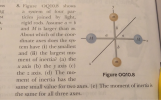 ss 8. Figure OQ10.8 shows ng st a system of four par- ticles joined by light, rigid rods. Assume a = b and M is larger than m. About which of the coor- dinate axes does the sys- tem have (i) the smallest and (ii) the largest mo- ment of inertia? (a) the x axis (b) the y axis (c) the axis, (d) The mo- ment of inertia has the (l Figure OQ10.8 same small value for two axes. (e)...
1. All of the objects below are rotating with an angular velocity of 2 rpm. They...
 1. All of the objects below are rotating with an angular velocity of 2 rpm. They each have a mass of 15 kg and a radius of 0.3 m. For each object a) calculate the moment of inertia. Rank in order from smallest to largest. b) calculate the rotational kinetic energy. Rank in order from smallest to largest. c) calculate the angular momentum. Rank in order from smallest to largest. Solid cylinder or disc, symmetry axis Hoop about symmetry axis...
The L-shaped object(Figure 1) can be rotated in one of the following three ways: case A,...
 The L-shaped object(Figure 1) can be rotated in one of the
following three ways: case A, about the x axis; case B,
about the y axis; and case C, about the z axis
(which passes through the origin perpendicular to the plane of the
figure).
If the same torque ? is applied in each of these cases,
rank them in decreasing order of the resulting angular
acceleration.
The L-shaped object(Figure 1) can be rotated in one of the following three...
The L-shaped object(Figure 1) can be rotated in one of the
following three ways: case A, about the x axis; case B,
about the y axis; and case C, about the z axis
(which passes through the origin perpendicular to the plane of the
figure).
If the same torque ? is applied in each of these cases,
rank them in decreasing order of the resulting angular
acceleration.
The L-shaped object(Figure 1) can be rotated in one of the following three...
Problem 7 A satellite consists two cylinders which can rotate relative to each other about the common axis of summetry. The rotation can be precisely controlled through a built-in motor. Both cyllind...
 Problem 7 A satellite consists two cylinders which can rotate relative to each other about the common axis of summetry. The rotation can be precisely controlled through a built-in motor. Both cyllinders can be asuumed to be uniform; they have the same mass, m 10.0 kg, and the same radius 0.30 m. The top cylinder has attached to it two balls, each of which has mass 1.0kg and radius b 0.1 m. Each ball is fastened to the end of...
5 and 6 (iii) F+dp/dt = 0 5.) (a) A point object of mass 10 Kg...
 5
and 6
(iii) F+dp/dt = 0 5.) (a) A point object of mass 10 Kg is rotating about an axis 1 metre away at an angular speed of 10 rad/second. Its moment of inertia about the rotation axis is: (i) 10 Kg -Metre (ii) 100 Kg/Second (iii) 10 Kg-Metre2 (b) Which one of the following equations (using standard nomenclature) is incorrect? (i) v =r o (ii) ac = v2/r (ii) da/dt (c) The moment of inertia of a uniform...
5
and 6
(iii) F+dp/dt = 0 5.) (a) A point object of mass 10 Kg is rotating about an axis 1 metre away at an angular speed of 10 rad/second. Its moment of inertia about the rotation axis is: (i) 10 Kg -Metre (ii) 100 Kg/Second (iii) 10 Kg-Metre2 (b) Which one of the following equations (using standard nomenclature) is incorrect? (i) v =r o (ii) ac = v2/r (ii) da/dt (c) The moment of inertia of a uniform...
5 and 6 "PdF/dt U HULIUI? (iii) F+ dp/dt = 0 5.) (a) A point object...
 5
and 6
"PdF/dt U HULIUI? (iii) F+ dp/dt = 0 5.) (a) A point object of mass 10 Kg is rotating about an axis 1 metre away at an angular speed of 10 rad/second. Its moment of inertia about the rotation axis is: (i) 10 Kg?-Metre (ii) 100 Kg/Second (iii) 10 Kg-Metre? (b) Which one of the following equations (using standard nomenclature) is incorrect? (i) v=ro (ii) ac = v2/r (iii) o = da/dt (c) The moment of inertia...
5
and 6
"PdF/dt U HULIUI? (iii) F+ dp/dt = 0 5.) (a) A point object of mass 10 Kg is rotating about an axis 1 metre away at an angular speed of 10 rad/second. Its moment of inertia about the rotation axis is: (i) 10 Kg?-Metre (ii) 100 Kg/Second (iii) 10 Kg-Metre? (b) Which one of the following equations (using standard nomenclature) is incorrect? (i) v=ro (ii) ac = v2/r (iii) o = da/dt (c) The moment of inertia...
 Three identical thin rods, each of length L an mass m, are welded perpendicular to one another as shown in Figure P10.23. The assembly is rotated about an axis that passes through the end of one rod and is parallel to another Determine the moment of inertia of this structure. (Answer in terms of m and L.) Axis of rotationn Figure P10.23
 ss 8. Figure OQ10.8 shows ng st a system of four par- ticles joined by light, rigid rods. Assume a = b and M is larger than m. About which of the coor- dinate axes does the sys- tem have (i) the smallest and (ii) the largest mo- ment of inertia? (a) the x axis (b) the y axis (c) the axis, (d) The mo- ment of inertia has the (l Figure OQ10.8 same small value for two axes. (e)...
 1. All of the objects below are rotating with an angular velocity of 2 rpm. They each have a mass of 15 kg and a radius of 0.3 m. For each object a) calculate the moment of inertia. Rank in order from smallest to largest. b) calculate the rotational kinetic energy. Rank in order from smallest to largest. c) calculate the angular momentum. Rank in order from smallest to largest. Solid cylinder or disc, symmetry axis Hoop about symmetry axis...
 The L-shaped object(Figure 1) can be rotated in one of the
following three ways: case A, about the x axis; case B,
about the y axis; and case C, about the z axis
(which passes through the origin perpendicular to the plane of the
figure).
If the same torque ? is applied in each of these cases,
rank them in decreasing order of the resulting angular
acceleration.
The L-shaped object(Figure 1) can be rotated in one of the following three...
The L-shaped object(Figure 1) can be rotated in one of the
following three ways: case A, about the x axis; case B,
about the y axis; and case C, about the z axis
(which passes through the origin perpendicular to the plane of the
figure).
If the same torque ? is applied in each of these cases,
rank them in decreasing order of the resulting angular
acceleration.
The L-shaped object(Figure 1) can be rotated in one of the following three...
 Problem 7 A satellite consists two cylinders which can rotate relative to each other about the common axis of summetry. The rotation can be precisely controlled through a built-in motor. Both cyllinders can be asuumed to be uniform; they have the same mass, m 10.0 kg, and the same radius 0.30 m. The top cylinder has attached to it two balls, each of which has mass 1.0kg and radius b 0.1 m. Each ball is fastened to the end of...
 5
and 6
(iii) F+dp/dt = 0 5.) (a) A point object of mass 10 Kg is rotating about an axis 1 metre away at an angular speed of 10 rad/second. Its moment of inertia about the rotation axis is: (i) 10 Kg -Metre (ii) 100 Kg/Second (iii) 10 Kg-Metre2 (b) Which one of the following equations (using standard nomenclature) is incorrect? (i) v =r o (ii) ac = v2/r (ii) da/dt (c) The moment of inertia of a uniform...
5
and 6
(iii) F+dp/dt = 0 5.) (a) A point object of mass 10 Kg is rotating about an axis 1 metre away at an angular speed of 10 rad/second. Its moment of inertia about the rotation axis is: (i) 10 Kg -Metre (ii) 100 Kg/Second (iii) 10 Kg-Metre2 (b) Which one of the following equations (using standard nomenclature) is incorrect? (i) v =r o (ii) ac = v2/r (ii) da/dt (c) The moment of inertia of a uniform...
 5
and 6
"PdF/dt U HULIUI? (iii) F+ dp/dt = 0 5.) (a) A point object of mass 10 Kg is rotating about an axis 1 metre away at an angular speed of 10 rad/second. Its moment of inertia about the rotation axis is: (i) 10 Kg?-Metre (ii) 100 Kg/Second (iii) 10 Kg-Metre? (b) Which one of the following equations (using standard nomenclature) is incorrect? (i) v=ro (ii) ac = v2/r (iii) o = da/dt (c) The moment of inertia...
5
and 6
"PdF/dt U HULIUI? (iii) F+ dp/dt = 0 5.) (a) A point object of mass 10 Kg is rotating about an axis 1 metre away at an angular speed of 10 rad/second. Its moment of inertia about the rotation axis is: (i) 10 Kg?-Metre (ii) 100 Kg/Second (iii) 10 Kg-Metre? (b) Which one of the following equations (using standard nomenclature) is incorrect? (i) v=ro (ii) ac = v2/r (iii) o = da/dt (c) The moment of inertia...
Most questions answered within 3 hours.
-
Where is the error in this code sequence?
String s1 = "Hello";
String s2 = "ello";...
asked 10 months ago -
Financial data for Joel de Paris, Inc., for last year
follow:
Joel de Paris, Inc.
Balance...
asked 10 months ago -
Consider this reaction:
Al2(SO4)3 (aq)+ BaCl3
(aq) Al2Cl6 (aq)- +
3BaSO4(s) . What is the...
asked 10 months ago -
Suppose that Savneet is considering increasing her
recent random sample from 20 car rentals to 40...
asked 10 months ago -
Trucks arrive at an unloading terminal at an average rate of 120
per hour.
Trucks arrive...
asked 10 months ago -
Why are methanol and ethanol completely soluble in water while
octanol is not very little soluble....
asked 10 months ago -
A facilities manager at a university reads in a research report
that the mean amount of...
asked 10 months ago -
When the CuSO4 is rehydrated by adding water to the anhydrous
compound, is this an endothermic...
asked 10 months ago -
A ray of sunlight is passing from diamond into crown glass; the
angle of incidence is...
asked 10 months ago -
A block of mass 0.249 kg is placed on top of a light, vertical
spring of...
asked 10 months ago -
how do the kidneys compensate in the presences of acidosis
a) trigger hyperventilate
b) reserve acid...
asked 10 months ago -
Question 501 pts
The rental rate of capital to the firm increases. Which of the
following...
asked 10 months ago