Describe the location and function of the various joints in the body and the developmental care...
- Describe the location and function of the various joints in the body and the developmental care regarding the musculoskeletal system.
Homework Answers
Ans) Joints are formed where bones come together.
- The six types of synovial joints are the pivot, hinge, saddle, plane, condyloid, and ball-and-socket joints.
- Pivot joints are found in your neck vertebrae, while hinge joints are located in your elbows, fingers, and knees.
- Saddle and plane joints are found in your hands.
- The skeletal system has five main functions in the body, three of which are external and visible to the naked eye, and two of which are internal.
• The external functions are: structure, movement and protection.
• The internal functions are: blood cell production and storage.
Development of Musculoskeletal system:
Age-related changes in joints. In a joint, bones do not directly contact each other. As age, joint movement becomes stiffer and less flexible because the amount of lubricating fluid inside joints decreases and the cartilage becomes thinner.
Developmental care of Musculoskeletal system:
- Eat foods rich in calcium.
- Try yogurt, cheese, milk, and dark green vegetables.
- Eat foods rich in vitamin D.
- Try eggs, fatty fish, soft margarine, and fortified milk.
Add Answer to:
Describe the location and function of the various joints in the
body and the developmental care...
Also please answer only one of the following questions: Describe the location and function of the...
Also please answer only one of the following questions: Describe the location and function of the various joints in the body and the developmental care regarding the musculoskeletal system. Describe the autonomic nervous system and how this can serve as a defense mechanism for the boy. Give an example. Please I want a new references... thanks
Assignment about joints Describe what are the joints. give example of one joint, its location and...
Assignment about joints Describe what are the joints. give example of one joint, its location and function. minimal one page.
Body Systems: Skeletal: Bones provide joints or levers for motion potential but can only move via...
Body Systems: Skeletal: Bones provide joints or levers for motion potential but can only move via muscle acting on the bones and joints. The skeleton system has two parts, axial and appendicular. Explain the two parts axial and appendicular, and give an example of each. Muscular: There are three types of muscles. Skeletal, Cardiac, and Smooth. Research each muscle and their relationship to movement, and compare and contrast their relationship to movement. Nervous: The nervous system enables the body to...
Identify the tissues, describe their function and location in the body for each picture below PASSAC...
 Identify the tissues, describe their function and location in the
body for each picture below
PASSAC VESSE We were unable to transcribe this imageWe were unable to transcribe this image
Identify the tissues, describe their function and location in the
body for each picture below
PASSAC VESSE We were unable to transcribe this imageWe were unable to transcribe this image
Describe the location (which bone where applicable and/or where in the body) AND function of ALL...
Describe the location (which bone where applicable and/or where in the body) AND function of ALL of the following: Hyoid Sella turcica/hypophyseal fossa Olecranon Cribriform plate Mastoid process
.Identify the anatomical location of major organs in each body system. (I.C5) Compare structure and function...
 .Identify the anatomical location of major organs in each body system. (I.C5) Compare structure and function of the human body across the life span. (I.C.6) . Describe the normal function of each body system. (1.C.7) . Identify common pathology related to each body system including: a. signs, b. symptoms c. etiology. (I.C.8) Analyze pathology for each body system including: a diagnostic measures, b. treatment modalities. (I.C.9)
Discuss the similarities and differences among the various genetic and developmental disorders. Describe the treatments and...
Discuss the similarities and differences among the various genetic and developmental disorders. Describe the treatments and technology that assist individuals with these disorders today that were not available a few years ago.
Compare and contrast the three subclasses of fibrous joints. Give examples of fibrous joints, and describe...
 Compare and contrast the three subclasses of fibrous joints. Give examples of fibrous joints, and describe how they function 3. Compare and contrast the two subclasses of cartilaginous jomis. 4. Give examples of cartilaginous joints, and describe their function. Build Your Own Summary Table Type of Joint Structural Classification Functional Classification Suture Gomphosis Syndesmosis Synchondrosis Symphysis
Describe the role and function of the healthcare professional in relation to the care of the...
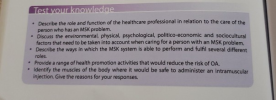 Describe the role and function of the healthcare professional in relation to the care of the . person who has an MSK problem. . Discuss the environmental, physical, psychological, politico-economic and sociocultural factors that need to be taken into account when caring for a person with an MSK problem . Describe the ways in which the MSK system is able to perform and fulfil several different roles. Provide a range of health promotion activities that would reduce the risk of...
JOINTS AND SURFACE ANATOMY OF THE THORACIC CAGE c. Show and describe how to locate the...
 JOINTS AND SURFACE ANATOMY OF THE THORACIC CAGE c. Show and describe how to locate the jugular notch and the sternal angle in your body or the body of a willing victim! i. Demonstrate the clinical use of the sternal angle; that is, how by palpating the sternal angle and counting ribs, you can pinpoint the location of injuries, pain, etc. in your future clients. d. Using all the facts described in previous bullets, briefly explain what Costochondritis is. Is...
 Identify the tissues, describe their function and location in the
body for each picture below
PASSAC VESSE We were unable to transcribe this imageWe were unable to transcribe this image
Identify the tissues, describe their function and location in the
body for each picture below
PASSAC VESSE We were unable to transcribe this imageWe were unable to transcribe this image
 .Identify the anatomical location of major organs in each body system. (I.C5) Compare structure and function of the human body across the life span. (I.C.6) . Describe the normal function of each body system. (1.C.7) . Identify common pathology related to each body system including: a. signs, b. symptoms c. etiology. (I.C.8) Analyze pathology for each body system including: a diagnostic measures, b. treatment modalities. (I.C.9)
 Compare and contrast the three subclasses of fibrous joints. Give examples of fibrous joints, and describe how they function 3. Compare and contrast the two subclasses of cartilaginous jomis. 4. Give examples of cartilaginous joints, and describe their function. Build Your Own Summary Table Type of Joint Structural Classification Functional Classification Suture Gomphosis Syndesmosis Synchondrosis Symphysis
 Describe the role and function of the healthcare professional in relation to the care of the . person who has an MSK problem. . Discuss the environmental, physical, psychological, politico-economic and sociocultural factors that need to be taken into account when caring for a person with an MSK problem . Describe the ways in which the MSK system is able to perform and fulfil several different roles. Provide a range of health promotion activities that would reduce the risk of...
 JOINTS AND SURFACE ANATOMY OF THE THORACIC CAGE c. Show and describe how to locate the jugular notch and the sternal angle in your body or the body of a willing victim! i. Demonstrate the clinical use of the sternal angle; that is, how by palpating the sternal angle and counting ribs, you can pinpoint the location of injuries, pain, etc. in your future clients. d. Using all the facts described in previous bullets, briefly explain what Costochondritis is. Is...
Most questions answered within 3 hours.
-
Where is the error in this code sequence?
String s1 = "Hello";
String s2 = "ello";...
asked 10 months ago -
Financial data for Joel de Paris, Inc., for last year
follow:
Joel de Paris, Inc.
Balance...
asked 10 months ago -
Consider this reaction:
Al2(SO4)3 (aq)+ BaCl3
(aq) Al2Cl6 (aq)- +
3BaSO4(s) . What is the...
asked 10 months ago -
Suppose that Savneet is considering increasing her
recent random sample from 20 car rentals to 40...
asked 10 months ago -
Trucks arrive at an unloading terminal at an average rate of 120
per hour.
Trucks arrive...
asked 10 months ago -
Why are methanol and ethanol completely soluble in water while
octanol is not very little soluble....
asked 10 months ago -
A facilities manager at a university reads in a research report
that the mean amount of...
asked 10 months ago -
When the CuSO4 is rehydrated by adding water to the anhydrous
compound, is this an endothermic...
asked 10 months ago -
A ray of sunlight is passing from diamond into crown glass; the
angle of incidence is...
asked 10 months ago -
A block of mass 0.249 kg is placed on top of a light, vertical
spring of...
asked 10 months ago -
how do the kidneys compensate in the presences of acidosis
a) trigger hyperventilate
b) reserve acid...
asked 10 months ago -
Question 501 pts
The rental rate of capital to the firm increases. Which of the
following...
asked 10 months ago