Describe the location (which bone where applicable and/or where in the body) AND function of ALL...
Describe the location (which bone where applicable and/or where in the body) AND function of ALL of the following:
- Hyoid
- Sella turcica/hypophyseal fossa
- Olecranon
- Cribriform plate
- Mastoid process
Homework Answers
Answer a. Hyoid bone is present at the root level of the tongue and in front of the neck. It's main function is to help in the attachment of tongue. Tongue is a highly muscular structure that helps in the mastication of the food.
Answer b. Sella tursica is a depression like structure formed in the sphenoid bone of the brain. It's function is to accommodate the master gland of our body called the pituitary gland.
Answer c. Olecranon is the prolongation of the ulna bone in the arm, which forms the elbow. It helps in attachment of ulna to the humerus, means lower arm is attached to the upper arm with the hell of it.
Answer d. It is a part of ethmoid bone, that forms a sieve like structure. It is situated between the anterior cranial fossa and the nasal cavity. It function is to accommodate the olfactory bulbs.
Answer e. It is closely associated to the temporal bone. It is located inferior and posterior to the ear canal. It helps in protecting delicate parts of the ear and of the temporal bone too.
Add Answer to:
Describe the location (which bone where
applicable and/or where in the body) AND function
of ALL...
Predict the bone where the bone marking would be found, using the click and drag. Predict...
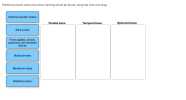 Predict the bone where the bone marking would be found, using
the click and drag.
Predict the bone where the bone marking would be found, using the click and drag. External acoustic meatus Parietal bone Temporal bone Sphenoid bone Sella turcica Forms sagittal, coronal, squamous, and lambdoid sutures Styloid process Mandibular fossa Mastoid process
Predict the bone where the bone marking would be found, using
the click and drag.
Predict the bone where the bone marking would be found, using the click and drag. External acoustic meatus Parietal bone Temporal bone Sphenoid bone Sella turcica Forms sagittal, coronal, squamous, and lambdoid sutures Styloid process Mandibular fossa Mastoid process
please answer the question as in the picture(by filling the table and note in paragraphs or sentences) NAME: FUNCTIO...
 please answer the question as in the picture(by
filling the table and note in paragraphs or sentences)
NAME: FUNCTIONS OF BONE MARKINGS MARKING BONE(S) MARKING FUNCTION articulates with it, what OCCURS ON (e.g s through it or attaches to it) External auditory meatus Mastoid process Styloid process Petrous portion Internal auditory meatus Foramen magnum Occipital condyle Sella turcica Op plate Crista galli cess Intervertebral discs Zygomatic process Temporal process Condylar process Mandibular fossa Superior articular processes Inferior articular processes Transverse...
please answer the question as in the picture(by
filling the table and note in paragraphs or sentences)
NAME: FUNCTIONS OF BONE MARKINGS MARKING BONE(S) MARKING FUNCTION articulates with it, what OCCURS ON (e.g s through it or attaches to it) External auditory meatus Mastoid process Styloid process Petrous portion Internal auditory meatus Foramen magnum Occipital condyle Sella turcica Op plate Crista galli cess Intervertebral discs Zygomatic process Temporal process Condylar process Mandibular fossa Superior articular processes Inferior articular processes Transverse...
Describe the location and function of the various joints in the body and the developmental care...
Describe the location and function of the various joints in the body and the developmental care regarding the musculoskeletal system.
Which is NOT a function of bone? - Protection - Mineral Storage - Body Movement -...
Which is NOT a function of bone? - Protection - Mineral Storage - Body Movement - Hormone synthesis - Hempoiesis
136 Review Sheet 9 2. Using choices from the numbered key to the right, identify all...
 136 Review Sheet 9 2. Using choices from the numbered key to the right, identify all bones and bone markings provided with various leader lines in the two following photographs. A colored dot at the end of a leader line indicates a bone leader lines without a colored dot indicate bone markings. Note that vomer, sphenoid bone, and zygomatic bone will each be labeled twice. Key: 1. alveolar processes 2. carotid canal 3. ethmoid bone (perpendicular plate) 4. external occipital...
Identify the tissues, describe their function and location in the body for each picture below PASSAC...
 Identify the tissues, describe their function and location in the
body for each picture below
PASSAC VESSE We were unable to transcribe this imageWe were unable to transcribe this image
Identify the tissues, describe their function and location in the
body for each picture below
PASSAC VESSE We were unable to transcribe this imageWe were unable to transcribe this image
PRE-LABORATORY WORKSHEET Chapter 8: The Skeletal System: Axial Skeleton These Pre-Laboratory Worksheet questions may be assigned...
 PRE-LABORATORY WORKSHEET Chapter 8: The Skeletal System: Axial Skeleton These Pre-Laboratory Worksheet questions may be assigned by instructors through their connect course. d in com March the description of the bone featurested in column with the appropriate name Column CA I smooth, grooved, pulele process to facet 9 2 small flat shallow, articulating surface B a large amooth and round projection C e troches prominent, rounded epiphysis of a bone 2. Which of the following are bony features that function...
Also please answer only one of the following questions: Describe the location and function of the...
Also please answer only one of the following questions: Describe the location and function of the various joints in the body and the developmental care regarding the musculoskeletal system. Describe the autonomic nervous system and how this can serve as a defense mechanism for the boy. Give an example. Please I want a new references... thanks
pls help with this paper. 2103-Review # 11 1) Function of the axial skeleton? 2) The...
 pls help with this paper.
2103-Review # 11 1) Function of the axial skeleton? 2) The four curves of the adult spinal column 3) The vertebral column 4) Part of the axial skeleton? S) What organ of lacrimal fossa? 6) The bony portion of the nasal septum is formed by the bones. 8) The hyoid bone 9] Are eye muscles composed entirely of fast fibers? 10) Fibrous connective tissue in infants. 11) The widest intervertebral discs are found in where...
pls help with this paper.
2103-Review # 11 1) Function of the axial skeleton? 2) The four curves of the adult spinal column 3) The vertebral column 4) Part of the axial skeleton? S) What organ of lacrimal fossa? 6) The bony portion of the nasal septum is formed by the bones. 8) The hyoid bone 9] Are eye muscles composed entirely of fast fibers? 10) Fibrous connective tissue in infants. 11) The widest intervertebral discs are found in where...
Find all relative extrema of the function. Use the Second Derivative Test where applicable. (If an...
 Find all relative extrema of the function. Use the Second Derivative Test where applicable. (If an answer does not exist, enter DNE.) h(t) = t - 4vt + 7 relative maximum (t, y) relative minimum (t, y)
 Predict the bone where the bone marking would be found, using
the click and drag.
Predict the bone where the bone marking would be found, using the click and drag. External acoustic meatus Parietal bone Temporal bone Sphenoid bone Sella turcica Forms sagittal, coronal, squamous, and lambdoid sutures Styloid process Mandibular fossa Mastoid process
Predict the bone where the bone marking would be found, using
the click and drag.
Predict the bone where the bone marking would be found, using the click and drag. External acoustic meatus Parietal bone Temporal bone Sphenoid bone Sella turcica Forms sagittal, coronal, squamous, and lambdoid sutures Styloid process Mandibular fossa Mastoid process
 please answer the question as in the picture(by
filling the table and note in paragraphs or sentences)
NAME: FUNCTIONS OF BONE MARKINGS MARKING BONE(S) MARKING FUNCTION articulates with it, what OCCURS ON (e.g s through it or attaches to it) External auditory meatus Mastoid process Styloid process Petrous portion Internal auditory meatus Foramen magnum Occipital condyle Sella turcica Op plate Crista galli cess Intervertebral discs Zygomatic process Temporal process Condylar process Mandibular fossa Superior articular processes Inferior articular processes Transverse...
please answer the question as in the picture(by
filling the table and note in paragraphs or sentences)
NAME: FUNCTIONS OF BONE MARKINGS MARKING BONE(S) MARKING FUNCTION articulates with it, what OCCURS ON (e.g s through it or attaches to it) External auditory meatus Mastoid process Styloid process Petrous portion Internal auditory meatus Foramen magnum Occipital condyle Sella turcica Op plate Crista galli cess Intervertebral discs Zygomatic process Temporal process Condylar process Mandibular fossa Superior articular processes Inferior articular processes Transverse...
 136 Review Sheet 9 2. Using choices from the numbered key to the right, identify all bones and bone markings provided with various leader lines in the two following photographs. A colored dot at the end of a leader line indicates a bone leader lines without a colored dot indicate bone markings. Note that vomer, sphenoid bone, and zygomatic bone will each be labeled twice. Key: 1. alveolar processes 2. carotid canal 3. ethmoid bone (perpendicular plate) 4. external occipital...
 Identify the tissues, describe their function and location in the
body for each picture below
PASSAC VESSE We were unable to transcribe this imageWe were unable to transcribe this image
Identify the tissues, describe their function and location in the
body for each picture below
PASSAC VESSE We were unable to transcribe this imageWe were unable to transcribe this image
 PRE-LABORATORY WORKSHEET Chapter 8: The Skeletal System: Axial Skeleton These Pre-Laboratory Worksheet questions may be assigned by instructors through their connect course. d in com March the description of the bone featurested in column with the appropriate name Column CA I smooth, grooved, pulele process to facet 9 2 small flat shallow, articulating surface B a large amooth and round projection C e troches prominent, rounded epiphysis of a bone 2. Which of the following are bony features that function...
 pls help with this paper.
2103-Review # 11 1) Function of the axial skeleton? 2) The four curves of the adult spinal column 3) The vertebral column 4) Part of the axial skeleton? S) What organ of lacrimal fossa? 6) The bony portion of the nasal septum is formed by the bones. 8) The hyoid bone 9] Are eye muscles composed entirely of fast fibers? 10) Fibrous connective tissue in infants. 11) The widest intervertebral discs are found in where...
pls help with this paper.
2103-Review # 11 1) Function of the axial skeleton? 2) The four curves of the adult spinal column 3) The vertebral column 4) Part of the axial skeleton? S) What organ of lacrimal fossa? 6) The bony portion of the nasal septum is formed by the bones. 8) The hyoid bone 9] Are eye muscles composed entirely of fast fibers? 10) Fibrous connective tissue in infants. 11) The widest intervertebral discs are found in where...
 Find all relative extrema of the function. Use the Second Derivative Test where applicable. (If an answer does not exist, enter DNE.) h(t) = t - 4vt + 7 relative maximum (t, y) relative minimum (t, y)
Most questions answered within 3 hours.
-
Where is the error in this code sequence?
String s1 = "Hello";
String s2 = "ello";...
asked 10 months ago -
Financial data for Joel de Paris, Inc., for last year
follow:
Joel de Paris, Inc.
Balance...
asked 10 months ago -
Consider this reaction:
Al2(SO4)3 (aq)+ BaCl3
(aq) Al2Cl6 (aq)- +
3BaSO4(s) . What is the...
asked 10 months ago -
Suppose that Savneet is considering increasing her
recent random sample from 20 car rentals to 40...
asked 10 months ago -
Trucks arrive at an unloading terminal at an average rate of 120
per hour.
Trucks arrive...
asked 10 months ago -
Why are methanol and ethanol completely soluble in water while
octanol is not very little soluble....
asked 10 months ago -
A facilities manager at a university reads in a research report
that the mean amount of...
asked 10 months ago -
When the CuSO4 is rehydrated by adding water to the anhydrous
compound, is this an endothermic...
asked 10 months ago -
A ray of sunlight is passing from diamond into crown glass; the
angle of incidence is...
asked 10 months ago -
A block of mass 0.249 kg is placed on top of a light, vertical
spring of...
asked 10 months ago -
how do the kidneys compensate in the presences of acidosis
a) trigger hyperventilate
b) reserve acid...
asked 10 months ago -
Question 501 pts
The rental rate of capital to the firm increases. Which of the
following...
asked 10 months ago