
Homework Answers
Add Answer to:
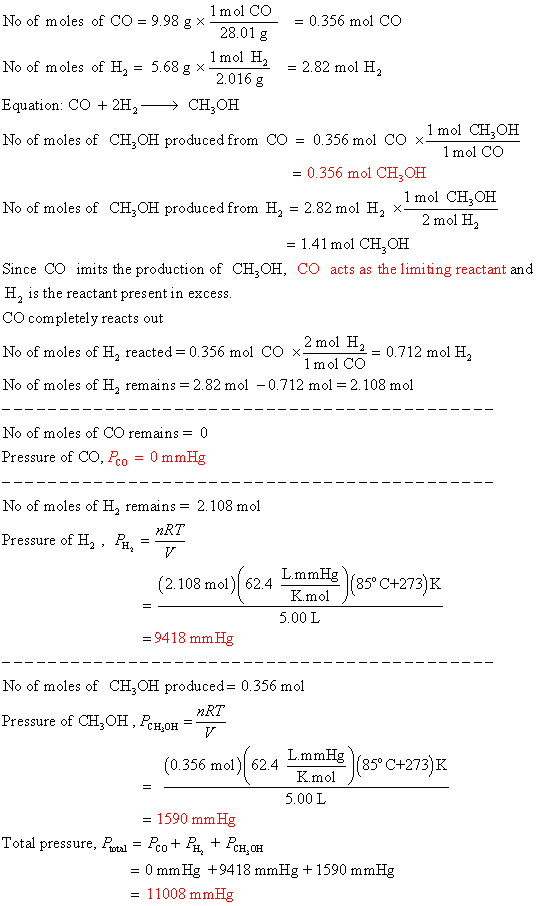
A mass of 9.98 g carbon monoxide is reacted with 5.68 g hydrogen to form methanol....
A mass of 1.49 g carbon monoxide is reacted with 6.32 g hydrogen to form methanol....
A mass of 1.49 g carbon monoxide is reacted with 6.32 g hydrogen to form methanol. CO(g) + 2 H2(g) → CH3OH(g) The reaction is performed in a 5.00 L flask at 85.0 °C and proceeds to completion. What is the partial pressure (in mmHg) of each of the three species following completion of the reaction? What is the total pressure in the flask? CO ? mmHg H2 ? mmHg CH3OH ? mmHg Total ? mmHg
Carbon monoxide gas reacts with hydrogen gas to form methanol via the following reaction: CO(g)+2H2(g)→CH3OH(g) A...
Carbon monoxide gas reacts with hydrogen gas to form methanol via the following reaction: CO(g)+2H2(g)→CH3OH(g) A 1.70 L reaction vessel, initially at 305 K, contains carbon monoxide gas at a partial pressure of 232 mmHg and hydrogen gas at a partial pressure of 355 mmHg . Identify the limiting reactant and determine the theoretical yield of methanol in grams
Carbon monoxide gas reacts with hydrogen gas to form methanol via the following reaction: CO(g)+2H2(g)→CH3OH(g) A...
Carbon monoxide gas reacts with hydrogen gas to form methanol via the following reaction: CO(g)+2H2(g)→CH3OH(g) A 1.15 L reaction vessel, initially at 305 K, contains carbon monoxide gas at a partial pressure of 232 mmHg and hydrogen gas at a partial pressure of 375 mmHg . Identify the limiting reactant and determine the theoretical yield of methanol in grams.
1.Carbon monoxide gas reacts with hydrogen gas to form methanol via the following reaction: CO(g)+2H2(g)→CH3OH(g)CO(g)+2H2(g)→CH3OH(g) A...
1.Carbon monoxide gas reacts with hydrogen gas to form methanol via the following reaction: CO(g)+2H2(g)→CH3OH(g)CO(g)+2H2(g)→CH3OH(g) A 1.65 LL reaction vessel, initially at 305 KK, contains carbon monoxide gas at a partial pressure of 232 mmHg and hydrogen gas at a partial pressure of 395 mmHg. Identify the limiting reactant and determine the theoretical yield of methanol in grams. Express your answer with the appropriate units. 2. What is the pressure in a 12.0-LL cylinder filled with 39.5 g of oxygen...
52. A high temperatures carbon monoxide and hydrogen react to produce methanol, CO(g) + 2H2(g) CHOH(g)...
 52. A high temperatures carbon monoxide and hydrogen react to produce methanol, CO(g) + 2H2(g) CHOH(g) Δ}":-129 klinol Suppose that in an industrial reactor, the reaction is at equilibrium. For each of the following changes made to the equilibrium system a. The partial pressure of hydrogen is lowered, how will the partial pressures of b. Methanol is rapidly removed from the reactor, how will the pressures of the c· The temperature remains constant while the volume decreases, compressing d. The...
10.Methanol (CH3OH) is produced commercially by the catalyzed reaction of carbon monoxide and hydrogen: CO(g)+2H2(g)⇌CH3OH(g) ....
10.Methanol (CH3OH) is produced commercially by the catalyzed reaction of carbon monoxide and hydrogen: CO(g)+2H2(g)⇌CH3OH(g) . An equilibrium mixture in a 1.50 L vessel is found to contain 0.0675 mol CH3OH , 0.160 mol CO , and 0.301 mol H2 at 500 K . Calculate Kc at this temperature.
please place the terms into the correct bin The synthesis of methanol from carbon monoxide and...
 please place the terms into the correct bin
The synthesis of methanol from carbon monoxide and hydrogen gas is described by the following chemical equation: CO(g) + 2H2(g) = CH3OH(g) The equilibrium constant for this reaction at 25 ° C is K. = 2.3 x 10". In this tutorial, you will use the equilibrium-constant expression to find the concentration of methanol at equilibrium, given the concentration of the reactants. CH3OH) H2] CO Numerator Denominator Not used
please place the terms into the correct bin
The synthesis of methanol from carbon monoxide and hydrogen gas is described by the following chemical equation: CO(g) + 2H2(g) = CH3OH(g) The equilibrium constant for this reaction at 25 ° C is K. = 2.3 x 10". In this tutorial, you will use the equilibrium-constant expression to find the concentration of methanol at equilibrium, given the concentration of the reactants. CH3OH) H2] CO Numerator Denominator Not used
A mixture of carbon monoxide, hydrogen, and methanol, CH, OH, is at equilibrium according to the...
 A mixture of carbon monoxide, hydrogen, and methanol, CH, OH, is at equilibrium according to the equation CO(g) + 2H2 (9) = CH3OH(9) At 270°C, the mixture is 5.0 x 10⁻² M CO.0.760 M H2, and 9.8 x 10⁻³ M CH3OH What is Ke for this reaction at 270°C? Ke= When 0.125 mol of NO and 18.50 g of bromine are placed in a 1.00-L reaction vessel and sealed, the mixture is heated to 350 K and the following equilibrium...
4.66. Methanol is formed from carbon monoxide and hydrogen in the gas-phase reaction CO 2H2 CH3OH...
 4.66. Methanol is formed from carbon monoxide and hydrogen in the gas-phase reaction CO 2H2 CH3OH (A) (B) (C) The mole fractions of the reactive species at equilibrium satisfy the relation 1 = Ke(T where P is the total pressure (atm), Ke the reaction equilibrium constant (atm2), and T the temperature (K). The equilibrium constant Ke equals 10.5 at 373 K, and 2.316 x 10⁻⁴ at 573 K. A semilog plot of Ke (logarithmic scale) versus 1/T (rectangular scale) is...
Methanol is obtained from carbon monoxide and hydrogen, according to: Suppose 100 m3/h of reagent mixture...
 Methanol is obtained from carbon monoxide and hydrogen,
according to:
Suppose 100 m3/h of reagent mixture is fed in
stoichiometric amounts, at 35°C and 1 atm. If 17.2 kW of heat is
removed from the reactor, determine the conversion rate (using four
decimal places) of the reaction when the outlet temperature is
135°C.
CO(g) + H2 - CH3OH (9)
Methanol is obtained from carbon monoxide and hydrogen,
according to:
Suppose 100 m3/h of reagent mixture is fed in
stoichiometric amounts, at 35°C and 1 atm. If 17.2 kW of heat is
removed from the reactor, determine the conversion rate (using four
decimal places) of the reaction when the outlet temperature is
135°C.
CO(g) + H2 - CH3OH (9)
 52. A high temperatures carbon monoxide and hydrogen react to produce methanol, CO(g) + 2H2(g) CHOH(g) Δ}":-129 klinol Suppose that in an industrial reactor, the reaction is at equilibrium. For each of the following changes made to the equilibrium system a. The partial pressure of hydrogen is lowered, how will the partial pressures of b. Methanol is rapidly removed from the reactor, how will the pressures of the c· The temperature remains constant while the volume decreases, compressing d. The...
 please place the terms into the correct bin
The synthesis of methanol from carbon monoxide and hydrogen gas is described by the following chemical equation: CO(g) + 2H2(g) = CH3OH(g) The equilibrium constant for this reaction at 25 ° C is K. = 2.3 x 10". In this tutorial, you will use the equilibrium-constant expression to find the concentration of methanol at equilibrium, given the concentration of the reactants. CH3OH) H2] CO Numerator Denominator Not used
please place the terms into the correct bin
The synthesis of methanol from carbon monoxide and hydrogen gas is described by the following chemical equation: CO(g) + 2H2(g) = CH3OH(g) The equilibrium constant for this reaction at 25 ° C is K. = 2.3 x 10". In this tutorial, you will use the equilibrium-constant expression to find the concentration of methanol at equilibrium, given the concentration of the reactants. CH3OH) H2] CO Numerator Denominator Not used
 A mixture of carbon monoxide, hydrogen, and methanol, CH, OH, is at equilibrium according to the equation CO(g) + 2H2 (9) = CH3OH(9) At 270°C, the mixture is 5.0 x 10⁻² M CO.0.760 M H2, and 9.8 x 10⁻³ M CH3OH What is Ke for this reaction at 270°C? Ke= When 0.125 mol of NO and 18.50 g of bromine are placed in a 1.00-L reaction vessel and sealed, the mixture is heated to 350 K and the following equilibrium...
 4.66. Methanol is formed from carbon monoxide and hydrogen in the gas-phase reaction CO 2H2 CH3OH (A) (B) (C) The mole fractions of the reactive species at equilibrium satisfy the relation 1 = Ke(T where P is the total pressure (atm), Ke the reaction equilibrium constant (atm2), and T the temperature (K). The equilibrium constant Ke equals 10.5 at 373 K, and 2.316 x 10⁻⁴ at 573 K. A semilog plot of Ke (logarithmic scale) versus 1/T (rectangular scale) is...
 Methanol is obtained from carbon monoxide and hydrogen,
according to:
Suppose 100 m3/h of reagent mixture is fed in
stoichiometric amounts, at 35°C and 1 atm. If 17.2 kW of heat is
removed from the reactor, determine the conversion rate (using four
decimal places) of the reaction when the outlet temperature is
135°C.
CO(g) + H2 - CH3OH (9)
Methanol is obtained from carbon monoxide and hydrogen,
according to:
Suppose 100 m3/h of reagent mixture is fed in
stoichiometric amounts, at 35°C and 1 atm. If 17.2 kW of heat is
removed from the reactor, determine the conversion rate (using four
decimal places) of the reaction when the outlet temperature is
135°C.
CO(g) + H2 - CH3OH (9)
Most questions answered within 3 hours.
-
Where is the error in this code sequence?
String s1 = "Hello";
String s2 = "ello";...
asked 11 months ago -
Financial data for Joel de Paris, Inc., for last year
follow:
Joel de Paris, Inc.
Balance...
asked 11 months ago -
Consider this reaction:
Al2(SO4)3 (aq)+ BaCl3
(aq) Al2Cl6 (aq)- +
3BaSO4(s) . What is the...
asked 11 months ago -
Suppose that Savneet is considering increasing her
recent random sample from 20 car rentals to 40...
asked 11 months ago -
Trucks arrive at an unloading terminal at an average rate of 120
per hour.
Trucks arrive...
asked 11 months ago -
Why are methanol and ethanol completely soluble in water while
octanol is not very little soluble....
asked 11 months ago -
A facilities manager at a university reads in a research report
that the mean amount of...
asked 11 months ago -
When the CuSO4 is rehydrated by adding water to the anhydrous
compound, is this an endothermic...
asked 11 months ago -
A ray of sunlight is passing from diamond into crown glass; the
angle of incidence is...
asked 11 months ago -
A block of mass 0.249 kg is placed on top of a light, vertical
spring of...
asked 11 months ago -
how do the kidneys compensate in the presences of acidosis
a) trigger hyperventilate
b) reserve acid...
asked 11 months ago -
Question 501 pts
The rental rate of capital to the firm increases. Which of the
following...
asked 11 months ago