
Homework Answers

Add Answer to:
NL HR 7. Kodelis acondensation polymer made from terephthalic acid and 14-cyclohexanedimethanol. Write the structure of...
Kodel is a condensation polymer made from terephthalic acid and 1,4-cyclohexanedimethanol. Write the structure of the...
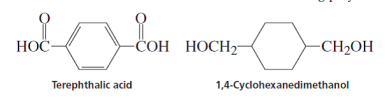 Kodel is a condensation polymer made from terephthalic acid and 1,4-cyclohexanedimethanol. Write the structure of the resulting polymer.
1. Draw the polymer that would be made from the monomer vinylidene chloride (CH2=CCl2). 2. Draw the structure of the pol...
1. Draw the polymer that would be made from the monomer vinylidene chloride (CH2=CCl2). 2. Draw the structure of the polymer that would be produced from the condensation polymerization of maleic anhydride with ethylene glycol. 3. Draw the structure of the polymer that would be produced from the condensation polymerization of terephthalic acid with 1,4-cyclohexane-dimethanol.
Kodel is a condensation polymer made from terphthalic acid and1,4-cyclohexandimethanol. Write the structure of the resultingpolymer...
Kodel is a condensation polymer made from terphthalic acid and1,4-cyclohexandimethanol. Write the structure of the resultingpolymer .
* Discussion Questions, continued. Kodel"is a condensation polymer produced by the co-polymerization of the two monomer...
 * Discussion Questions, continued. Kodel"is a condensation polymer produced by the co-polymerization of the two monomer molecules shown below Draw the 1,4-dihydroxymethyleyclohexane and rwo of terephthalic acid, in alternating order). Identify the two reactant functional groups, and the functional group of the linkage that's formed. When the polymer forms, thousands of these molecules link together (in alternating order) via condensation reactions. structure of a portion of a "Kodel"molecule by linking together FOUR of the reactant molecules (nwvo of он н...
Draw the structure of the polymer that could be made from the following monomer. ball &...
 Draw the structure of the polymer that could be made from the following monomer. ball & stick labels You do not have to consider stereochemistry. You do not have to explicitly draw H atoms. Do not include lone pairs in your answer. They will not be considered in the grading. In cases where there is more than one answer, just draw one Use R1 groups to indicate the points where the polymer repeats. The R group tool is located in...
Draw the monomer unit(s) from which the following polymer is made. tom7 . In the case...
 Draw the monomer unit(s) from which the following polymer is made. tom7 . In the case of a reactive acyl monomer, draw a methyl ester. • Draw one structure per sketcher. Add additional sketchers using the drop-down menu in the bottom right com • Separate structures with + signs from the drop-down menu. - -/ -O0O- Chemde
1. A. Draw out the polymer made from 3 molecules of propanedioic acid and 3 molecules...
 1. A. Draw out the polymer made from 3 molecules of propanedioic acid and 3 molecules of ethane-1,2-diamine B. What's the by-product of this reaction? C. Break up polyester, below, into its monomers n
Questions for Experiment 8: Preparation and Properties of Polymers - Polyester and Nylon 1. Which polyester...
 Questions for Experiment 8: Preparation and Properties of Polymers - Polyester and Nylon 1. Which polyester should be theoretically more rigid, the one obtained from ethylene glycol or the one from glycerol? Why? Explain with structural arguments. 2. Draw the structure for the polymer produced from the monomer vinylidene chloride CH-00) 3. Draw the structure of the copolymer produced from vinyl acetate and vinyl chloride. This copolymer is employed in some paints, adhesives, and paper coatings 00CH, CI coc Vinyl...
Q1. The following data was reported for the fractionation of a polyester made from sebacic acid...
 Q1. The following data was reported for the fractionation of a polyester made from sebacic acid and 1,6-hexanediol. (10 marks) Molecular weight range (g/mol) Fractions 8000-16000 16000-24000 24000-32000 32 40000-48000 48000-56000 0.05 0.16 0.24 0.28 0.20 0.07 (I)Draw the structure of the monomers and the polymer. (II)Identify the repeat unit (II) Identify the functionality of the monomers (IV) Evaluate Mn, Mw and the D (V)Calculate the degree of polymerization of the polymer Q2. A polymer mixture is prepared by mixing...
7. One way for the triarylaminium cation radical mediated oxidation of Ar CH2OH to form ArCHO begins in Art Ar the manner shown here. (a) Draw a structure resulting from the curly arrow formalism. (b...
 7. One way for the triarylaminium cation radical mediated oxidation of Ar CH2OH to form ArCHO begins in Art Ar the manner shown here. (a) Draw a structure resulting from the curly arrow formalism. (b) Continue the sequence, the next two steps being loss of a proton and an electron. Draw the resulting structure. That structure when treated with a base (B: ) leads to the aldehyde and Ar3N: (the neutral form of the mediator). (c) Use the curly arrow...
 Kodel is a condensation polymer made from terephthalic acid and 1,4-cyclohexanedimethanol. Write the structure of the resulting polymer.
 * Discussion Questions, continued. Kodel"is a condensation polymer produced by the co-polymerization of the two monomer molecules shown below Draw the 1,4-dihydroxymethyleyclohexane and rwo of terephthalic acid, in alternating order). Identify the two reactant functional groups, and the functional group of the linkage that's formed. When the polymer forms, thousands of these molecules link together (in alternating order) via condensation reactions. structure of a portion of a "Kodel"molecule by linking together FOUR of the reactant molecules (nwvo of он н...
 Draw the structure of the polymer that could be made from the following monomer. ball & stick labels You do not have to consider stereochemistry. You do not have to explicitly draw H atoms. Do not include lone pairs in your answer. They will not be considered in the grading. In cases where there is more than one answer, just draw one Use R1 groups to indicate the points where the polymer repeats. The R group tool is located in...
 Draw the monomer unit(s) from which the following polymer is made. tom7 . In the case of a reactive acyl monomer, draw a methyl ester. • Draw one structure per sketcher. Add additional sketchers using the drop-down menu in the bottom right com • Separate structures with + signs from the drop-down menu. - -/ -O0O- Chemde
 1. A. Draw out the polymer made from 3 molecules of propanedioic acid and 3 molecules of ethane-1,2-diamine B. What's the by-product of this reaction? C. Break up polyester, below, into its monomers n
 Questions for Experiment 8: Preparation and Properties of Polymers - Polyester and Nylon 1. Which polyester should be theoretically more rigid, the one obtained from ethylene glycol or the one from glycerol? Why? Explain with structural arguments. 2. Draw the structure for the polymer produced from the monomer vinylidene chloride CH-00) 3. Draw the structure of the copolymer produced from vinyl acetate and vinyl chloride. This copolymer is employed in some paints, adhesives, and paper coatings 00CH, CI coc Vinyl...
 Q1. The following data was reported for the fractionation of a polyester made from sebacic acid and 1,6-hexanediol. (10 marks) Molecular weight range (g/mol) Fractions 8000-16000 16000-24000 24000-32000 32 40000-48000 48000-56000 0.05 0.16 0.24 0.28 0.20 0.07 (I)Draw the structure of the monomers and the polymer. (II)Identify the repeat unit (II) Identify the functionality of the monomers (IV) Evaluate Mn, Mw and the D (V)Calculate the degree of polymerization of the polymer Q2. A polymer mixture is prepared by mixing...
 7. One way for the triarylaminium cation radical mediated oxidation of Ar CH2OH to form ArCHO begins in Art Ar the manner shown here. (a) Draw a structure resulting from the curly arrow formalism. (b) Continue the sequence, the next two steps being loss of a proton and an electron. Draw the resulting structure. That structure when treated with a base (B: ) leads to the aldehyde and Ar3N: (the neutral form of the mediator). (c) Use the curly arrow...
Most questions answered within 3 hours.
-
Where is the error in this code sequence?
String s1 = "Hello";
String s2 = "ello";...
asked 10 months ago -
Financial data for Joel de Paris, Inc., for last year
follow:
Joel de Paris, Inc.
Balance...
asked 10 months ago -
Consider this reaction:
Al2(SO4)3 (aq)+ BaCl3
(aq) Al2Cl6 (aq)- +
3BaSO4(s) . What is the...
asked 10 months ago -
Suppose that Savneet is considering increasing her
recent random sample from 20 car rentals to 40...
asked 10 months ago -
Trucks arrive at an unloading terminal at an average rate of 120
per hour.
Trucks arrive...
asked 10 months ago -
Why are methanol and ethanol completely soluble in water while
octanol is not very little soluble....
asked 10 months ago -
A facilities manager at a university reads in a research report
that the mean amount of...
asked 10 months ago -
When the CuSO4 is rehydrated by adding water to the anhydrous
compound, is this an endothermic...
asked 10 months ago -
A ray of sunlight is passing from diamond into crown glass; the
angle of incidence is...
asked 10 months ago -
A block of mass 0.249 kg is placed on top of a light, vertical
spring of...
asked 10 months ago -
how do the kidneys compensate in the presences of acidosis
a) trigger hyperventilate
b) reserve acid...
asked 10 months ago -
Question 501 pts
The rental rate of capital to the firm increases. Which of the
following...
asked 10 months ago