Kodel is a condensation polymer made from terphthalic acid and1,4-cyclohexandimethanol. Write the structure of the resultingpolymer...
Homework Answers


Add Answer to:
Kodel is a condensation polymer made from terphthalic acid
and1,4-cyclohexandimethanol. Write the structure of the
resultingpolymer...
Kodel is a condensation polymer made from terephthalic acid and 1,4-cyclohexanedimethanol. Write the structure of the...
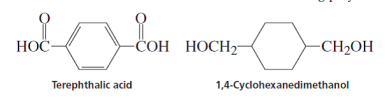 Kodel is a condensation polymer made from terephthalic acid and 1,4-cyclohexanedimethanol. Write the structure of the resulting polymer.
NL HR 7. Kodelis acondensation polymer made from terephthalic acid and 14-cyclohexanedimethanol. Write the structure of...
 NL HR 7. Kodelis acondensation polymer made from terephthalic acid and 14-cyclohexanedimethanol. Write the structure of the resulting polymer. COH HOCHZ CH2OH HOC Terephthalic add 1,4-Cydohexanedimethanol
1. Draw the polymer that would be made from the monomer vinylidene chloride (CH2=CCl2). 2. Draw the structure of the pol...
1. Draw the polymer that would be made from the monomer vinylidene chloride (CH2=CCl2). 2. Draw the structure of the polymer that would be produced from the condensation polymerization of maleic anhydride with ethylene glycol. 3. Draw the structure of the polymer that would be produced from the condensation polymerization of terephthalic acid with 1,4-cyclohexane-dimethanol.
0. A fragment of the polymer, Dacron, is shown below. Dacron is made by condensation polymerization...
 0. A fragment of the polymer, Dacron, is shown below. Dacron is made by condensation polymerization of 2 monomers that combine in-A-B-A-B-A-B- structure similar to nylon. a. Draw brackets around one polymer unit in the structure below. b. Draw the structures of 2 difunctional monomers A and B that would underg polymerization to produce this polymer A= x-R-X and B-y-R,-y Identify the small molecule byproduct of condensation. 4 pts o condensation c. Ax-R-x B- y-R'-y Byproduct A fragment of the...
What kind of polymer (if any) is produced by a condensation reaction involving the following reactants? Write its che...
 What kind of polymer (if any) is produced by a condensation reaction involving the following reactants? Write its chemical structure if the reaction forms a linear polymer: terephthalic acid glycerol а) Он НО но. Он + НО b) aminohexanoic acid H2N СООН n pyromellitic dianhydride ethanamine c) H2N n
* Discussion Questions, continued. Kodel"is a condensation polymer produced by the co-polymerization of the two monomer...
 * Discussion Questions, continued. Kodel"is a condensation polymer produced by the co-polymerization of the two monomer molecules shown below Draw the 1,4-dihydroxymethyleyclohexane and rwo of terephthalic acid, in alternating order). Identify the two reactant functional groups, and the functional group of the linkage that's formed. When the polymer forms, thousands of these molecules link together (in alternating order) via condensation reactions. structure of a portion of a "Kodel"molecule by linking together FOUR of the reactant molecules (nwvo of он н...
Write a mechanism for the acid–catalysed condensation of acetone. Looking at the structure of this product, and of ethyl...
Write a mechanism for the acid–catalysed condensation of acetone. Looking at the structure of this product, and of ethylenediamine, suggest how the macrocyclic ligand might form. Can you provide answer for this question, the macro ligand was prepared from ethylenediamine, 50% tetrafluoroboric acid.
Examine the structure of the Kevlar polymer shown below. Polat Part A Knowing that the polymer...
 Examine the structure of the Kevlar polymer shown below. Polat Part A Knowing that the polymer is a condensation polymer, draw the structures of its monomers before the condensation reaction. Draw the molecules on the canvas by choosing buttons from the Tools (for bonds and charges), Atoms, and Templates toolbars. H: 20 EXP"conto H с N Tz O S ( CI ch Marvin JS Br (1) A Chemax
I. Nylon 6-6 is a condensation polymer. The last two lab handouts pointed out that "condensation...
 I. Nylon 6-6 is a condensation polymer. The last two lab handouts pointed out that "condensation reactions are extremely common among a variety of organic functional groups." Pick two appropriate functional groups (your choice) and draw structures to show the condensation reaction between them. Identify the functional groups that are reacting, as well as the linkage formed by the condensation. 2. Rather than use a carboxylic acid for the nylon condensation, you'll use the more reactive acid chloride. This must...
The process of forming a polymer from monomers is called polymerization. Polymerization is achieved through condensation...
The process of forming a polymer from monomers is called polymerization. Polymerization is achieved through condensation reactions. Which of the following is true concerning the energy requirements of condensation reactions? Question 2 options: A) condensation reactions do not require the input of energy because they result in the formation of covalent bonds between monomers and result in the liberation of water B) the covalent bonds generated by condensation reactions are easily broken by water and thus do not require the...
 Kodel is a condensation polymer made from terephthalic acid and 1,4-cyclohexanedimethanol. Write the structure of the resulting polymer.
 NL HR 7. Kodelis acondensation polymer made from terephthalic acid and 14-cyclohexanedimethanol. Write the structure of the resulting polymer. COH HOCHZ CH2OH HOC Terephthalic add 1,4-Cydohexanedimethanol
 0. A fragment of the polymer, Dacron, is shown below. Dacron is made by condensation polymerization of 2 monomers that combine in-A-B-A-B-A-B- structure similar to nylon. a. Draw brackets around one polymer unit in the structure below. b. Draw the structures of 2 difunctional monomers A and B that would underg polymerization to produce this polymer A= x-R-X and B-y-R,-y Identify the small molecule byproduct of condensation. 4 pts o condensation c. Ax-R-x B- y-R'-y Byproduct A fragment of the...
 What kind of polymer (if any) is produced by a condensation reaction involving the following reactants? Write its chemical structure if the reaction forms a linear polymer: terephthalic acid glycerol а) Он НО но. Он + НО b) aminohexanoic acid H2N СООН n pyromellitic dianhydride ethanamine c) H2N n
 * Discussion Questions, continued. Kodel"is a condensation polymer produced by the co-polymerization of the two monomer molecules shown below Draw the 1,4-dihydroxymethyleyclohexane and rwo of terephthalic acid, in alternating order). Identify the two reactant functional groups, and the functional group of the linkage that's formed. When the polymer forms, thousands of these molecules link together (in alternating order) via condensation reactions. structure of a portion of a "Kodel"molecule by linking together FOUR of the reactant molecules (nwvo of он н...
 Examine the structure of the Kevlar polymer shown below. Polat Part A Knowing that the polymer is a condensation polymer, draw the structures of its monomers before the condensation reaction. Draw the molecules on the canvas by choosing buttons from the Tools (for bonds and charges), Atoms, and Templates toolbars. H: 20 EXP"conto H с N Tz O S ( CI ch Marvin JS Br (1) A Chemax
 I. Nylon 6-6 is a condensation polymer. The last two lab handouts pointed out that "condensation reactions are extremely common among a variety of organic functional groups." Pick two appropriate functional groups (your choice) and draw structures to show the condensation reaction between them. Identify the functional groups that are reacting, as well as the linkage formed by the condensation. 2. Rather than use a carboxylic acid for the nylon condensation, you'll use the more reactive acid chloride. This must...
Most questions answered within 3 hours.
-
Where is the error in this code sequence?
String s1 = "Hello";
String s2 = "ello";...
asked 10 months ago -
Financial data for Joel de Paris, Inc., for last year
follow:
Joel de Paris, Inc.
Balance...
asked 10 months ago -
Consider this reaction:
Al2(SO4)3 (aq)+ BaCl3
(aq) Al2Cl6 (aq)- +
3BaSO4(s) . What is the...
asked 10 months ago -
Suppose that Savneet is considering increasing her
recent random sample from 20 car rentals to 40...
asked 10 months ago -
Trucks arrive at an unloading terminal at an average rate of 120
per hour.
Trucks arrive...
asked 10 months ago -
Why are methanol and ethanol completely soluble in water while
octanol is not very little soluble....
asked 10 months ago -
A facilities manager at a university reads in a research report
that the mean amount of...
asked 10 months ago -
When the CuSO4 is rehydrated by adding water to the anhydrous
compound, is this an endothermic...
asked 10 months ago -
A ray of sunlight is passing from diamond into crown glass; the
angle of incidence is...
asked 10 months ago -
A block of mass 0.249 kg is placed on top of a light, vertical
spring of...
asked 10 months ago -
how do the kidneys compensate in the presences of acidosis
a) trigger hyperventilate
b) reserve acid...
asked 10 months ago -
Question 501 pts
The rental rate of capital to the firm increases. Which of the
following...
asked 10 months ago