I'm looking for 5 articles from magazine about operational budgeting
I'm looking for 5 articles from magazine about operational budgeting
Homework Answers
ARTICLE 1: OPERATIONAL BUDGETING
What Is an Operating Budget?
An operating budget shows the company's projected revenue and associated expenses for an upcoming period -- usually the next year -- and is often presented in an income statement format. Usually, management goes through the process of compiling the budget before the start of each year, and then makes ongoing updates each month. An operating budget might consist of a high-level summary schedule, supported by detail to back up each line item in the budget.
OPERATING BUDGET COMPONENTS
An operating budget starts with revenue, and then shows each expense type. This includes variable costs, or the costs that vary with sales, such as the cost of raw materials and production labor. The operating budget includes fixed costs, such as the monthly rent on office space or the monthly payment for a photocopier lease. The budget also includes operating expenses, such as interest on business loans, and the non-cash expense of depreciation. These items enable the company to compute its projected net income and net profit percentage.
THE BUDGET IN ACTION
The budget-assembling process can be time-consuming, especially as it becomes more detailed in large, complex businesses. Historical performance always serves as the foundation for forward-looking budget numbers. Once the budget is finished, accountants typically produce a monthly report that shows the company's actual performance for the month, along with the month's budgeted numbers, for comparison and analysis. The analysis includes asking and answering questions such as the following:
- Are we meeting or beating our sales targets?
- Did we have any expenses that we didn't include in the budget?
- Have we projected costs fairly well, or do we have cost overruns that need immediate attention?
Asking and answering these types of questions will help management plan better so that they can make changes each month, quarter and year, which enables them to guide the company toward better performance.
GETTING INTO THE DETAILS
Although it is efficient to construct a high-level budget, having greater detail helps improve the budget's relevance, while also adding value when it is used to guide the company's financial decisions. For example, human resources would assemble an in-depth budget that includes updated calculations for certain benefits, costs for each new hire, and other details that they work with regularly. The company purchasing department would be the most familiar with the cost of raw goods and issues that affect the accuracy of its budget, such as price-cut opportunities, seasonal inventory buying costs or external events that cause fluctuating prices for certain inventory.
USING THE BUDGET VS. FORECAST
The further out a company makes its budget, the less accurate the information. Budgets represent a company's target, or where it would like to go with its business. Companies use another very similar tool -- forecasting, to project the "reality" view of where the company is actually headed. For example, the sales department might have a budget that has an annual sales target of just over $5 million and with monthly goals of $420,000.
Accountants would then take actual results each month, and would then forecast the rest of the year accordingly. The forecast might reflect that the company is actually only earning about $350,000 in sales each month, showing a forecasted revenue of closer to $4.2 million for the year, instead of the budget target of $5 million. This knowledge helps management choose different strategies early in the year so that the company can make changes that could better help them reach their budget target.
ARTICLE #2: OPERATING BUDGETING
WHAT ARE BENEFITS OF AN OPERATING BUDGET?
An operating budget helps you plan for the day-to-day operations of your business so you don’t run into a financial ditch. Although most budgets are written a year in advance and are based on projections, monthly or quarterly tweaking keeps you more finely tuned to how it actually unfolds. It isn't difficult to explain the benefits of creating a spending plan. Budget benefits include tracking actual expenses, projecting future expenses, allowing you to build investments and promoting accountability.
MANAGING CURRENT EXPENSES
The importance of operating budgets is evident as you manage current expenses. Fixed overhead costs, such as office rent and staff salaries, are a starting point for an operating budget. These are not the types of expenses that can be trimmed from your budget, unless you can reduce your staff or work hours. This can happen naturally when an employee leaves, if you can find reasonable ways to cover that employee's work duties without hiring for the position. Of course, it's important not to overburden current employees just to save money. Perhaps you can hire a lower level employee at a lower salary, who can be trained to do a lot of the work, and redistribute the rest to current employees. You may find, upon examination, that the tasks of the position have changed through automation, for example, so it isn't necessary for a new employee to take all the old responsibilities on. Also, if you actively track some of your operating expenses, such as the cost of office supplies, you may find areas of considerable savings that could benefit your total budget and ease some financial strain.
PROJECTING FUTURE EXPENSES
Evaluating actual past and current expenses can benefit your budget going forward. If you underestimated last year’s or last quarter’s operating expenses, you can write your new operating budget so it more closely aligns with the actual needs of your business. Conversely, if you overestimated past expenses, pare down the line items in your budget that correspond to unnecessary costs. You can apply these overages to other areas that were deficient in your previous budget or increase your projected reserves. Projecting future expenses is somewhat like getting a "do-over," where you can use hindsight to compensate for past budgeting mistakes going forward.
BUILDING FINANCIAL RESERVES
An operating budget should be liberating instead of restricting. It can help you reduce debt as you work toward a goal of building financial reserves. Saving, investing and planning for unforeseen circumstances are solid benefits of a successful operating budget. Sometimes your income may be unexpectedly reduced, although your operating costs remain the same, when contracts fall through or inventory doesn’t move as expected. If you’ve built your budget around being able to keep some cash reserves, your business can more easily endure temporary setbacks.
BUDGET BENEFITS OF INCREASING ACCOUNTABILITY
You can rein in your tendency to spend beyond your means if you diligently stick to an operating budget. With a well-written and closely followed operating budget, you can establish financial accountability instead of spending haphazardly and losing sight of your goals. This kind of budget is not meant to be outlined on paper and then filed away in the bottom drawer for future review. Your accountability in keeping the operating budget timely requires your ongoing involvement.
ARTICLE #3: OPERATING BUDGETING
OPERATING BUDGET
Operational budgets are not the same as capital budgets. Capital budgets estimate the capital needed to complete a project, such as acquiring real estate or new equipment, or repairs that are unanticipated or extraordinary. Operating budgets provide reasonably good estimates concerning the volume and sources associated with:
- the types and amounts of future expenses necessary to continue daily business, project, operations, such as equipment expenditures and salaries, and
- future income generated by those operations and/or projects
Accounting procedures are typically used to identify, quantify, evaluate, and report a firm's financial information. These may include:
- budgeting
- financial statements, and
- operation plans and forecasts
Of all of these, the most important tool is the budget. Budgets are used to strategically plan future business goals, as well as the financing that will be needed to achieve them.
- Operating budgets facilitate planning of anticipated income and expenses for a specified budget period.
- Operating budgets take into account seasonal differences.
- Operating budgets encompasses the largest segment of the budgeting process.
- Operating budgets are generally created on an annual basis to minimize time spent creating and managing capital resources.
Constructing and Using Budgets
The annual budget is a short-term budget based on estimated income and expenses. It is generally defined according to budget classification code (typical for government operations), functional and sub-functional categories, and cost accounts. The Annual Budget report provides:
- estimated total values of resources necessary for optimum operation performance (including reimbursable work / services), and
- estimated workload (total work units identified by cost accounts)
BUDGET CLASSIFICATION CODE SYSTEMS
Many corporate, and most organization accounting departments, have some form of budget classification coding system, which generally determines the way the budget is recorded, presented, and reported. Budget classification code systems are widely used within government organizations in particular.
Effective systems classify revenues and expenditures according to administrative, economic, and functional classifications. Administrative and economic classification (codes) and their revenues/expenditures are distinct and independent of each other.
The budget classification is a decision-making, as well as an accountability, tool. It classifies expenditures and revenues, which are important for
- overall performance analysis
- efficient and uniform resource allocation, and
- daily budget administration
The primary elements of a budget classification system are intended to show:
1. a comprehensive overview of all operations for a given period (a consolidated report of all operations)
2. overview and breakdown of individual department, divisions, sector, etc. operations' revenues and expenditures (ensuring efficient allocation of resources), and
3. consistency between components of the budget (ensuring current expenditures and past investment maintenance are included in the budget)
Want to learn more? Take an online course in Financial Analysis.
CREATING AN OPERATING BUDGET
The operating budget discloses all of the firm's operational costs. This includes:
- materials costs
- labor costs
- equipment and machinery costs
- transportation and storage costs
- utilities, and
- administration, salaries, and supervision
Continued optimal operation and production depends on knowing the product's, item's, or service's cost. The operating budget focuses daily activity revenues and expenses, such as:
- Sales (of the product or service)
- Production (of the product or service), and
- Support (general office and management)
ARTICLE #4 OPERATING BUDGETING
WHAT IS AN OPERATING BUDGET?
An operating budget serves as a roadmap for companies to lay out their financial plans for the upcoming year. It includes both revenues and expenses, is typically presented in an income-statement format and provides a valuable way for the company to document financial targets and goals for activities it wants to achieve going forward
As a business owner, you may find yourself needing a budget to guide and support your company's financial decisions. Different budget types exist depending on what type of spending you're planning, and many companies use versions such as a divisional budget, budget by cost-center, top-down or bottom-up budget each year to document their goals for the next 12 months.
WHAT IS AN OPERATING BUDGET?
An operating budget is a projected statement of upcoming operational revenues and expenses for a company. It does not include costs for capital purchases or investments, such as the cost to construct a warehouse. Operating budgets are typically assembled on a monthly or quarterly basis and cover a one-year period.
Expenses include the cost of sales (the direct costs to produce a product) and operating expenses related to the selling and general and administrative activities of the company. Depending on the level of detail, an operating budget might also include the depreciation, amortization, interest expense and tax expense expected for the upcoming year.
An operating budget is often assembled with expenses on a line-by-line basis so that when planning the budget it can be refined by item. For example, if a company knows that it will be paying a consultant for the first three months of the year, it helps to have this line-item detail in the budget so that the costs can be removed from the budget for the rest of the year. Or, if the company knows that its rent will be increasing in June, it can also factor this into its line-item detail budget.
Larger companies that have many divisions or other entities often assemble separate operating budgets for each business unit and then consolidate them into one summary-level master budget for the company as a whole.
WHAT ARE THE DIFFERENT TYPES OF BUDGETS?
Companies use different types of budgets for a variety of reasons, and each of the four main types or methods works for various situations.
- Incremental budgeting: Possibly the most commonly-used, straightforward budgeting method. One simply takes the company's actual numbers from last year and increases or decreases them by a specific percentage. For example, a company might budget a 10-percent increase in sales revenue for its top-selling product and a 5-percent decrease in spending on unused office space. This is a common method because of its ease but tends to ignore outside influences such as inflation. Additionally, managers might estimate expense growth at a higher percent to give the appearance that they always come in under budget. This budgeting method can disincentivize managers to make efforts to cut costs or increase efficiencies.
- Activity-based budget: A type of top-down budget with output goals such as a target of $150 million in revenue. Top-down budgets involve senior-level managers who formulate a high-level budget based on their objectives. This budget is given to department managers to determine the activities needed to hit this target and the costs of doing those activities.
- Value-proposition budget: This type of budget requires more thought, and it involves asking the question of whether every item in the budget creates value for customers, employees and the company's other stakeholders.
- Zero-based budgeting: This type of budget assumes that each department starts with zero budget, and each budgeted expense needs to be justified before it's added. While this type of budgeting is time-consuming, it works for companies that need to restructure their operations financially, or otherwise, need to exert very tight control over spending. This type of budgeting is more effective for discretionary costs, rather than for the core operational costs that keep the business running.
Why You Need an Operating Budget
Companies must be able to stay in touch with the current financial state of the business to be successful, as well as to project what they're expecting in future months so they can plan for the coming year's revenues and expenses. An operating budget is important because it gives management a way to set and communicate its financial goals and targets for the next 12 months, and it can be used to hold employees and management accountable to those targets. It is not uncommon for companies to prepare a schedule that compares the budget to actual financial results each month, or at least each quarter, to see how the company's actual performance is tracking with its budgeted targets.
The operating budget and the planning process also provides an opportunity for companies to be prepared in the event of unforeseen circumstances. For example, a company can set its revenue and expense targets and plan them so that it has enough profitability to put money into a slush fund. The fund could be used in case of a downturn in the economy, the loss of a large supplier, the loss of a frequent customer or any other type of business issue that could impact the company's cash flow in a negative way.
Creating an effective budget is part art and part science. As a business owner, you will need to figure out where to set the bar in terms of creating a budget that reflects the kind of performance that your team is capable of, while also considering what your company needs to do to keep in line with or beat its competitors and peers and excel in its marketplace. It's important to set budget goals at a high enough level that the market and any investors perceive your company as a leader and an achiever, yet keep the targets at a realistic enough level that you don't create a negative perception by missing the targets.
ARTICLE #5: OPERATING BUDGETING
A LOOK AT BUDGETS
We can all think of something we would love to purchase that costs more money than we have. Or maybe you have been to a store recently and saw a product you fell in love with but at the time your money was tied up somewhere else. Part of being an adult is knowing how much money you have and what that money needs to pay for. This understanding of the quantity of money and what it is being used for is known as a budget. Thus, when you went to the store and fell in love with that product but could not purchase it, it was probably because you already had other plans or obligations for your money, like paying bills and other expenses.
OPERATING BUDGETS DEFINED
Now, a budget is knowing the amount of money you have and planning what you will do with it. An operating budget is very similar but has a few more components. An operating budget takes into consideration what expenses a company knows it will have, the costs it expects in the future, as well as the income it predicts to make over the next year. You see, an operating budget is basically an estimate of what a company thinks future costs and income will be.
KNOWN EXPENSES
One component of an operating budget consists of known expenses. These are expenses that a company knows it will have to pay. For example, electric bills must be paid to turn the lights on and keep equipment running. insurance, wages, and rent or a mortgage payment must also be paid. Many known expenses are those that occur every year, and a company expects these expenses every time it plans a budget.
FUTURE COSTS
Unlike known expenses, future costs are those that may change from year to year. They may only occur once, and may not be something the company expects to pay every time a budget is planned. For example, if a company has an old machine that looks like it will need to be replaced within the next year, it would be considered a future cost. Because the machine is not replaced yearly, and it is not known exactly when the machine will quit working, it is figured into the budget as a future cost so that the company has enough money in the budget to cover the expense of a new machine.
FUTURE INCOME
The last main component of an operating budget is future income. This is the part where a company tries to predict how much money it will make over the next year. For example, if a company manufactures phones and expects to unveil a new model at some point over the next year, it might anticipate an increase in profits, which would increase future income. But if a company makes only one type of phone, and a newer, better device is predicted to be released over the next year by a competitor, sales might be projected to drop because customers will want the newer phone. This would result in a lower level of future income predicted.
Add Answer to:
I'm looking for 5 articles from magazine about operational
budgeting
How does capital budgeting differ from operational budgeting?
How does capital budgeting differ from operational budgeting?
Describe the difference in Capital and Operational budgeting. How does the manager go about "justifying" them?...
Describe the difference in Capital and Operational budgeting. How does the manager go about "justifying" them? Is there a difference in how to justify?
Describe the difference in Capital and Operational budgeting. How does the manager go about "justifying" them?...
Describe the difference in Capital and Operational budgeting. How does the manager go about "justifying" them? Is there a difference in how to justify?
Who writes the articles in scientific America magazine QUESTION 5 The reason for the increase in...
 Who
writes the articles in scientific America magazine
QUESTION 5 The reason for the increase in carbon dioxikde concentratico 1.plants are blooming, taking in CO2 O2.plants are going dormant, not taking in C02 QUESTION 6 Radiation is the transfer of heat by two things touching waves hot air rishig QUESTION 7 If we use a thick down blanket as an analogy for the atmosphe atmosphere, absorbing heat, keeping the surface warm. aerosols greenhouse gases Click Save and Submit to save...
Who
writes the articles in scientific America magazine
QUESTION 5 The reason for the increase in carbon dioxikde concentratico 1.plants are blooming, taking in CO2 O2.plants are going dormant, not taking in C02 QUESTION 6 Radiation is the transfer of heat by two things touching waves hot air rishig QUESTION 7 If we use a thick down blanket as an analogy for the atmosphe atmosphere, absorbing heat, keeping the surface warm. aerosols greenhouse gases Click Save and Submit to save...
Monopoly and Natural Monopoly I'm looking for a scholarly definition about the terms monopoly and natural...
Monopoly and Natural Monopoly I'm looking for a scholarly definition about the terms monopoly and natural monopoly (hopefully thats the correct way of asking)? Then What is the comparison and contrast of social costs and benefits of a monopoly?
Monopoly and Natural Monopoly I'm looking for a scholarly definition about the terms monopoly and natural...
Monopoly and Natural Monopoly I'm looking for a scholarly definition about the terms monopoly and natural monopoly (hopefully thats the correct way of asking)? Then what is the comparison and contrast of social costs and benefits of a monopoly? What are two options for society to consider when dealing with a natural monopoly?
I'm looking for a list of fiscal policies from 1965 through 1975. And a list of...
I'm looking for a list of fiscal policies from 1965 through 1975. And a list of fiscal policy action s taken. I'm setting up a power point presentation any help would be greatly appreciated.
So I'm looking for some clarification on the products from this rxn. I got two different...
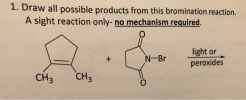 So I'm looking for some clarification on the products from
this rxn. I got two different kinds and just want to make sure I'm
correct. Thanks!
1. Draw all possible products from this bromination reaction. A sight reaction only- no mechanism required. N-Br light or peroxides CH₃ CH₂
So I'm looking for some clarification on the products from
this rxn. I got two different kinds and just want to make sure I'm
correct. Thanks!
1. Draw all possible products from this bromination reaction. A sight reaction only- no mechanism required. N-Br light or peroxides CH₃ CH₂
How do adults experience their on pre-operational thinking? (It means looking at your own point of...
How do adults experience their on pre-operational thinking? (It means looking at your own point of view only) Provide your own example from your own life experience
Identify two articles from the published literature that make recommendations about the U.S. Food & Drug...
Identify two articles from the published literature that make recommendations about the U.S. Food & Drug Approval process. In your own words, provide feedback on their recommendations. Please reference the articles.
 Who
writes the articles in scientific America magazine
QUESTION 5 The reason for the increase in carbon dioxikde concentratico 1.plants are blooming, taking in CO2 O2.plants are going dormant, not taking in C02 QUESTION 6 Radiation is the transfer of heat by two things touching waves hot air rishig QUESTION 7 If we use a thick down blanket as an analogy for the atmosphe atmosphere, absorbing heat, keeping the surface warm. aerosols greenhouse gases Click Save and Submit to save...
Who
writes the articles in scientific America magazine
QUESTION 5 The reason for the increase in carbon dioxikde concentratico 1.plants are blooming, taking in CO2 O2.plants are going dormant, not taking in C02 QUESTION 6 Radiation is the transfer of heat by two things touching waves hot air rishig QUESTION 7 If we use a thick down blanket as an analogy for the atmosphe atmosphere, absorbing heat, keeping the surface warm. aerosols greenhouse gases Click Save and Submit to save...
 So I'm looking for some clarification on the products from
this rxn. I got two different kinds and just want to make sure I'm
correct. Thanks!
1. Draw all possible products from this bromination reaction. A sight reaction only- no mechanism required. N-Br light or peroxides CH₃ CH₂
So I'm looking for some clarification on the products from
this rxn. I got two different kinds and just want to make sure I'm
correct. Thanks!
1. Draw all possible products from this bromination reaction. A sight reaction only- no mechanism required. N-Br light or peroxides CH₃ CH₂
Most questions answered within 3 hours.
-
Where is the error in this code sequence?
String s1 = "Hello";
String s2 = "ello";...
asked 10 months ago -
Financial data for Joel de Paris, Inc., for last year
follow:
Joel de Paris, Inc.
Balance...
asked 10 months ago -
Consider this reaction:
Al2(SO4)3 (aq)+ BaCl3
(aq) Al2Cl6 (aq)- +
3BaSO4(s) . What is the...
asked 10 months ago -
Suppose that Savneet is considering increasing her
recent random sample from 20 car rentals to 40...
asked 10 months ago -
Trucks arrive at an unloading terminal at an average rate of 120
per hour.
Trucks arrive...
asked 10 months ago -
Why are methanol and ethanol completely soluble in water while
octanol is not very little soluble....
asked 10 months ago -
A facilities manager at a university reads in a research report
that the mean amount of...
asked 10 months ago -
When the CuSO4 is rehydrated by adding water to the anhydrous
compound, is this an endothermic...
asked 10 months ago -
A ray of sunlight is passing from diamond into crown glass; the
angle of incidence is...
asked 10 months ago -
A block of mass 0.249 kg is placed on top of a light, vertical
spring of...
asked 10 months ago -
how do the kidneys compensate in the presences of acidosis
a) trigger hyperventilate
b) reserve acid...
asked 10 months ago -
Question 501 pts
The rental rate of capital to the firm increases. Which of the
following...
asked 10 months ago