
Homework Answers
Add Answer to:
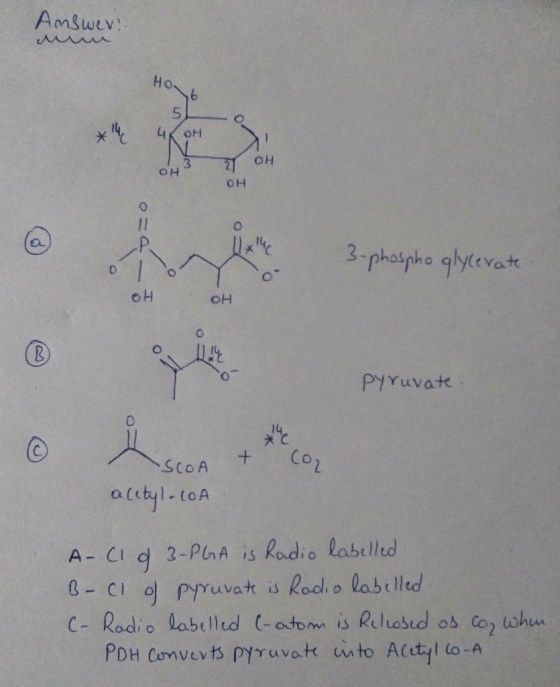
Many metabolic pathways were mapped using radiolabels in a pulse-chase experiment. A pulse of radiolabeled substrate...
biochemistry glycolosis Part 2: Glycolysis and Radiolabeling A common practice in biochemistry is the feeder study, in which radiolabeled substrate is fed to an organism; afterwards, radiolabeled...
 biochemistry glycolosis
Part 2: Glycolysis and Radiolabeling A common practice in biochemistry is the feeder study, in which radiolabeled substrate is fed to an organism; afterwards, radiolabeled metabolites are isolated and used to determine how the substrate was used by the organism. 4. Plants use intermediates from the glycolytic pathway as substrates for other pathways. For example, if we feed plants radiolabeled glucose, the radiolabel eventually ends up in the amino acid valine. If we feed the plants 6-(C)glucose i.e....
biochemistry glycolosis
Part 2: Glycolysis and Radiolabeling A common practice in biochemistry is the feeder study, in which radiolabeled substrate is fed to an organism; afterwards, radiolabeled metabolites are isolated and used to determine how the substrate was used by the organism. 4. Plants use intermediates from the glycolytic pathway as substrates for other pathways. For example, if we feed plants radiolabeled glucose, the radiolabel eventually ends up in the amino acid valine. If we feed the plants 6-(C)glucose i.e....
In a "pulse chase" experiment under anaerobic conditions, 14C glucose is added to an ethanol-producing yeast...
In a "pulse chase" experiment under anaerobic conditions, 14C glucose is added to an ethanol-producing yeast cell extract just long enough that each intermediate in the ethanol fermentation is labeled with a 14C (pulse). The 14C label is then diluted so that no additional radioactivity is incorporated into the intermediates (chase). 1. What position in ethanol will be labeled with 14C if 14C-glucose labeled at position C-1 is used? 2. Where should the 14C label sit in glucose for it...
The complex metabolic pathways in the parasite Trypanosoma brucei were elucidated in part by adding radiolabeled...
The complex metabolic pathways in the parasite Trypanosoma brucei were elucidated in part by adding radiolabeled metabolites to cultured parasites. In the parasite, glucose is converted t0 phosphoenolpyruvate (PEP) in the cytosol. PEP then enters an organelle called the glycosome and is converted to oxaloacetate (OAA); OAA is then converted to malate, and malate to fumarate. Fumarate reductase catalyzes the conversion of fumarate to succinate; the succinate is then secreted from the glycosome. If C1 of glucose is labeled, what...
Question: You buy a sample of glucose that has the radioactive carbon-14 (C) isotope at the...
 Question: You buy a sample of glucose that has the radioactive carbon-14 (C) isotope at the second position (Carbon #2). All other carbon positions in the glucose molecules have the "C isotope. "C is only a label and does not alter the biochemical behavior of the molecules in which it is found. This glucose sample is mixed with all the enzymes derived from liver cells, which initially contain no other C-labeled chemicals. A) Draw the Haworth structure of glucose and...
Bio 121 I need to make (yeast fermentation) lab report. This is the lab experiment and...
 Bio 121
I need to make (yeast fermentation) lab
report.
This is the lab experiment and results:
This is a guide to making the lab report:
General Biology BIO121 Yeast Fermentation Lab Introduction Organisms stay alive by the utilization of energy through metabolism. The energy acquiring pathways in photosynthesis convert radiant energy from the sun into the chemical bond energy of carbohydrates. This photosynthetic process is limited to the producers or autotrophs, which include plants, photosynthetic bacteria and some protists....
Bio 121
I need to make (yeast fermentation) lab
report.
This is the lab experiment and results:
This is a guide to making the lab report:
General Biology BIO121 Yeast Fermentation Lab Introduction Organisms stay alive by the utilization of energy through metabolism. The energy acquiring pathways in photosynthesis convert radiant energy from the sun into the chemical bond energy of carbohydrates. This photosynthetic process is limited to the producers or autotrophs, which include plants, photosynthetic bacteria and some protists....
just the prelab worksheet, no data yet Lab Six: Fermentation Learning Objectives: • Explain the biochemistry...
 just the prelab worksheet, no data yet
Lab Six: Fermentation Learning Objectives: • Explain the biochemistry of fermentation, substrates and products, conditions, and purpose for cells • Describe alcoholic fermentation of yeast, naming reactants and products Perform a pre-designed experiment to measure the rate of yeast fermentation of glucose under two different conditions. Propose hypotheses and make predictions based on them. Design and perform a novel experiment to test additional substrates for yeast fermentation using findings of the pre-designed experiment....
just the prelab worksheet, no data yet
Lab Six: Fermentation Learning Objectives: • Explain the biochemistry of fermentation, substrates and products, conditions, and purpose for cells • Describe alcoholic fermentation of yeast, naming reactants and products Perform a pre-designed experiment to measure the rate of yeast fermentation of glucose under two different conditions. Propose hypotheses and make predictions based on them. Design and perform a novel experiment to test additional substrates for yeast fermentation using findings of the pre-designed experiment....
Can you please explain in simple terms the methods of this experiment? I'm having difficulty visualizing...
Can you please explain in simple terms the methods of this experiment? I'm having difficulty visualizing and understanding what is being done. I have copied and pasted some of the text from the article. Thank you! Abstract : Obesity, high-fat diets, and subsequent type 2 diabetes (T2DM) are associated with cognitive impairment. Moreover, T2DM increases the risk of Alzheimer's disease (AD) and leads to abnormal elevation of brain beta-amyloid levels, one of the hallmarks of AD. The psychoactive alkaloid caffeine...
Create graphs for Figures 1-4 (circled on pages 111 & 114) based on the data given in Tables ...
 Create graphs for Figures 1-4 (circled on pages 111 & 114)
based on the data given in Tables 2 & 4.
Lab # 8 Cellular Respiration and Fermentation I. Goals and Objectives At the completion of this laboratory exercise, students will be able to: A Differentiate between the intermediates and products of fermentation versus acrobic cellular respiration in yeast. Relate rates of fermentation with sugar availability in yeast. Utilize a reduction-oxidation dye to determine the effect of varying yeast concentration...
Create graphs for Figures 1-4 (circled on pages 111 & 114)
based on the data given in Tables 2 & 4.
Lab # 8 Cellular Respiration and Fermentation I. Goals and Objectives At the completion of this laboratory exercise, students will be able to: A Differentiate between the intermediates and products of fermentation versus acrobic cellular respiration in yeast. Relate rates of fermentation with sugar availability in yeast. Utilize a reduction-oxidation dye to determine the effect of varying yeast concentration...
 biochemistry glycolosis
Part 2: Glycolysis and Radiolabeling A common practice in biochemistry is the feeder study, in which radiolabeled substrate is fed to an organism; afterwards, radiolabeled metabolites are isolated and used to determine how the substrate was used by the organism. 4. Plants use intermediates from the glycolytic pathway as substrates for other pathways. For example, if we feed plants radiolabeled glucose, the radiolabel eventually ends up in the amino acid valine. If we feed the plants 6-(C)glucose i.e....
biochemistry glycolosis
Part 2: Glycolysis and Radiolabeling A common practice in biochemistry is the feeder study, in which radiolabeled substrate is fed to an organism; afterwards, radiolabeled metabolites are isolated and used to determine how the substrate was used by the organism. 4. Plants use intermediates from the glycolytic pathway as substrates for other pathways. For example, if we feed plants radiolabeled glucose, the radiolabel eventually ends up in the amino acid valine. If we feed the plants 6-(C)glucose i.e....
 Question: You buy a sample of glucose that has the radioactive carbon-14 (C) isotope at the second position (Carbon #2). All other carbon positions in the glucose molecules have the "C isotope. "C is only a label and does not alter the biochemical behavior of the molecules in which it is found. This glucose sample is mixed with all the enzymes derived from liver cells, which initially contain no other C-labeled chemicals. A) Draw the Haworth structure of glucose and...
 Bio 121
I need to make (yeast fermentation) lab
report.
This is the lab experiment and results:
This is a guide to making the lab report:
General Biology BIO121 Yeast Fermentation Lab Introduction Organisms stay alive by the utilization of energy through metabolism. The energy acquiring pathways in photosynthesis convert radiant energy from the sun into the chemical bond energy of carbohydrates. This photosynthetic process is limited to the producers or autotrophs, which include plants, photosynthetic bacteria and some protists....
Bio 121
I need to make (yeast fermentation) lab
report.
This is the lab experiment and results:
This is a guide to making the lab report:
General Biology BIO121 Yeast Fermentation Lab Introduction Organisms stay alive by the utilization of energy through metabolism. The energy acquiring pathways in photosynthesis convert radiant energy from the sun into the chemical bond energy of carbohydrates. This photosynthetic process is limited to the producers or autotrophs, which include plants, photosynthetic bacteria and some protists....
 just the prelab worksheet, no data yet
Lab Six: Fermentation Learning Objectives: • Explain the biochemistry of fermentation, substrates and products, conditions, and purpose for cells • Describe alcoholic fermentation of yeast, naming reactants and products Perform a pre-designed experiment to measure the rate of yeast fermentation of glucose under two different conditions. Propose hypotheses and make predictions based on them. Design and perform a novel experiment to test additional substrates for yeast fermentation using findings of the pre-designed experiment....
just the prelab worksheet, no data yet
Lab Six: Fermentation Learning Objectives: • Explain the biochemistry of fermentation, substrates and products, conditions, and purpose for cells • Describe alcoholic fermentation of yeast, naming reactants and products Perform a pre-designed experiment to measure the rate of yeast fermentation of glucose under two different conditions. Propose hypotheses and make predictions based on them. Design and perform a novel experiment to test additional substrates for yeast fermentation using findings of the pre-designed experiment....
 Create graphs for Figures 1-4 (circled on pages 111 & 114)
based on the data given in Tables 2 & 4.
Lab # 8 Cellular Respiration and Fermentation I. Goals and Objectives At the completion of this laboratory exercise, students will be able to: A Differentiate between the intermediates and products of fermentation versus acrobic cellular respiration in yeast. Relate rates of fermentation with sugar availability in yeast. Utilize a reduction-oxidation dye to determine the effect of varying yeast concentration...
Create graphs for Figures 1-4 (circled on pages 111 & 114)
based on the data given in Tables 2 & 4.
Lab # 8 Cellular Respiration and Fermentation I. Goals and Objectives At the completion of this laboratory exercise, students will be able to: A Differentiate between the intermediates and products of fermentation versus acrobic cellular respiration in yeast. Relate rates of fermentation with sugar availability in yeast. Utilize a reduction-oxidation dye to determine the effect of varying yeast concentration...
Most questions answered within 3 hours.
-
Where is the error in this code sequence?
String s1 = "Hello";
String s2 = "ello";...
asked 10 months ago -
Financial data for Joel de Paris, Inc., for last year
follow:
Joel de Paris, Inc.
Balance...
asked 10 months ago -
Consider this reaction:
Al2(SO4)3 (aq)+ BaCl3
(aq) Al2Cl6 (aq)- +
3BaSO4(s) . What is the...
asked 10 months ago -
Suppose that Savneet is considering increasing her
recent random sample from 20 car rentals to 40...
asked 10 months ago -
Trucks arrive at an unloading terminal at an average rate of 120
per hour.
Trucks arrive...
asked 10 months ago -
Why are methanol and ethanol completely soluble in water while
octanol is not very little soluble....
asked 10 months ago -
A facilities manager at a university reads in a research report
that the mean amount of...
asked 10 months ago -
When the CuSO4 is rehydrated by adding water to the anhydrous
compound, is this an endothermic...
asked 10 months ago -
A ray of sunlight is passing from diamond into crown glass; the
angle of incidence is...
asked 10 months ago -
A block of mass 0.249 kg is placed on top of a light, vertical
spring of...
asked 10 months ago -
how do the kidneys compensate in the presences of acidosis
a) trigger hyperventilate
b) reserve acid...
asked 10 months ago -
Question 501 pts
The rental rate of capital to the firm increases. Which of the
following...
asked 10 months ago