
Homework Answers
A.  B.
B. 
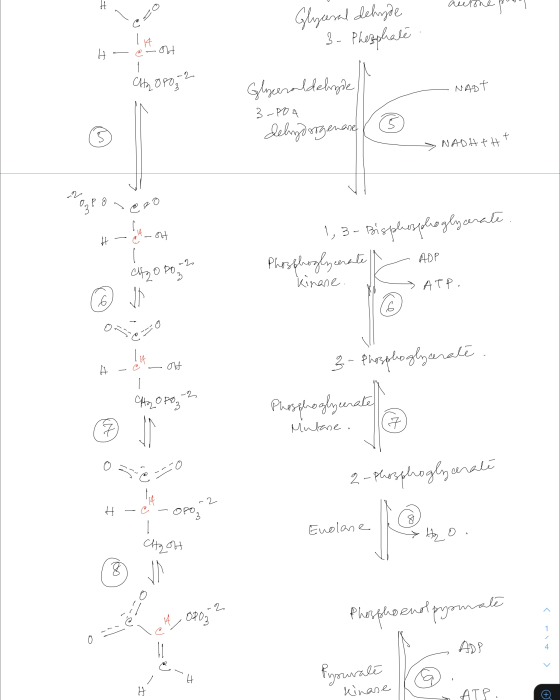
 C.
C.  D.
D. 
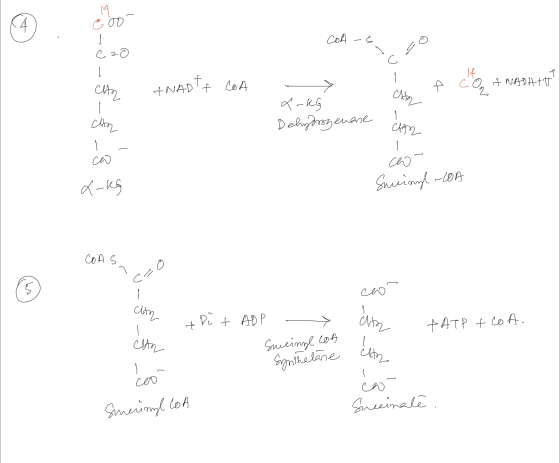
 E.
The TCA cycle will take a single turn to release the C14 molecule
as carbon di oxide. The reaction involving isocitrate dehydrogenase
to produce oxalosuccinate and alpha ketoglutarate from iso citrate
produce the first carbon di oxide molecule.
E.
The TCA cycle will take a single turn to release the C14 molecule
as carbon di oxide. The reaction involving isocitrate dehydrogenase
to produce oxalosuccinate and alpha ketoglutarate from iso citrate
produce the first carbon di oxide molecule.
F. No. Carbon di oxide can not be release at a different step.
Add Answer to:
Question: You buy a sample of glucose that has the radioactive carbon-14 (C) isotope at the...
Biochemistry: Answer the following questions about a molecule of glucose that has a radioactivr carbon at...
 Biochemistry: Answer the following questions about a molecule
of glucose that has a radioactivr carbon at carbon 2. For each
question, draw the molecule specified and indicate the location of
the radioactive carbon. if there are multiple positions that the
radioactive carbon may be located, include ALL positions in your
answer.
draw structure
2. Answer the following questions about a molecule of glucose that has a radioactive carbon (C14) at carbon 2. This molecule undergoes metabolism in a human cell...
Biochemistry: Answer the following questions about a molecule
of glucose that has a radioactivr carbon at carbon 2. For each
question, draw the molecule specified and indicate the location of
the radioactive carbon. if there are multiple positions that the
radioactive carbon may be located, include ALL positions in your
answer.
draw structure
2. Answer the following questions about a molecule of glucose that has a radioactive carbon (C14) at carbon 2. This molecule undergoes metabolism in a human cell...
OH cr nC-labeled glucose at C6 13C-labeled pyruvate at C3 a) When glucose is enriched with C at C...
 OH cr nC-labeled glucose at C6 13C-labeled pyruvate at C3 a) When glucose is enriched with C at C6, it will form pyruvate enriched at C3 (above). The labeled Where does the label exist in succinyl-CoA after the 'C acetyl-CoA is processed in the first round of TCA (after a single action by the first four enzymes in TCA). Circle the atom/atoms where the label exists on the molecule below d pyruvate will be converted into 1'C acetyl-CoA and then...
Citric Acid Cycle questions a) Since carbons arrive from glucose via acetyl CoA, what carbons from...
Citric Acid Cycle questions a) Since carbons arrive from glucose via acetyl CoA, what carbons from glucose are in Acetyl CoA? Number them in Acetyl CoA using the original number from glucose. b) Are any carbons from acetyl CoA removed as CO2 during the first "turn" of the citric acid cycle? c) What glucose carbon(s) is (are) the first to be removed as CO2 in the citric acid cycle?
3. Draw one turn of the citric acid cycle starting from a radio-labeled (*) acetyl-CoA shown...
 3. Draw one turn of the citric acid cycle starting from a radio-labeled (*) acetyl-CoA shown below. Trace the fate of radio-labeled carbons and fully label each structure of intermediates through the citric acid cycle. Include the names of enzymes involved (in the table below), number each step, and indicate the names of each consumed or produced product. (Hint: There are symmetrical molecules present) (12 marks) CoA Нас 5. 2. 6 7. 3. 4. 8
You are carrying out an experiment in the lab to study the citric acid cycle. To do this, you add 14C-labeled pyruvate at carbon 3 (this is the methyl carbon) to metabolically active mitochondria. Bas...
You are carrying out an experiment in the lab to study the citric acid cycle. To do this, you add 14C-labeled pyruvate at carbon 3 (this is the methyl carbon) to metabolically active mitochondria. Based on your knowledge of the citric acid cycle, what is the location of the 14C-label in oxaloacetate after one turn of the cycle? How many turns of the cycle are required to release all of the14C-label as CO2? Be sure to justify your answers by...
4. (20 points) The reaction of pyruvate to acetyl-CoA and CO2 is the bridge reaction between...
 4. (20 points) The reaction of pyruvate to acetyl-CoA and CO2 is the bridge reaction between glycolysis and the citric acid cycle. The carbon atoms in pyruvate are numbered and where they end up in the products are indicated CO0Θ 2 C=O + HS-CoA 3 CH3 Pyruvate S-COA 2C=O 3 CH3 Acetyl CoA Pyruvate dehydrogenase +1 CO2 a) Is C atom 1 in CO2 in a more reduced state or more oxidized state compared to its state in pyruvate? Why?...
13) When a molecule of glucose gets split during the energy investment phase of glycolysis, the...
 13) When a molecule of glucose gets split during the energy investment phase of glycolysis, the products are two molecules of that then move to the energy payoff phase. A) Glyceraldehyde-3-phospahte B) Pyruvate C) Acetyl-COA D) NADH 14) Following glycolysis and the citric acid cycle, but before the electron transport chain and oxidative phosphorylation, the carbon skeleton of glucose has been broken down to CO2 with some net gain of ATP. Most of the energy from the original glucose molecule...
Draw the complete TCA cycle (Krebs or Citric acid cycle). Show the entry of acetyl- COA...
 Draw the complete TCA cycle (Krebs or Citric acid cycle). Show the entry of acetyl- COA and the eight intermediates. Draw the chemical structures of each compound. Show the control point(s) in the pathway. Show where all CO2 is released and label the reactions where oxidation of carbon occurs.
Assume a cell has just completed glycolysis and the resulting pyruvate has a c-14 radio label...
 Assume a cell has just completed glycolysis and the resulting
pyruvate has a c-14 radio label on carbon -1. Highlight the carbon
on the attached pages as it passes through the PDH complex and the
TCA cycle until it is lost as CO2. If only a portion of the carbons
are lost stop highlighting when the CO2 first starts to come off.
ONLY ONE TIME THRU THE CYCLE ON EACH PAGE
2. Repeat question 1 but now assume the radio...
Assume a cell has just completed glycolysis and the resulting
pyruvate has a c-14 radio label on carbon -1. Highlight the carbon
on the attached pages as it passes through the PDH complex and the
TCA cycle until it is lost as CO2. If only a portion of the carbons
are lost stop highlighting when the CO2 first starts to come off.
ONLY ONE TIME THRU THE CYCLE ON EACH PAGE
2. Repeat question 1 but now assume the radio...
the citric acid cycle has 8 enzymes: citrate synthase, aconitase, isocitrase dehydrogenase,.... 1 Jom L C...
 the citric acid cycle has 8 enzymes: citrate synthase,
aconitase, isocitrase dehydrogenase,....
1 Jom L C Tegulation TCA cycle (Ch. 16) 1. The citric acid cycle has eight enzymes: citrate synthase, aconitase, isocitrate dehydrogenase, a-ketoglutarate dehydrogenase, succinyl-CoA synthetase, succinate dehydrogenase, fumarase, and malate dehydrogenase. (a) Write a balanced equation for the reaction catalyzed by each enzyme. (b) Name the cofactor(s) required by each enzyme reaction. (c) For each enzyme determine which of the following describes the type of reaction(s) catalyzed:...
the citric acid cycle has 8 enzymes: citrate synthase,
aconitase, isocitrase dehydrogenase,....
1 Jom L C Tegulation TCA cycle (Ch. 16) 1. The citric acid cycle has eight enzymes: citrate synthase, aconitase, isocitrate dehydrogenase, a-ketoglutarate dehydrogenase, succinyl-CoA synthetase, succinate dehydrogenase, fumarase, and malate dehydrogenase. (a) Write a balanced equation for the reaction catalyzed by each enzyme. (b) Name the cofactor(s) required by each enzyme reaction. (c) For each enzyme determine which of the following describes the type of reaction(s) catalyzed:...
 Biochemistry: Answer the following questions about a molecule
of glucose that has a radioactivr carbon at carbon 2. For each
question, draw the molecule specified and indicate the location of
the radioactive carbon. if there are multiple positions that the
radioactive carbon may be located, include ALL positions in your
answer.
draw structure
2. Answer the following questions about a molecule of glucose that has a radioactive carbon (C14) at carbon 2. This molecule undergoes metabolism in a human cell...
Biochemistry: Answer the following questions about a molecule
of glucose that has a radioactivr carbon at carbon 2. For each
question, draw the molecule specified and indicate the location of
the radioactive carbon. if there are multiple positions that the
radioactive carbon may be located, include ALL positions in your
answer.
draw structure
2. Answer the following questions about a molecule of glucose that has a radioactive carbon (C14) at carbon 2. This molecule undergoes metabolism in a human cell...
 OH cr nC-labeled glucose at C6 13C-labeled pyruvate at C3 a) When glucose is enriched with C at C6, it will form pyruvate enriched at C3 (above). The labeled Where does the label exist in succinyl-CoA after the 'C acetyl-CoA is processed in the first round of TCA (after a single action by the first four enzymes in TCA). Circle the atom/atoms where the label exists on the molecule below d pyruvate will be converted into 1'C acetyl-CoA and then...
 3. Draw one turn of the citric acid cycle starting from a radio-labeled (*) acetyl-CoA shown below. Trace the fate of radio-labeled carbons and fully label each structure of intermediates through the citric acid cycle. Include the names of enzymes involved (in the table below), number each step, and indicate the names of each consumed or produced product. (Hint: There are symmetrical molecules present) (12 marks) CoA Нас 5. 2. 6 7. 3. 4. 8
 4. (20 points) The reaction of pyruvate to acetyl-CoA and CO2 is the bridge reaction between glycolysis and the citric acid cycle. The carbon atoms in pyruvate are numbered and where they end up in the products are indicated CO0Θ 2 C=O + HS-CoA 3 CH3 Pyruvate S-COA 2C=O 3 CH3 Acetyl CoA Pyruvate dehydrogenase +1 CO2 a) Is C atom 1 in CO2 in a more reduced state or more oxidized state compared to its state in pyruvate? Why?...
 13) When a molecule of glucose gets split during the energy investment phase of glycolysis, the products are two molecules of that then move to the energy payoff phase. A) Glyceraldehyde-3-phospahte B) Pyruvate C) Acetyl-COA D) NADH 14) Following glycolysis and the citric acid cycle, but before the electron transport chain and oxidative phosphorylation, the carbon skeleton of glucose has been broken down to CO2 with some net gain of ATP. Most of the energy from the original glucose molecule...
 Draw the complete TCA cycle (Krebs or Citric acid cycle). Show the entry of acetyl- COA and the eight intermediates. Draw the chemical structures of each compound. Show the control point(s) in the pathway. Show where all CO2 is released and label the reactions where oxidation of carbon occurs.
 Assume a cell has just completed glycolysis and the resulting
pyruvate has a c-14 radio label on carbon -1. Highlight the carbon
on the attached pages as it passes through the PDH complex and the
TCA cycle until it is lost as CO2. If only a portion of the carbons
are lost stop highlighting when the CO2 first starts to come off.
ONLY ONE TIME THRU THE CYCLE ON EACH PAGE
2. Repeat question 1 but now assume the radio...
Assume a cell has just completed glycolysis and the resulting
pyruvate has a c-14 radio label on carbon -1. Highlight the carbon
on the attached pages as it passes through the PDH complex and the
TCA cycle until it is lost as CO2. If only a portion of the carbons
are lost stop highlighting when the CO2 first starts to come off.
ONLY ONE TIME THRU THE CYCLE ON EACH PAGE
2. Repeat question 1 but now assume the radio...
 the citric acid cycle has 8 enzymes: citrate synthase,
aconitase, isocitrase dehydrogenase,....
1 Jom L C Tegulation TCA cycle (Ch. 16) 1. The citric acid cycle has eight enzymes: citrate synthase, aconitase, isocitrate dehydrogenase, a-ketoglutarate dehydrogenase, succinyl-CoA synthetase, succinate dehydrogenase, fumarase, and malate dehydrogenase. (a) Write a balanced equation for the reaction catalyzed by each enzyme. (b) Name the cofactor(s) required by each enzyme reaction. (c) For each enzyme determine which of the following describes the type of reaction(s) catalyzed:...
the citric acid cycle has 8 enzymes: citrate synthase,
aconitase, isocitrase dehydrogenase,....
1 Jom L C Tegulation TCA cycle (Ch. 16) 1. The citric acid cycle has eight enzymes: citrate synthase, aconitase, isocitrate dehydrogenase, a-ketoglutarate dehydrogenase, succinyl-CoA synthetase, succinate dehydrogenase, fumarase, and malate dehydrogenase. (a) Write a balanced equation for the reaction catalyzed by each enzyme. (b) Name the cofactor(s) required by each enzyme reaction. (c) For each enzyme determine which of the following describes the type of reaction(s) catalyzed:...
Most questions answered within 3 hours.
-
Where is the error in this code sequence?
String s1 = "Hello";
String s2 = "ello";...
asked 11 months ago -
Financial data for Joel de Paris, Inc., for last year
follow:
Joel de Paris, Inc.
Balance...
asked 11 months ago -
Consider this reaction:
Al2(SO4)3 (aq)+ BaCl3
(aq) Al2Cl6 (aq)- +
3BaSO4(s) . What is the...
asked 11 months ago -
Suppose that Savneet is considering increasing her
recent random sample from 20 car rentals to 40...
asked 11 months ago -
Trucks arrive at an unloading terminal at an average rate of 120
per hour.
Trucks arrive...
asked 11 months ago -
Why are methanol and ethanol completely soluble in water while
octanol is not very little soluble....
asked 11 months ago -
A facilities manager at a university reads in a research report
that the mean amount of...
asked 11 months ago -
When the CuSO4 is rehydrated by adding water to the anhydrous
compound, is this an endothermic...
asked 11 months ago -
A ray of sunlight is passing from diamond into crown glass; the
angle of incidence is...
asked 11 months ago -
A block of mass 0.249 kg is placed on top of a light, vertical
spring of...
asked 11 months ago -
how do the kidneys compensate in the presences of acidosis
a) trigger hyperventilate
b) reserve acid...
asked 11 months ago -
Question 501 pts
The rental rate of capital to the firm increases. Which of the
following...
asked 11 months ago