3) The complete combustion of hexane has a H of -8326kJ/mol for the balanced reaction a....
3) The complete combustion of hexane has a H of -8326kJ/mol for the balanced reaction
a. Write the balanced equation for the combustion of pentane
b. What is the enthalpy change for the reverse reaction?
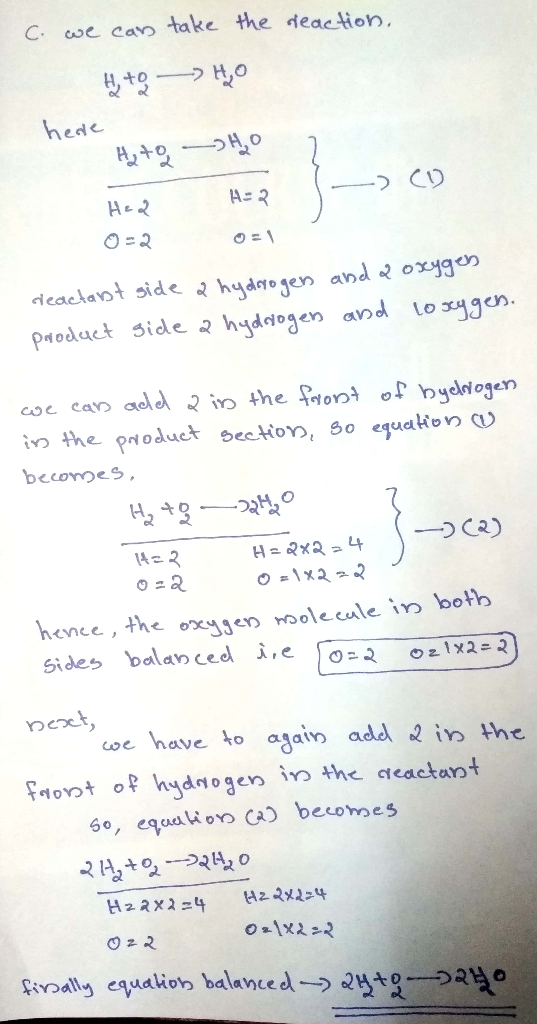
c. Balance the equation in the forward direction with whole number coefficients
d. What is the enthalpy change for the reaction in problem “c”?
e. Which reaction is more likely to be thermodynamically favored; the forward or reverse?
f. Explain your answer to e.
g. If the reaction was written to produce H2O gas instead of liquid, would the magnitude of H increase, decrease or stay the same?
h. Explain your answer to g.
Homework Answers
A.
by balancing we get ,
B. Enthalpy is the heat content of the system at
constant pressure. It is denoted by H. The absolute value of
enthalpy cannot be determined.Enthalpy of a system is a state
function, thus the magnitude of the enthalpy change depends only
upon the enthalpies in the initial and final states
i.e
For any reation ,enthalpy change of the forward reaction and reverse reaction will be equal in magnitude and has opposite signs. For eg: enthalpy change of a forward reaction is -834 kj and enthalpy change for a reverse reaction must be +834 kj
Add Answer to:
3) The complete combustion of hexane has a H of -8326kJ/mol for
the balanced reaction
a....
Consider the production of calcium carbide and liquid water from acetylene: 1/2 Ca(OH)2(s) + 1/2 C2H2(g)...
 Consider the production of calcium carbide and liquid water from
acetylene:
1/2 Ca(OH)2(s) + 1/2 C2H2(g)
1/2 CaC2(s) +
H2O(l)
H = 63.6 kJ
(a) What is the enthalpy change for the reverse reaction?
Hreverse = kJ/mol.
(b) Balance the forward reaction with whole-number coefficients.
What is H for the reaction represented by this
equation?
H = kJ/mol.
(c) Which is more likely to be thermodynamically-favored, the
forward reaction or the reverse reaction?
---Select--- The forward reaction. The reverse reaction.
(d) If...
Consider the production of calcium carbide and liquid water from
acetylene:
1/2 Ca(OH)2(s) + 1/2 C2H2(g)
1/2 CaC2(s) +
H2O(l)
H = 63.6 kJ
(a) What is the enthalpy change for the reverse reaction?
Hreverse = kJ/mol.
(b) Balance the forward reaction with whole-number coefficients.
What is H for the reaction represented by this
equation?
H = kJ/mol.
(c) Which is more likely to be thermodynamically-favored, the
forward reaction or the reverse reaction?
---Select--- The forward reaction. The reverse reaction.
(d) If...
A Review Constants Periodic Table Consider the combustion of liquid methanol, CH2OH(I): CH,OH(L) + 3/2 0,(9)...
 A Review Constants Periodic Table Consider the combustion of liquid methanol, CH2OH(I): CH,OH(L) + 3/2 0,(9) + CO2(g) + 2 H20(1) AH = -726.5kJ Part C What is AH for the reaction represented by this equation? Express your answer using four significant figures. AH = -1453 kJ Previous Answers Correct Part D Which is more likely to be thermodynamically favored, the forward reaction or the reverse reaction? the forward reaction the reverse reaction Submit Request Answer Part E If the...
#3 please 1) Write the balanced chemical equation for the combustion of hexane, including physical states....
 #3 please
1) Write the balanced chemical equation for the combustion of hexane, including physical states. Combustion reactions occur during burning, releasing heat and generally accompanied by light. Because of the heat, water will be produced as a vapor. 2 C 6 H 14 (g) + 19 O2(g) → 12 CO 2 (g) + 14 H2O(g) Use the balanced chemical equation above and stoichiometry to solve the following problems. 2) Calculate the maximum number of moles of carbon dioxide that...
#3 please
1) Write the balanced chemical equation for the combustion of hexane, including physical states. Combustion reactions occur during burning, releasing heat and generally accompanied by light. Because of the heat, water will be produced as a vapor. 2 C 6 H 14 (g) + 19 O2(g) → 12 CO 2 (g) + 14 H2O(g) Use the balanced chemical equation above and stoichiometry to solve the following problems. 2) Calculate the maximum number of moles of carbon dioxide that...
p1 P1. Write a balanced chemical equation for each combustion reaction. Assume that combustion is complete. The fo...
 p1
P1. Write a balanced chemical equation for each combustion reaction. Assume that combustion is complete. The formulas and the line-bond structures for the compounds are given on the previous page. Write your equations so that liquid water is one of the products. Ethanol: Ethyl acetate: mm For onoh fuol'c combuetion reaction fill in the tables belo for the number of each AHr = [(4 x 413 kJ/mol for the C-H bonds in one mole of methane)+ (2 x 495...
p1
P1. Write a balanced chemical equation for each combustion reaction. Assume that combustion is complete. The formulas and the line-bond structures for the compounds are given on the previous page. Write your equations so that liquid water is one of the products. Ethanol: Ethyl acetate: mm For onoh fuol'c combuetion reaction fill in the tables belo for the number of each AHr = [(4 x 413 kJ/mol for the C-H bonds in one mole of methane)+ (2 x 495...
Question 3: (a) For the combustion of 0.05193 mol of C5H12O(l) at constant pressure and a...
Question 3: (a) For the combustion of 0.05193 mol of C5H12O(l) at constant pressure and a temperature of 25.00oC, we measure that 171.2 kJ of heat is released by the reaction. With this data, what would be the values of ΔH, ΔU, Q, and W for the combustion of 1.000 moles of C5H12O(l) at constant volume and a temperature of 25.00oC? Combustion is the reaction of a substance with O2(g) to produce CO2(g) and H2O(l). (b) We have an unknown...
Consider the balanced chemical reaction for the complete combustion reaction of cyclopropane gas (C,H): a) What...
 Consider the balanced chemical reaction for the complete combustion reaction of cyclopropane gas (C,H): a) What compounds are on the left of the reaction (reactants)? Provide the names in alphabetical order (not the formulas, and don't worry about the stoichiometric coefficients for this part), and write the states of each matter **For example if you have 2 NO, (g), you just write nitrogen dioxide in gas state in state, and in state. b) What compounds are on the right of...
(a) For the combustion of 0.05033 mol of C5H12O(l) at constant pressure and a temperature of...
(a) For the combustion of 0.05033 mol of C5H12O(l) at constant pressure and a temperature of 25.00oC, we measure that 176.8 kJ of heat is released by the reaction. With this data, what would be the values of ΔH, ΔU, Q, and W for the combustion of 1.000 moles of C5H12O(l) at constant volume and a temperature of 25.00oC? Combustion is the reaction of a substance with O2(g) to produce CO2(g) and H2O(l). (b) We have an unknown liquid. For...
(a) For the combustion of 0.05087 mol of C5H12O(l) at constant pressure and a temperature of...
(a) For the combustion of 0.05087 mol of C5H12O(l) at constant pressure and a temperature of 25.00oC, we measure that 176.1 kJ of heat is released by the reaction. With this data, what would be the values of ΔH, ΔU, Q, and W for the combustion of 1.000 moles of C5H12O(l) at constant volume and a temperature of 25.00oC? Combustion is the reaction of a substance with O2(g) to produce CO2(g) and H2O(l). (b) We have an unknown liquid. For...
a) For the combustion of 0.05355 mol of C5H12O(l) at constant pressure and a temperature of...
a) For the combustion of 0.05355 mol of C5H12O(l) at constant pressure and a temperature of 25.00oC, we measure that 177.3 kJ of heat is released by the reaction. With this data, what would be the values of ΔH, ΔU, Q, and W for the combustion of 1.000 moles of C5H12O(l) at constant volume and a temperature of 25.00oC? Combustion is the reaction of a substance with O2(g) to produce CO2(g) and H2O(l). b) We have an unknown liquid. For...
(a) For the combustion of 0.05328 mol of C5H12O(l) at constant pressure and a temperature of...
(a) For the combustion of 0.05328 mol of C5H12O(l) at constant pressure and a temperature of 25.00oC, we measure that 170.6 kJ of heat is released by the reaction. With this data, what would be the values of ΔH, ΔU, Q, and W for the combustion of 1.000 moles of C5H12O(l) at constant volume and a temperature of 25.00oC? Combustion is the reaction of a substance with O2(g) to produce CO2(g) and H2O(l). (b) We have an unknown liquid. For...
 Consider the production of calcium carbide and liquid water from
acetylene:
1/2 Ca(OH)2(s) + 1/2 C2H2(g)
1/2 CaC2(s) +
H2O(l)
H = 63.6 kJ
(a) What is the enthalpy change for the reverse reaction?
Hreverse = kJ/mol.
(b) Balance the forward reaction with whole-number coefficients.
What is H for the reaction represented by this
equation?
H = kJ/mol.
(c) Which is more likely to be thermodynamically-favored, the
forward reaction or the reverse reaction?
---Select--- The forward reaction. The reverse reaction.
(d) If...
Consider the production of calcium carbide and liquid water from
acetylene:
1/2 Ca(OH)2(s) + 1/2 C2H2(g)
1/2 CaC2(s) +
H2O(l)
H = 63.6 kJ
(a) What is the enthalpy change for the reverse reaction?
Hreverse = kJ/mol.
(b) Balance the forward reaction with whole-number coefficients.
What is H for the reaction represented by this
equation?
H = kJ/mol.
(c) Which is more likely to be thermodynamically-favored, the
forward reaction or the reverse reaction?
---Select--- The forward reaction. The reverse reaction.
(d) If...
 A Review Constants Periodic Table Consider the combustion of liquid methanol, CH2OH(I): CH,OH(L) + 3/2 0,(9) + CO2(g) + 2 H20(1) AH = -726.5kJ Part C What is AH for the reaction represented by this equation? Express your answer using four significant figures. AH = -1453 kJ Previous Answers Correct Part D Which is more likely to be thermodynamically favored, the forward reaction or the reverse reaction? the forward reaction the reverse reaction Submit Request Answer Part E If the...
 #3 please
1) Write the balanced chemical equation for the combustion of hexane, including physical states. Combustion reactions occur during burning, releasing heat and generally accompanied by light. Because of the heat, water will be produced as a vapor. 2 C 6 H 14 (g) + 19 O2(g) → 12 CO 2 (g) + 14 H2O(g) Use the balanced chemical equation above and stoichiometry to solve the following problems. 2) Calculate the maximum number of moles of carbon dioxide that...
#3 please
1) Write the balanced chemical equation for the combustion of hexane, including physical states. Combustion reactions occur during burning, releasing heat and generally accompanied by light. Because of the heat, water will be produced as a vapor. 2 C 6 H 14 (g) + 19 O2(g) → 12 CO 2 (g) + 14 H2O(g) Use the balanced chemical equation above and stoichiometry to solve the following problems. 2) Calculate the maximum number of moles of carbon dioxide that...
 p1
P1. Write a balanced chemical equation for each combustion reaction. Assume that combustion is complete. The formulas and the line-bond structures for the compounds are given on the previous page. Write your equations so that liquid water is one of the products. Ethanol: Ethyl acetate: mm For onoh fuol'c combuetion reaction fill in the tables belo for the number of each AHr = [(4 x 413 kJ/mol for the C-H bonds in one mole of methane)+ (2 x 495...
p1
P1. Write a balanced chemical equation for each combustion reaction. Assume that combustion is complete. The formulas and the line-bond structures for the compounds are given on the previous page. Write your equations so that liquid water is one of the products. Ethanol: Ethyl acetate: mm For onoh fuol'c combuetion reaction fill in the tables belo for the number of each AHr = [(4 x 413 kJ/mol for the C-H bonds in one mole of methane)+ (2 x 495...
 Consider the balanced chemical reaction for the complete combustion reaction of cyclopropane gas (C,H): a) What compounds are on the left of the reaction (reactants)? Provide the names in alphabetical order (not the formulas, and don't worry about the stoichiometric coefficients for this part), and write the states of each matter **For example if you have 2 NO, (g), you just write nitrogen dioxide in gas state in state, and in state. b) What compounds are on the right of...
Most questions answered within 3 hours.
-
Where is the error in this code sequence?
String s1 = "Hello";
String s2 = "ello";...
asked 11 months ago -
Financial data for Joel de Paris, Inc., for last year
follow:
Joel de Paris, Inc.
Balance...
asked 11 months ago -
Consider this reaction:
Al2(SO4)3 (aq)+ BaCl3
(aq) Al2Cl6 (aq)- +
3BaSO4(s) . What is the...
asked 11 months ago -
Suppose that Savneet is considering increasing her
recent random sample from 20 car rentals to 40...
asked 11 months ago -
Trucks arrive at an unloading terminal at an average rate of 120
per hour.
Trucks arrive...
asked 11 months ago -
Why are methanol and ethanol completely soluble in water while
octanol is not very little soluble....
asked 11 months ago -
A facilities manager at a university reads in a research report
that the mean amount of...
asked 11 months ago -
When the CuSO4 is rehydrated by adding water to the anhydrous
compound, is this an endothermic...
asked 11 months ago -
A ray of sunlight is passing from diamond into crown glass; the
angle of incidence is...
asked 11 months ago -
A block of mass 0.249 kg is placed on top of a light, vertical
spring of...
asked 11 months ago -
how do the kidneys compensate in the presences of acidosis
a) trigger hyperventilate
b) reserve acid...
asked 11 months ago -
Question 501 pts
The rental rate of capital to the firm increases. Which of the
following...
asked 11 months ago