


Homework Answers
Add Answer to:
l Review (Figure 1) A man is running at speed c (much less than the speed...
Review (Figure 1) A man is running at speed c (much less than the speed of...
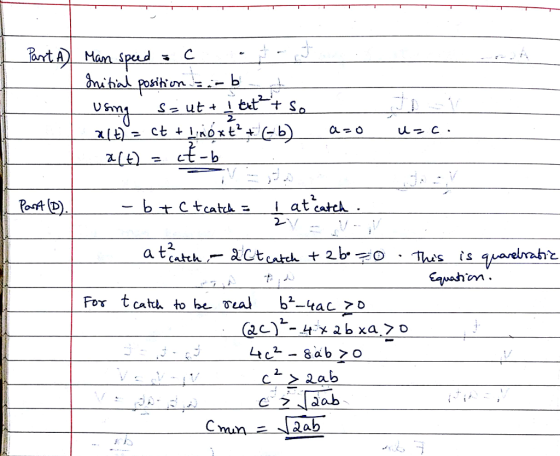
 Review (Figure 1) A man is running at speed c (much less than the speed of light) to catch a bus already at a stop. At t0, when he is a distance b from the door to the bus, the bus starts moving with the positive acceleration a. Figure 〈 1011 > Ar=b r0 Part A What Is Tman(t), the position of the man as a tunction of time? Answer symbolically in terms of the variables b, c, and t....
A man is running at speed c (much less than the speed of light) to catch...
 A man is running at speed c
(much less than the speed of light) to catch a bus already at a
stop. At t=0, when he is a distance b from the door to the bus, the
bus starts moving with the positive acceleration a. Use a
coordinate system with x=0 at the door of the stopped bus.
Constants Part A Figure 1) A man is running at speed c (much less than the speed of light) to catch a...
A man is running at speed c
(much less than the speed of light) to catch a bus already at a
stop. At t=0, when he is a distance b from the door to the bus, the
bus starts moving with the positive acceleration a. Use a
coordinate system with x=0 at the door of the stopped bus.
Constants Part A Figure 1) A man is running at speed c (much less than the speed of light) to catch a...
A man is running at speed c (much less than the speed of light) to catch...
 A man is running at speed c (much less than the speed of light) to catch a bus already at a stop. At t = 0, when he is a distance b from the door of the bus, the bus starts moving with the positive acceleration a. Use a coordinate system with x = 0 at the door of the stopped bus. Draw a position vs. time graph for both the man and bus on the same graph. Make sure...
A man is of light) to catch a bus already at a stop Att 0 e...
 A man is of light) to catch a bus already at a stop Att 0 e b from the door to the bus, the Part D bus starts moving with the positive a Use a stopped bus system with z 0 at the door of the Inserting the formulas you found for man(t) and () into the mn(Ceatch)h) you obtain the following Figure 1 of 1 Intuitively, the man will not catch the bus unless he is running fast enough...
13 of 1: Problem 2.97 Constants Part A A student is running at her top speed...
 13 of 1: Problem 2.97 Constants Part A A student is running at her top speed of 5.3 m/s to catch a bus, which is stopped at the bus stop When the student is still a distance 39.6 m from the bus, iR starts to pull away, moving with a constant acceleration of 0.179 m/s For how much time does the student have to run at 5 3 m/s before she overta the bus? Submit Part B For what distance...
Review 1 Constants PartA A proton's speed as it passes point A is 44000 m/s. It...
 Review 1 Constants PartA A proton's speed as it passes point A is 44000 m/s. It follows the trajectory shown in the figure. (Figure 1) What is the proton's speed at point B? Express your answer using two significant figures. Figure v51000 m/s Submit Previous Answers Request Answer XIncorrect; Try Again; 5 attempts remaining Provide Feedback 30 V 10 V -10 V
Constants An electron at point A in the figure (Figure 1) has a speed vo of...
 Constants An electron at point A in the figure (Figure 1) has a speed vo of 1.20x10 m/s. Part A Find the magnitude of the magnetic field that will cause the electron to follow the semicircular path from A to B. VO AEVO 2 ? B = Figure < 1 of 1 > Submit Request Answer Part B Find the direction of the magnetic field that will cause the electron to follow the semicircular path from A to B. out...
Options: Greater than, less than, equal to Fluid Flow Concepts Puntos:1 The figure illustrates flow through...
 Options: Greater than, less than, equal to
Fluid Flow Concepts Puntos:1 The figure illustrates flow through a pipe with diameters of 1 mm and 2 mm and with different elevations. px is the pressure in the pipe, and vx is the speed of a non-viscous incompressible fluid at locations x = Q,RS,T, or U. 0 D-2 mm Select the correct answers. Greater than Ps IS .Pu Greater than VR i 0.5v Equal toPs is.. PR Enviar Respuesta Incorrecto. Tries 2/10...
Options: Greater than, less than, equal to
Fluid Flow Concepts Puntos:1 The figure illustrates flow through a pipe with diameters of 1 mm and 2 mm and with different elevations. px is the pressure in the pipe, and vx is the speed of a non-viscous incompressible fluid at locations x = Q,RS,T, or U. 0 D-2 mm Select the correct answers. Greater than Ps IS .Pu Greater than VR i 0.5v Equal toPs is.. PR Enviar Respuesta Incorrecto. Tries 2/10...
P 2.88 < 8 of 11 > I Review Consider the circuit shown in (Figure 1)....
 P 2.88 < 8 of 11 > I Review Consider the circuit shown in (Figure 1). Suppose that R=52, vg = 19 V. Correct Part C Find the value of the Thévenin voltage. Express your answer to three significant figures and include the appropriate units. Enter positive value if the positive reference is at point a and negative value if the positive reference is at point b. Figure 1 of 1 > HÅR O 2 ? V Submit Previous Answers...
NEED ASAP question b A 200-kg beam 2.5 m in length slides broadside down the ice with a speed of 18 m/s A 65-kg man at...
 NEED ASAP
question b
A 200-kg beam 2.5 m in length slides broadside down the ice with a speed of 18 m/s A 65-kg man at rest grabs one end as it goes past and hangs on as both he and the beam go spinning down the ice. Assume frictionless motion. (Figure 1) Part A How fast does the center of mass of the system move after the collision? Express your answer using two significant figures. v= 14 m/s Submit...
NEED ASAP
question b
A 200-kg beam 2.5 m in length slides broadside down the ice with a speed of 18 m/s A 65-kg man at rest grabs one end as it goes past and hangs on as both he and the beam go spinning down the ice. Assume frictionless motion. (Figure 1) Part A How fast does the center of mass of the system move after the collision? Express your answer using two significant figures. v= 14 m/s Submit...
 Review (Figure 1) A man is running at speed c (much less than the speed of light) to catch a bus already at a stop. At t0, when he is a distance b from the door to the bus, the bus starts moving with the positive acceleration a. Figure 〈 1011 > Ar=b r0 Part A What Is Tman(t), the position of the man as a tunction of time? Answer symbolically in terms of the variables b, c, and t....
 A man is running at speed c
(much less than the speed of light) to catch a bus already at a
stop. At t=0, when he is a distance b from the door to the bus, the
bus starts moving with the positive acceleration a. Use a
coordinate system with x=0 at the door of the stopped bus.
Constants Part A Figure 1) A man is running at speed c (much less than the speed of light) to catch a...
A man is running at speed c
(much less than the speed of light) to catch a bus already at a
stop. At t=0, when he is a distance b from the door to the bus, the
bus starts moving with the positive acceleration a. Use a
coordinate system with x=0 at the door of the stopped bus.
Constants Part A Figure 1) A man is running at speed c (much less than the speed of light) to catch a...
 A man is running at speed c (much less than the speed of light) to catch a bus already at a stop. At t = 0, when he is a distance b from the door of the bus, the bus starts moving with the positive acceleration a. Use a coordinate system with x = 0 at the door of the stopped bus. Draw a position vs. time graph for both the man and bus on the same graph. Make sure...
 A man is of light) to catch a bus already at a stop Att 0 e b from the door to the bus, the Part D bus starts moving with the positive a Use a stopped bus system with z 0 at the door of the Inserting the formulas you found for man(t) and () into the mn(Ceatch)h) you obtain the following Figure 1 of 1 Intuitively, the man will not catch the bus unless he is running fast enough...
 13 of 1: Problem 2.97 Constants Part A A student is running at her top speed of 5.3 m/s to catch a bus, which is stopped at the bus stop When the student is still a distance 39.6 m from the bus, iR starts to pull away, moving with a constant acceleration of 0.179 m/s For how much time does the student have to run at 5 3 m/s before she overta the bus? Submit Part B For what distance...
 Review 1 Constants PartA A proton's speed as it passes point A is 44000 m/s. It follows the trajectory shown in the figure. (Figure 1) What is the proton's speed at point B? Express your answer using two significant figures. Figure v51000 m/s Submit Previous Answers Request Answer XIncorrect; Try Again; 5 attempts remaining Provide Feedback 30 V 10 V -10 V
 Constants An electron at point A in the figure (Figure 1) has a speed vo of 1.20x10 m/s. Part A Find the magnitude of the magnetic field that will cause the electron to follow the semicircular path from A to B. VO AEVO 2 ? B = Figure < 1 of 1 > Submit Request Answer Part B Find the direction of the magnetic field that will cause the electron to follow the semicircular path from A to B. out...
 Options: Greater than, less than, equal to
Fluid Flow Concepts Puntos:1 The figure illustrates flow through a pipe with diameters of 1 mm and 2 mm and with different elevations. px is the pressure in the pipe, and vx is the speed of a non-viscous incompressible fluid at locations x = Q,RS,T, or U. 0 D-2 mm Select the correct answers. Greater than Ps IS .Pu Greater than VR i 0.5v Equal toPs is.. PR Enviar Respuesta Incorrecto. Tries 2/10...
Options: Greater than, less than, equal to
Fluid Flow Concepts Puntos:1 The figure illustrates flow through a pipe with diameters of 1 mm and 2 mm and with different elevations. px is the pressure in the pipe, and vx is the speed of a non-viscous incompressible fluid at locations x = Q,RS,T, or U. 0 D-2 mm Select the correct answers. Greater than Ps IS .Pu Greater than VR i 0.5v Equal toPs is.. PR Enviar Respuesta Incorrecto. Tries 2/10...
 P 2.88 < 8 of 11 > I Review Consider the circuit shown in (Figure 1). Suppose that R=52, vg = 19 V. Correct Part C Find the value of the Thévenin voltage. Express your answer to three significant figures and include the appropriate units. Enter positive value if the positive reference is at point a and negative value if the positive reference is at point b. Figure 1 of 1 > HÅR O 2 ? V Submit Previous Answers...
 NEED ASAP
question b
A 200-kg beam 2.5 m in length slides broadside down the ice with a speed of 18 m/s A 65-kg man at rest grabs one end as it goes past and hangs on as both he and the beam go spinning down the ice. Assume frictionless motion. (Figure 1) Part A How fast does the center of mass of the system move after the collision? Express your answer using two significant figures. v= 14 m/s Submit...
NEED ASAP
question b
A 200-kg beam 2.5 m in length slides broadside down the ice with a speed of 18 m/s A 65-kg man at rest grabs one end as it goes past and hangs on as both he and the beam go spinning down the ice. Assume frictionless motion. (Figure 1) Part A How fast does the center of mass of the system move after the collision? Express your answer using two significant figures. v= 14 m/s Submit...
Most questions answered within 3 hours.
-
Where is the error in this code sequence?
String s1 = "Hello";
String s2 = "ello";...
asked 11 months ago -
Financial data for Joel de Paris, Inc., for last year
follow:
Joel de Paris, Inc.
Balance...
asked 11 months ago -
Consider this reaction:
Al2(SO4)3 (aq)+ BaCl3
(aq) Al2Cl6 (aq)- +
3BaSO4(s) . What is the...
asked 11 months ago -
Suppose that Savneet is considering increasing her
recent random sample from 20 car rentals to 40...
asked 11 months ago -
Trucks arrive at an unloading terminal at an average rate of 120
per hour.
Trucks arrive...
asked 11 months ago -
Why are methanol and ethanol completely soluble in water while
octanol is not very little soluble....
asked 11 months ago -
A facilities manager at a university reads in a research report
that the mean amount of...
asked 11 months ago -
When the CuSO4 is rehydrated by adding water to the anhydrous
compound, is this an endothermic...
asked 11 months ago -
A ray of sunlight is passing from diamond into crown glass; the
angle of incidence is...
asked 11 months ago -
A block of mass 0.249 kg is placed on top of a light, vertical
spring of...
asked 11 months ago -
how do the kidneys compensate in the presences of acidosis
a) trigger hyperventilate
b) reserve acid...
asked 11 months ago -
Question 501 pts
The rental rate of capital to the firm increases. Which of the
following...
asked 11 months ago