
Homework Answers
Let me know if there’s a problem. 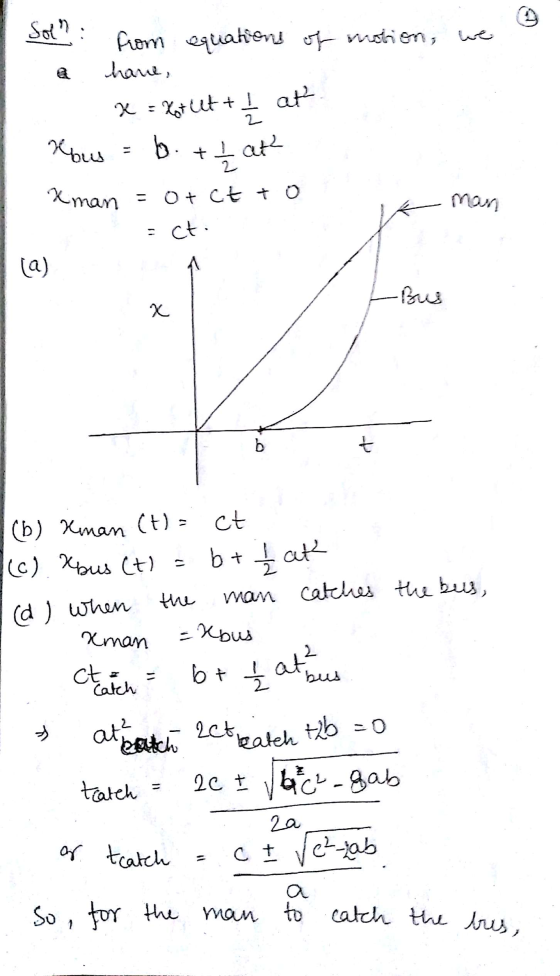
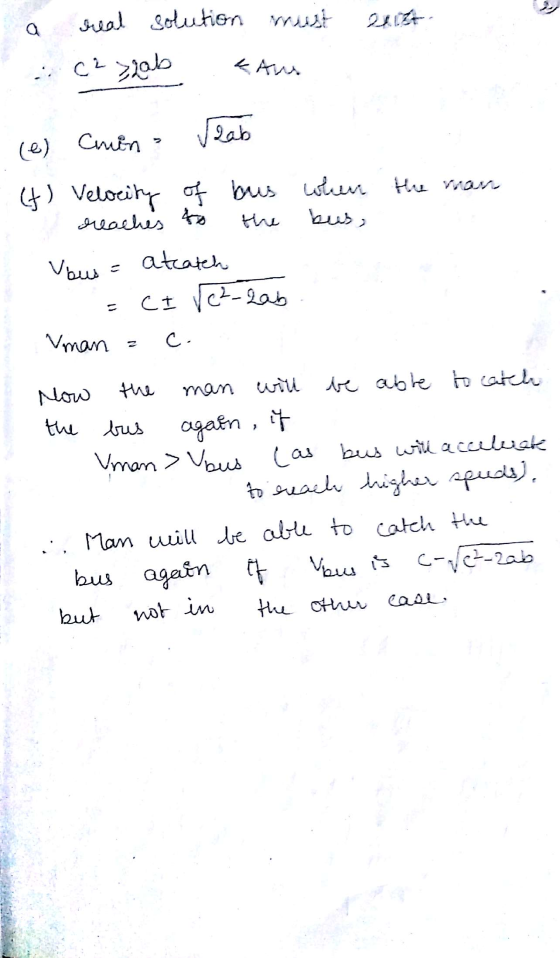
Add Answer to:
A man is running at speed c (much less than the speed of light) to catch...
A man is running at speed c (much less than the speed of light) to catch...
 A man is running at speed c
(much less than the speed of light) to catch a bus already at a
stop. At t=0, when he is a distance b from the door to the bus, the
bus starts moving with the positive acceleration a. Use a
coordinate system with x=0 at the door of the stopped bus.
Constants Part A Figure 1) A man is running at speed c (much less than the speed of light) to catch a...
A man is running at speed c
(much less than the speed of light) to catch a bus already at a
stop. At t=0, when he is a distance b from the door to the bus, the
bus starts moving with the positive acceleration a. Use a
coordinate system with x=0 at the door of the stopped bus.
Constants Part A Figure 1) A man is running at speed c (much less than the speed of light) to catch a...
Review (Figure 1) A man is running at speed c (much less than the speed of...
 Review (Figure 1) A man is running at speed c (much less than the speed of light) to catch a bus already at a stop. At t0, when he is a distance b from the door to the bus, the bus starts moving with the positive acceleration a. Figure 〈 1011 > Ar=b r0 Part A What Is Tman(t), the position of the man as a tunction of time? Answer symbolically in terms of the variables b, c, and t....
l Review (Figure 1) A man is running at speed c (much less than the speed...
 l Review (Figure 1) A man is running at speed c (much less than the speed of light) to catch a bus already at a stop. At t 0, when he is a distance b from the door to the bus, the bus starts moving with the positive acceleration a. Use a coordinate system with 0 at the door of the stopped bus. Figure 1 of 1> Ar-b Part A Submitted Answers What is Eman (t), the position of the...
A man is of light) to catch a bus already at a stop Att 0 e...
 A man is of light) to catch a bus already at a stop Att 0 e b from the door to the bus, the Part D bus starts moving with the positive a Use a stopped bus system with z 0 at the door of the Inserting the formulas you found for man(t) and () into the mn(Ceatch)h) you obtain the following Figure 1 of 1 Intuitively, the man will not catch the bus unless he is running fast enough...
15. A man is running to cateh a bus at his top speed of 6 m/s....
 15. A man is running to cateh a bus at his top speed of 6 m/s. The man is 25 m behind the b starts to move forward with an acceleration of 1 m/s e man catch the bus? If yes, then fiud out when and where it happens. If no, then determine how w an accurate position-versus-time graph of this scenario for both the man and the bus on the same (c) Repeat Parts (a) and (b) assuming that...
A student is running at her top speed of 5.4m/s to catch a bus, which is...
A student is running at her top speed of 5.4m/s to catch a bus, which is stopped at the bus stop. When the student is still a distance 39.9m from the bus, it starts to pull away, moving with a constant acceleration of 0.174m/s2 . how much time does the student have to run at 5.4m/s before she overtakes the bus? what distance does the student have to run at 5.4m/s before she overtakes the bus? When she eaches the...
A student is running at her top speed of 5.0 m/s to catch a bus, which...
A student is running at her top speed of 5.0 m/s to catch a bus, which is stopped at the bus stop. When the student is still a distance 38.8 m from the bus, it starts to pull away, moving with a constant acceleration of 0.167 m/s2 . A. What is the minimum speed the student must have to just catch up with the bus? B. For what time does she have to run in that case? C. For what...
A student is running at her top speed of 5.0 m/s to catch a bus, which...
A student is running at her top speed of 5.0 m/s to catch a bus, which is stopped at the bus stop. When the student is still a distance 38.8 m from the bus, it starts to pull away, moving with a constant acceleration of 0.167 m/s2 . A. For how much time does the student have to run at 5.0 m/s before she overtakes the bus? B. For what distance does the student have to run at 5.0 m/s...
A passenger is running at his maximum velocity of 8 m/s to catch a train. When...
A passenger is running at his maximum velocity of 8 m/s to catch a train. When he is a distance d from the nearest entry to the train, the train starts from rest with a constant acceleration a= 1.0 m/s^2 away from him. a. If d= 30 m and the passenger keeps running, will he be able to jump on the train? b. What is the critical separation d_c such that the passenger just catches the train? c. What is...
Hi, please answer this physics question. n is running at his maximum speed of 6.0 m/s...
 Hi, please answer this physics question.
n is running at his maximum speed of 6.0 m/s to catch a bus stopped by a traffic light. When he is 25 metres from the bus, the light changes and the bus accelerates uniformly at 1.0 m/s2. By use of a graph find either (a) how far he has to run to catch the bus or (b) his "frustration distance" (closest approach). Do not use a graphing calculator.
Hi, please answer this physics question.
n is running at his maximum speed of 6.0 m/s to catch a bus stopped by a traffic light. When he is 25 metres from the bus, the light changes and the bus accelerates uniformly at 1.0 m/s2. By use of a graph find either (a) how far he has to run to catch the bus or (b) his "frustration distance" (closest approach). Do not use a graphing calculator.
 A man is running at speed c
(much less than the speed of light) to catch a bus already at a
stop. At t=0, when he is a distance b from the door to the bus, the
bus starts moving with the positive acceleration a. Use a
coordinate system with x=0 at the door of the stopped bus.
Constants Part A Figure 1) A man is running at speed c (much less than the speed of light) to catch a...
A man is running at speed c
(much less than the speed of light) to catch a bus already at a
stop. At t=0, when he is a distance b from the door to the bus, the
bus starts moving with the positive acceleration a. Use a
coordinate system with x=0 at the door of the stopped bus.
Constants Part A Figure 1) A man is running at speed c (much less than the speed of light) to catch a...
 Review (Figure 1) A man is running at speed c (much less than the speed of light) to catch a bus already at a stop. At t0, when he is a distance b from the door to the bus, the bus starts moving with the positive acceleration a. Figure 〈 1011 > Ar=b r0 Part A What Is Tman(t), the position of the man as a tunction of time? Answer symbolically in terms of the variables b, c, and t....
 l Review (Figure 1) A man is running at speed c (much less than the speed of light) to catch a bus already at a stop. At t 0, when he is a distance b from the door to the bus, the bus starts moving with the positive acceleration a. Use a coordinate system with 0 at the door of the stopped bus. Figure 1 of 1> Ar-b Part A Submitted Answers What is Eman (t), the position of the...
 A man is of light) to catch a bus already at a stop Att 0 e b from the door to the bus, the Part D bus starts moving with the positive a Use a stopped bus system with z 0 at the door of the Inserting the formulas you found for man(t) and () into the mn(Ceatch)h) you obtain the following Figure 1 of 1 Intuitively, the man will not catch the bus unless he is running fast enough...
 15. A man is running to cateh a bus at his top speed of 6 m/s. The man is 25 m behind the b starts to move forward with an acceleration of 1 m/s e man catch the bus? If yes, then fiud out when and where it happens. If no, then determine how w an accurate position-versus-time graph of this scenario for both the man and the bus on the same (c) Repeat Parts (a) and (b) assuming that...
 Hi, please answer this physics question.
n is running at his maximum speed of 6.0 m/s to catch a bus stopped by a traffic light. When he is 25 metres from the bus, the light changes and the bus accelerates uniformly at 1.0 m/s2. By use of a graph find either (a) how far he has to run to catch the bus or (b) his "frustration distance" (closest approach). Do not use a graphing calculator.
Hi, please answer this physics question.
n is running at his maximum speed of 6.0 m/s to catch a bus stopped by a traffic light. When he is 25 metres from the bus, the light changes and the bus accelerates uniformly at 1.0 m/s2. By use of a graph find either (a) how far he has to run to catch the bus or (b) his "frustration distance" (closest approach). Do not use a graphing calculator.
Most questions answered within 3 hours.
-
Where is the error in this code sequence?
String s1 = "Hello";
String s2 = "ello";...
asked 10 months ago -
Financial data for Joel de Paris, Inc., for last year
follow:
Joel de Paris, Inc.
Balance...
asked 10 months ago -
Consider this reaction:
Al2(SO4)3 (aq)+ BaCl3
(aq) Al2Cl6 (aq)- +
3BaSO4(s) . What is the...
asked 10 months ago -
Suppose that Savneet is considering increasing her
recent random sample from 20 car rentals to 40...
asked 10 months ago -
Trucks arrive at an unloading terminal at an average rate of 120
per hour.
Trucks arrive...
asked 10 months ago -
Why are methanol and ethanol completely soluble in water while
octanol is not very little soluble....
asked 10 months ago -
A facilities manager at a university reads in a research report
that the mean amount of...
asked 10 months ago -
When the CuSO4 is rehydrated by adding water to the anhydrous
compound, is this an endothermic...
asked 10 months ago -
A ray of sunlight is passing from diamond into crown glass; the
angle of incidence is...
asked 10 months ago -
A block of mass 0.249 kg is placed on top of a light, vertical
spring of...
asked 10 months ago -
how do the kidneys compensate in the presences of acidosis
a) trigger hyperventilate
b) reserve acid...
asked 10 months ago -
Question 501 pts
The rental rate of capital to the firm increases. Which of the
following...
asked 10 months ago