
Homework Answers
Reversing the last equation: E + C  F The enthalpy is the negative of the enthalpy change of the
forward reaction:
F The enthalpy is the negative of the enthalpy change of the
forward reaction:  H = -15 KJ/mol
Now adding the first two reactions and the equation we formed
above: 2A + B + D
2F
This means we need to add the individual enthalpies of the three separate equations: -35 + 20 - 15 = -30 KJ/mol
Add Answer to:
please show neatly with steps thank you.
12) Given the enthalpy changes: 0 Inn A+B →...
Question 12 and 13. Could you please show detailed work. Thank you. 12. Estimate the enthalpy...
 Question 12 and 13. Could you please show detailed
work. Thank you.
12. Estimate the enthalpy change for the reaction 2CO + O2 → 2CO2 given the following bond energies. BE(C = 0) = 1074 kJ/mol; BEIO = 0) = 499 kJ/mol; BE(C =0) = 802 kJ/mol 13. Using the information given below calculate the H-H bond energy. N2(g) + 3H2(g) + 2NH3(g) AHpX = -105.0 kJ N-N = 160 kJ/mol N=N = 418 kJ/mol NEN = 945 kJ/mol N-H=...
Question 12 and 13. Could you please show detailed
work. Thank you.
12. Estimate the enthalpy change for the reaction 2CO + O2 → 2CO2 given the following bond energies. BE(C = 0) = 1074 kJ/mol; BEIO = 0) = 499 kJ/mol; BE(C =0) = 802 kJ/mol 13. Using the information given below calculate the H-H bond energy. N2(g) + 3H2(g) + 2NH3(g) AHpX = -105.0 kJ N-N = 160 kJ/mol N=N = 418 kJ/mol NEN = 945 kJ/mol N-H=...
Calculate the standard enthalpy change for the reaction 2A+B⇌2C+2D where the heats of formation are given...
 Calculate the standard enthalpy change for the reaction
2A+B⇌2C+2D
where the heats of formation are given in the following
table:
Substance
ΔH∘f
(kJ/mol)
A
-275
B
-413
C
223
D
-521
Express your answer in kilojoules.
- Part A Calculate the standard enthalpy change for the reaction 2A+B=2C+2D where the heats of formation are given in the following table: Substance A AH (kJ/mol) -275 -413 223 -521 B D Express your answer in kilojoules. View Available Hint(s) O AED *...
Calculate the standard enthalpy change for the reaction
2A+B⇌2C+2D
where the heats of formation are given in the following
table:
Substance
ΔH∘f
(kJ/mol)
A
-275
B
-413
C
223
D
-521
Express your answer in kilojoules.
- Part A Calculate the standard enthalpy change for the reaction 2A+B=2C+2D where the heats of formation are given in the following table: Substance A AH (kJ/mol) -275 -413 223 -521 B D Express your answer in kilojoules. View Available Hint(s) O AED *...
Question 4 of 4 > The enthalpy changes, AH, for three reactions are given. H, ()0,()H,O)...
 Question 4 of 4 > The enthalpy changes, AH, for three reactions are given. H, ()0,()H,O) Ca(s) +2H (aq) Ca2 (aq) +H,(g) CaO(s) +2H (aq) - AH=-286 kJ/mol AH= -544 kJ/mol Ca2 (aq) +H,O() AH =-193 kJ/mol Using Hess's law, calculate the heat of formation for CaO(s) using the reaction shown. 0,()Ca) Ca(s) + kJ/mol ΔΗ- TOOLS During an experiment, a student adds 1.81 g CaO to 300.0 mL of 1.000 M HCI. The student observès a temperature increase of...
Given the thermochemical equations A(g) — Bg AH = 70 kJ B(g) — C(g) AH = -140 kJ find the enthalpy changes for each...
 Given the thermochemical equations A(g) — Bg AH = 70 kJ B(g) — C(g) AH = -140 kJ find the enthalpy changes for each reaction 3 A(g) — 3Bg AH = B(g) Ag) AH = A(g) -C(O) AH =
A set of chemical equations and their associated enthalpy values are given. | Reaction A+B →...
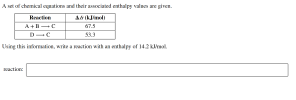 A set of chemical equations and their associated enthalpy values are given. | Reaction A+B → C D +C AH (kJ/mol) 67.5 53.3 | Using this information, write a reaction with an enthalpy of 14.2 kJ/mol. reaction:
I keep getting the answer wrong please show steps! Part A The change in enthalpy (AH)...
 I keep getting the answer wrong please show steps!
Part A The change in enthalpy (AH) for a reaction is -23.5 kJ/mol. The equilibrium constant for the reaction is 2.1x10³ at 298 K What is the equilibrium constant for the reaction at 605 K? Express your answer using two significant figures. Submit Request Answer
I keep getting the answer wrong please show steps!
Part A The change in enthalpy (AH) for a reaction is -23.5 kJ/mol. The equilibrium constant for the reaction is 2.1x10³ at 298 K What is the equilibrium constant for the reaction at 605 K? Express your answer using two significant figures. Submit Request Answer
#9-12 A simple step by step process for all please Thank you! a) -2.81 x 10³...
 #9-12
A simple step by step process for all please
Thank you!
a) -2.81 x 10³ kJ b) -25.8 k c15.6 k d) -42.6 k e) 25.8 k Given the thermochemical equation calculate AHo for the following reaction: 9. 2NOg) + 028) 2NO2g) 솨1°=-114.0 kJ NOg) NO(g) 1/2 02(g) a) +114.0 k b) +57.0 k c) -114 kJ d) -57.0k) e) +128 k] 10. The standard enthalpy change for the following reaction is -72.8 kJ. What is the standard enthalpy...
#9-12
A simple step by step process for all please
Thank you!
a) -2.81 x 10³ kJ b) -25.8 k c15.6 k d) -42.6 k e) 25.8 k Given the thermochemical equation calculate AHo for the following reaction: 9. 2NOg) + 028) 2NO2g) 솨1°=-114.0 kJ NOg) NO(g) 1/2 02(g) a) +114.0 k b) +57.0 k c) -114 kJ d) -57.0k) e) +128 k] 10. The standard enthalpy change for the following reaction is -72.8 kJ. What is the standard enthalpy...
CHANGES IN ENTROPY OF UNIVERSE VS SYSTEM. Evaluating Spontaneity Considering both Entropy and Enthalpy 7. In...
 CHANGES IN ENTROPY OF UNIVERSE VS SYSTEM. Evaluating Spontaneity Considering both Entropy and Enthalpy 7. In a spontaneous process, which of the following always increases? a. the entropy of the system b. the entropy of the surroundings c. the entropy of the universe d. the entropy of the system and the universe c. the entropy of the system, surroundings and the universe (Hand S refer to the system), a. AH>0 8. Processes are always spontaneous, regardless of temperature, when and...
5-7 help please !! due soon S When 7.0 g of sodium hydroxide (NaOH) is dissolved...
 5-7 help please !! due soon
S When 7.0 g of sodium hydroxide (NaOH) is dissolved in 238.5 g of water in an insulated container, the temperature rises from 20.00 oC to 27.66 oC. Calculate the molar enthalpy change (AH) for the dissolution process in kJ/mol NaOH A) -43.7 kJ/mol B) +45.0 kJ/ml C)-32.7 kJ/mol D) +32.7 kJ/mol E) -45.0 kJ/mol 6) Given the data in the table below, AH rxn for the reaction 4NH3 (g)+502 (8) -- 4NO (g)...
5-7 help please !! due soon
S When 7.0 g of sodium hydroxide (NaOH) is dissolved in 238.5 g of water in an insulated container, the temperature rises from 20.00 oC to 27.66 oC. Calculate the molar enthalpy change (AH) for the dissolution process in kJ/mol NaOH A) -43.7 kJ/mol B) +45.0 kJ/ml C)-32.7 kJ/mol D) +32.7 kJ/mol E) -45.0 kJ/mol 6) Given the data in the table below, AH rxn for the reaction 4NH3 (g)+502 (8) -- 4NO (g)...
TC04M01 Use the enthalpy changes given in the data below to calculate the enthalpy change for...
 TC04M01 Use the enthalpy changes given in the data below to calculate the enthalpy change for this reaction: Cus(s) + O2(g) → Cu(s) + SO2(9) Data: Reaction no. Reaction A.HⓇ/kJ morat 298K standard state = 1 bar. +314 2 2 CuO(s) – 2Cu(s) + O2(g) S(s) + O2(g) - S02(9) 2CuO(s) + 2S(s) - 2CuS(s) + O2(9) -297 +208 Select one: a. +225 kJ/mol b.-85 kJ/mol O C. -244 kJ/mol d. -191 kJ/mol e. -225 kJ/mol
 Question 12 and 13. Could you please show detailed
work. Thank you.
12. Estimate the enthalpy change for the reaction 2CO + O2 → 2CO2 given the following bond energies. BE(C = 0) = 1074 kJ/mol; BEIO = 0) = 499 kJ/mol; BE(C =0) = 802 kJ/mol 13. Using the information given below calculate the H-H bond energy. N2(g) + 3H2(g) + 2NH3(g) AHpX = -105.0 kJ N-N = 160 kJ/mol N=N = 418 kJ/mol NEN = 945 kJ/mol N-H=...
Question 12 and 13. Could you please show detailed
work. Thank you.
12. Estimate the enthalpy change for the reaction 2CO + O2 → 2CO2 given the following bond energies. BE(C = 0) = 1074 kJ/mol; BEIO = 0) = 499 kJ/mol; BE(C =0) = 802 kJ/mol 13. Using the information given below calculate the H-H bond energy. N2(g) + 3H2(g) + 2NH3(g) AHpX = -105.0 kJ N-N = 160 kJ/mol N=N = 418 kJ/mol NEN = 945 kJ/mol N-H=...
 Calculate the standard enthalpy change for the reaction
2A+B⇌2C+2D
where the heats of formation are given in the following
table:
Substance
ΔH∘f
(kJ/mol)
A
-275
B
-413
C
223
D
-521
Express your answer in kilojoules.
- Part A Calculate the standard enthalpy change for the reaction 2A+B=2C+2D where the heats of formation are given in the following table: Substance A AH (kJ/mol) -275 -413 223 -521 B D Express your answer in kilojoules. View Available Hint(s) O AED *...
Calculate the standard enthalpy change for the reaction
2A+B⇌2C+2D
where the heats of formation are given in the following
table:
Substance
ΔH∘f
(kJ/mol)
A
-275
B
-413
C
223
D
-521
Express your answer in kilojoules.
- Part A Calculate the standard enthalpy change for the reaction 2A+B=2C+2D where the heats of formation are given in the following table: Substance A AH (kJ/mol) -275 -413 223 -521 B D Express your answer in kilojoules. View Available Hint(s) O AED *...
 Question 4 of 4 > The enthalpy changes, AH, for three reactions are given. H, ()0,()H,O) Ca(s) +2H (aq) Ca2 (aq) +H,(g) CaO(s) +2H (aq) - AH=-286 kJ/mol AH= -544 kJ/mol Ca2 (aq) +H,O() AH =-193 kJ/mol Using Hess's law, calculate the heat of formation for CaO(s) using the reaction shown. 0,()Ca) Ca(s) + kJ/mol ΔΗ- TOOLS During an experiment, a student adds 1.81 g CaO to 300.0 mL of 1.000 M HCI. The student observès a temperature increase of...
 Given the thermochemical equations A(g) — Bg AH = 70 kJ B(g) — C(g) AH = -140 kJ find the enthalpy changes for each reaction 3 A(g) — 3Bg AH = B(g) Ag) AH = A(g) -C(O) AH =
 A set of chemical equations and their associated enthalpy values are given. | Reaction A+B → C D +C AH (kJ/mol) 67.5 53.3 | Using this information, write a reaction with an enthalpy of 14.2 kJ/mol. reaction:
 I keep getting the answer wrong please show steps!
Part A The change in enthalpy (AH) for a reaction is -23.5 kJ/mol. The equilibrium constant for the reaction is 2.1x10³ at 298 K What is the equilibrium constant for the reaction at 605 K? Express your answer using two significant figures. Submit Request Answer
I keep getting the answer wrong please show steps!
Part A The change in enthalpy (AH) for a reaction is -23.5 kJ/mol. The equilibrium constant for the reaction is 2.1x10³ at 298 K What is the equilibrium constant for the reaction at 605 K? Express your answer using two significant figures. Submit Request Answer
 #9-12
A simple step by step process for all please
Thank you!
a) -2.81 x 10³ kJ b) -25.8 k c15.6 k d) -42.6 k e) 25.8 k Given the thermochemical equation calculate AHo for the following reaction: 9. 2NOg) + 028) 2NO2g) 솨1°=-114.0 kJ NOg) NO(g) 1/2 02(g) a) +114.0 k b) +57.0 k c) -114 kJ d) -57.0k) e) +128 k] 10. The standard enthalpy change for the following reaction is -72.8 kJ. What is the standard enthalpy...
#9-12
A simple step by step process for all please
Thank you!
a) -2.81 x 10³ kJ b) -25.8 k c15.6 k d) -42.6 k e) 25.8 k Given the thermochemical equation calculate AHo for the following reaction: 9. 2NOg) + 028) 2NO2g) 솨1°=-114.0 kJ NOg) NO(g) 1/2 02(g) a) +114.0 k b) +57.0 k c) -114 kJ d) -57.0k) e) +128 k] 10. The standard enthalpy change for the following reaction is -72.8 kJ. What is the standard enthalpy...
 CHANGES IN ENTROPY OF UNIVERSE VS SYSTEM. Evaluating Spontaneity Considering both Entropy and Enthalpy 7. In a spontaneous process, which of the following always increases? a. the entropy of the system b. the entropy of the surroundings c. the entropy of the universe d. the entropy of the system and the universe c. the entropy of the system, surroundings and the universe (Hand S refer to the system), a. AH>0 8. Processes are always spontaneous, regardless of temperature, when and...
 5-7 help please !! due soon
S When 7.0 g of sodium hydroxide (NaOH) is dissolved in 238.5 g of water in an insulated container, the temperature rises from 20.00 oC to 27.66 oC. Calculate the molar enthalpy change (AH) for the dissolution process in kJ/mol NaOH A) -43.7 kJ/mol B) +45.0 kJ/ml C)-32.7 kJ/mol D) +32.7 kJ/mol E) -45.0 kJ/mol 6) Given the data in the table below, AH rxn for the reaction 4NH3 (g)+502 (8) -- 4NO (g)...
5-7 help please !! due soon
S When 7.0 g of sodium hydroxide (NaOH) is dissolved in 238.5 g of water in an insulated container, the temperature rises from 20.00 oC to 27.66 oC. Calculate the molar enthalpy change (AH) for the dissolution process in kJ/mol NaOH A) -43.7 kJ/mol B) +45.0 kJ/ml C)-32.7 kJ/mol D) +32.7 kJ/mol E) -45.0 kJ/mol 6) Given the data in the table below, AH rxn for the reaction 4NH3 (g)+502 (8) -- 4NO (g)...
 TC04M01 Use the enthalpy changes given in the data below to calculate the enthalpy change for this reaction: Cus(s) + O2(g) → Cu(s) + SO2(9) Data: Reaction no. Reaction A.HⓇ/kJ morat 298K standard state = 1 bar. +314 2 2 CuO(s) – 2Cu(s) + O2(g) S(s) + O2(g) - S02(9) 2CuO(s) + 2S(s) - 2CuS(s) + O2(9) -297 +208 Select one: a. +225 kJ/mol b.-85 kJ/mol O C. -244 kJ/mol d. -191 kJ/mol e. -225 kJ/mol
Most questions answered within 3 hours.
-
Where is the error in this code sequence?
String s1 = "Hello";
String s2 = "ello";...
asked 10 months ago -
Financial data for Joel de Paris, Inc., for last year
follow:
Joel de Paris, Inc.
Balance...
asked 10 months ago -
Consider this reaction:
Al2(SO4)3 (aq)+ BaCl3
(aq) Al2Cl6 (aq)- +
3BaSO4(s) . What is the...
asked 10 months ago -
Suppose that Savneet is considering increasing her
recent random sample from 20 car rentals to 40...
asked 10 months ago -
Trucks arrive at an unloading terminal at an average rate of 120
per hour.
Trucks arrive...
asked 10 months ago -
Why are methanol and ethanol completely soluble in water while
octanol is not very little soluble....
asked 10 months ago -
A facilities manager at a university reads in a research report
that the mean amount of...
asked 10 months ago -
When the CuSO4 is rehydrated by adding water to the anhydrous
compound, is this an endothermic...
asked 10 months ago -
A ray of sunlight is passing from diamond into crown glass; the
angle of incidence is...
asked 10 months ago -
A block of mass 0.249 kg is placed on top of a light, vertical
spring of...
asked 10 months ago -
how do the kidneys compensate in the presences of acidosis
a) trigger hyperventilate
b) reserve acid...
asked 10 months ago -
Question 501 pts
The rental rate of capital to the firm increases. Which of the
following...
asked 10 months ago