Consider the market for restaurant meals. Illustrate graphically how an increase in income would affect the...
Consider the market for restaurant meals. Illustrate graphically how an increase in income would affect the restaurant meal market.
Homework Answers
Restaurant meals are a normal good.
In case of normal good, increase in income leads to increase in demand and decrease in income leads to decrease in demand.
It has been given that there is an increase in income.
So, this increase in income will result in an increase in demand for restaurant meals.
This will shift the demand for restaurant meals to the right.
Following is the required figure -
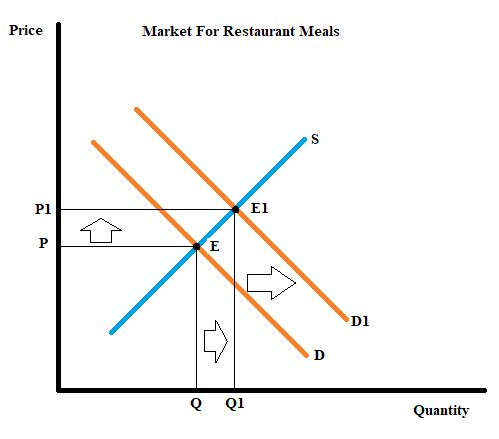
Initially, the market for restaurant meals was in equilibrium at point E. The equilibrium price was P per meal and the equilibrium quantity is Q meals.
Now, with increase in income, demand for restaurant meals have increased.
This increase in demand for restaurant meals will shift the demand curve for restaurant meals to the right from D to D1.
New equilibrium is attained at point E1. The new equilibrium price is P1 per meal and new equilibrium quantity is Q1 meals.
Thus,
An increase in income has resulted in an increase in price of meals and quantity of meals in the restaurant meal market.
Add Answer to:
Consider the market for restaurant meals. Illustrate graphically
how an increase in income would affect the...
Consider the market for Domino’s pizza. Illustrate graphically how an increase in the price of tomato...
Consider the market for Domino’s pizza. Illustrate graphically how an increase in the price of tomato sauce would affect the Domino’s Pizza market.
Consider the market for Pepsi. Illustrate graphically how a decrease in the price of Coke would...
Consider the market for Pepsi. Illustrate graphically how a decrease in the price of Coke would affect the Pepsi market.
Market Effects of Increased Income. Consider the market for restaurant meals. If consumer income increases, and restaur...
 Market Effects of Increased Income. Consider the market for restaurant meals. If consumer income increases, and restaurant meals are normal goods, what happens to the demand for restaurant meals? Restaurant meals Use the line-drawing tool to draw the new demand line for restaurant meals. Label this line "D2 Carefully follow the instructions above, and only draw the required objects. As a result of the change in consumer income, equilibrium price of meals will equilibrium quantity of meals will Price per...
using two graphs, graphically illustrate the effect of an increase in income with the prices of...
using two graphs, graphically illustrate the effect of an increase in income with the prices of all goods fixed, with the first graph demonstrating how this causes consumers to alter their choice of market baskets for the consumption of food and clothing. Plot food on the horizontal axis and clothing on the vertical axis. Draw a second graph related to the first graph to demonstrate how the demand for food changes as income increases.
graphically illustrate how does efficiency wage theory affect the unemployment level?
graphically illustrate how does efficiency wage theory affect the unemployment level?
Explain in short answers please: 1.Graphically illustrate and explain what happens to consumer spending when consumers...
Explain in short answers please: 1.Graphically illustrate and explain what happens to consumer spending when consumers become more optimistic about the future, i.e., consumer expectations rise. 2.Graphically illustrate and explain how an increase in the interest rate would affect consumer spending. 3.Graphically illustrate and explain what happens to consumer spending in response to an increase in consumer income.
Suppose a new invention allows corn farmers to shuck corn twice as fast. Illustrate graphically how...
Suppose a new invention allows corn farmers to shuck corn twice as fast. Illustrate graphically how this would affect the corn market.
A) Explain step-by-step how each of the following will affect the consumption and saving curves. Illustrate...
A) Explain step-by-step how each of the following will affect the consumption and saving curves. Illustrate your answers graphically (2 graphs for each). (3pts each) a. Consumers are afraid that prices will rise in the future. b. Income taxes are decreased. c. An increase in the price of houses and other assets. B) Explain step-by-step how each of the following will affect the demand for investment curve. Illustrate your answers graphically. (2.5pts each) a. A decrease in the real interest...
Suppose people expect the price of Microsoft stock to go down in the future. Illustrate graphically...
Suppose people expect the price of Microsoft stock to go down in the future. Illustrate graphically how this would affect the market for Microsoft stock today
Suppose we are analyzing the market for hot chocolate. Graphically illustrate the impact each of the...
 Suppose we are analyzing the market for hot chocolate. Graphically illustrate the impact each of the following would have on demand or supply. Also show how equilibrium price and equilibrium quantity would change i. Producers expect the price of hot chocolate to increase next month. J. Currently, the price of hot chocolate is $0.50 per cup above equilibrium.
 Market Effects of Increased Income. Consider the market for restaurant meals. If consumer income increases, and restaurant meals are normal goods, what happens to the demand for restaurant meals? Restaurant meals Use the line-drawing tool to draw the new demand line for restaurant meals. Label this line "D2 Carefully follow the instructions above, and only draw the required objects. As a result of the change in consumer income, equilibrium price of meals will equilibrium quantity of meals will Price per...
 Suppose we are analyzing the market for hot chocolate. Graphically illustrate the impact each of the following would have on demand or supply. Also show how equilibrium price and equilibrium quantity would change i. Producers expect the price of hot chocolate to increase next month. J. Currently, the price of hot chocolate is $0.50 per cup above equilibrium.
Most questions answered within 3 hours.
-
Where is the error in this code sequence?
String s1 = "Hello";
String s2 = "ello";...
asked 10 months ago -
Financial data for Joel de Paris, Inc., for last year
follow:
Joel de Paris, Inc.
Balance...
asked 10 months ago -
Consider this reaction:
Al2(SO4)3 (aq)+ BaCl3
(aq) Al2Cl6 (aq)- +
3BaSO4(s) . What is the...
asked 10 months ago -
Suppose that Savneet is considering increasing her
recent random sample from 20 car rentals to 40...
asked 10 months ago -
Trucks arrive at an unloading terminal at an average rate of 120
per hour.
Trucks arrive...
asked 10 months ago -
Why are methanol and ethanol completely soluble in water while
octanol is not very little soluble....
asked 10 months ago -
A facilities manager at a university reads in a research report
that the mean amount of...
asked 10 months ago -
When the CuSO4 is rehydrated by adding water to the anhydrous
compound, is this an endothermic...
asked 10 months ago -
A ray of sunlight is passing from diamond into crown glass; the
angle of incidence is...
asked 10 months ago -
A block of mass 0.249 kg is placed on top of a light, vertical
spring of...
asked 10 months ago -
how do the kidneys compensate in the presences of acidosis
a) trigger hyperventilate
b) reserve acid...
asked 10 months ago -
Question 501 pts
The rental rate of capital to the firm increases. Which of the
following...
asked 10 months ago