


Homework Answers
Add Answer to:
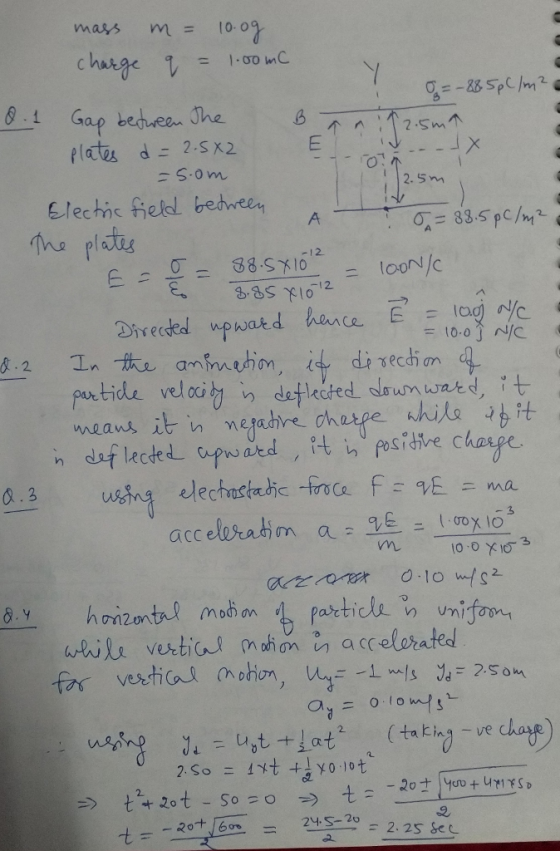
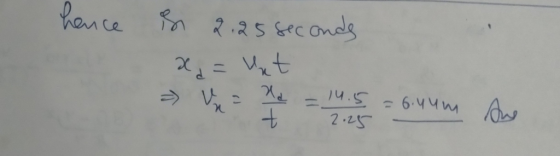
Interactive Exercises 22.14: Motion of a Charged Particle in an External Electric Field I A particle...
Active Figure Motion of a Charged Particle in a Uniform Magnetic Field The animation below illustrates...
 Active Figure Motion of a Charged Particle in a Uniform Magnetic Field The animation below illustrates a charged particle moving in circular motion due to the magnetic force caused by a constant and uniform magnetic field oriented into the page. The blue crosses represent the tails of the magnetic field vectors nstructions: Use the blue sliders to adjust the mass, speed, particle charge and magnetic field magnitude. Change each parameter and observe the eftect on the particle's motion. If the...
Interactive Exercises 22.13: Electric Field Due to Two Charged Sheets: Sample Problem (Two Parallel Sheets of...
 Interactive Exercises 22.13: Electric Field Due to Two Charged Sheets: Sample Problem (Two Parallel Sheets of Charge) In an industrial process to large, thin, lat sheets of plastic are given uniform charges over their surfaces. The sheets are so large that, for locations not too close to the edges, we can approximate them as being in'inite in extent. Figure 22.13.1 shows a side view of the e o sheets, hich are pe al el. The +x r ns aleng one...
3.2 Electric Field of a Charged Particle The four properties of the electric field of a...
 3.2 Electric Field of a Charged Particle The four properties of the electric field of a charged particle are captured by the vector field where the particle has charges and the source-to-target radial vector field and its associated unit vector field are defined as Psr (x,y) = (x - 1s)i + (- ) Pris(z,y) STIFT IFs (2.y) and k = 8.99 x 10°N C/ mºis Coulomb's constant. Question 3.3) Consider a 2 C source particle, located at the position (1,3)...
Consider a charged particle of mass 0.004 kg placed in a downward-pointing electric field of magnitude...
Consider a charged particle of mass 0.004 kg placed in a downward-pointing electric field of magnitude 700 N/C. Determine both the sign and magnitude of the particle's net charge that allows it to "levitate" motionlessly against gravity
A -50 nC charged particle is in a uniform electric field E⃗ = (30 V/m ,...
A -50 nC charged particle is in a uniform electric field E⃗ = (30 V/m , east). An external force moves the particle 4.0 m north, then 4.0 m east, then 5.0 m south, and finally 3.0 m west. The particle begins and ends its motion with zero velocity.How much work is done on it by the external force? What is the potential difference between the particle's final and initial positions?
A charged particle moves through a region of space that has both a uniform electric field...
A charged particle moves through a region of space that has both a uniform electric field and a uniform magnetic field. What is the condition for these fields in order for the particle to move through this region at a constant velocity? Does the answer depend on the sign of the particle’s electric charge?
An unknown charged particle passes without deflection through crossed electric and magnetic fields of strengths 187,500...
 An unknown charged particle passes without deflection through crossed electric and magnetic fields of strengths 187,500 V/m and 0.1250 T, respectively. The particle passes out of the electric field, but the magnetic field continues, and the particle makes a semicircle of diameter 25.05 cm. What is the particle's charge-to-mass ratio? Can you identify the particle? can't identify proton electron neutron
A -60 nC charged particle is in a uniform electric field E⃗ = (20 V/m , east)....
A -60 nC charged particle is in a uniform electric field E⃗ = (20 V/m , east). An external force moves the particle 2.0 m north, then 5.0 m east, then 7.0 m south, and finally 4.0 m west. The particle begins and ends its motion with zero velocity. Part A How much work is done on it by the external force? Express your answer to two significant figures and include the appropriate units. Part B What is the potential difference...
Interactive Exercises 22.04: Collinear Charges and the Principle of Superposition Question 1 The figure below shaws...
 Interactive Exercises 22.04: Collinear Charges and the Principle of Superposition Question 1 The figure below shaws two source partides fixed on the xaxis. The particle an the left has charge g, and the partidle on tha right has charga 3g, whre g0. Tha axis is divided into three regions, labelad A, B, and C. For each region, state i it is possible for the net electric field to equal zero someuhere in the region for ary finite value of x;...
Your answer is partially correct. Try again. A moving particle encounters an external electric field that...
 Your answer is partially correct. Try again. A moving particle encounters an external electric field that decreases its kinetic energy from 9040 eV to 7610 eV as the particle moves from position A to position B. The electric potential at A is -48.0 V, and that at B is +14.0 V. Determine the charge of the particle. Include the algebraic sign (+ or -) wth your answer. Higher potential Lower potential VA 36.9 Number Units the tolerance is +/-2%
 Active Figure Motion of a Charged Particle in a Uniform Magnetic Field The animation below illustrates a charged particle moving in circular motion due to the magnetic force caused by a constant and uniform magnetic field oriented into the page. The blue crosses represent the tails of the magnetic field vectors nstructions: Use the blue sliders to adjust the mass, speed, particle charge and magnetic field magnitude. Change each parameter and observe the eftect on the particle's motion. If the...
 Interactive Exercises 22.13: Electric Field Due to Two Charged Sheets: Sample Problem (Two Parallel Sheets of Charge) In an industrial process to large, thin, lat sheets of plastic are given uniform charges over their surfaces. The sheets are so large that, for locations not too close to the edges, we can approximate them as being in'inite in extent. Figure 22.13.1 shows a side view of the e o sheets, hich are pe al el. The +x r ns aleng one...
 3.2 Electric Field of a Charged Particle The four properties of the electric field of a charged particle are captured by the vector field where the particle has charges and the source-to-target radial vector field and its associated unit vector field are defined as Psr (x,y) = (x - 1s)i + (- ) Pris(z,y) STIFT IFs (2.y) and k = 8.99 x 10°N C/ mºis Coulomb's constant. Question 3.3) Consider a 2 C source particle, located at the position (1,3)...
 An unknown charged particle passes without deflection through crossed electric and magnetic fields of strengths 187,500 V/m and 0.1250 T, respectively. The particle passes out of the electric field, but the magnetic field continues, and the particle makes a semicircle of diameter 25.05 cm. What is the particle's charge-to-mass ratio? Can you identify the particle? can't identify proton electron neutron
 Interactive Exercises 22.04: Collinear Charges and the Principle of Superposition Question 1 The figure below shaws two source partides fixed on the xaxis. The particle an the left has charge g, and the partidle on tha right has charga 3g, whre g0. Tha axis is divided into three regions, labelad A, B, and C. For each region, state i it is possible for the net electric field to equal zero someuhere in the region for ary finite value of x;...
 Your answer is partially correct. Try again. A moving particle encounters an external electric field that decreases its kinetic energy from 9040 eV to 7610 eV as the particle moves from position A to position B. The electric potential at A is -48.0 V, and that at B is +14.0 V. Determine the charge of the particle. Include the algebraic sign (+ or -) wth your answer. Higher potential Lower potential VA 36.9 Number Units the tolerance is +/-2%
Most questions answered within 3 hours.
-
Where is the error in this code sequence?
String s1 = "Hello";
String s2 = "ello";...
asked 10 months ago -
Financial data for Joel de Paris, Inc., for last year
follow:
Joel de Paris, Inc.
Balance...
asked 10 months ago -
Consider this reaction:
Al2(SO4)3 (aq)+ BaCl3
(aq) Al2Cl6 (aq)- +
3BaSO4(s) . What is the...
asked 10 months ago -
Suppose that Savneet is considering increasing her
recent random sample from 20 car rentals to 40...
asked 10 months ago -
Trucks arrive at an unloading terminal at an average rate of 120
per hour.
Trucks arrive...
asked 10 months ago -
Why are methanol and ethanol completely soluble in water while
octanol is not very little soluble....
asked 10 months ago -
A facilities manager at a university reads in a research report
that the mean amount of...
asked 10 months ago -
When the CuSO4 is rehydrated by adding water to the anhydrous
compound, is this an endothermic...
asked 10 months ago -
A ray of sunlight is passing from diamond into crown glass; the
angle of incidence is...
asked 10 months ago -
A block of mass 0.249 kg is placed on top of a light, vertical
spring of...
asked 10 months ago -
how do the kidneys compensate in the presences of acidosis
a) trigger hyperventilate
b) reserve acid...
asked 10 months ago -
Question 501 pts
The rental rate of capital to the firm increases. Which of the
following...
asked 10 months ago