
Homework Answers
Add Answer to:
help
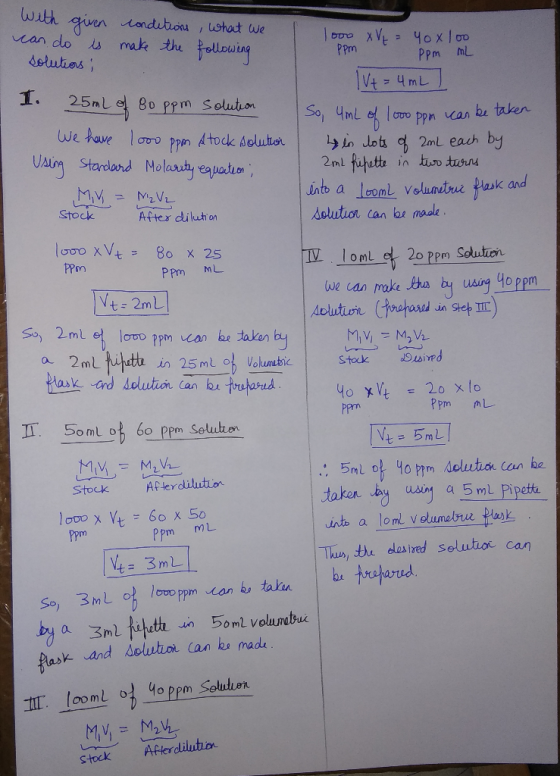
Describe in detail how you would make a series of four standards ranging from 1...
Attempt 1 Question 11 of 14 > You want to prepare a solution with a concentration...
 Attempt 1 Question 11 of 14 > You want to prepare a solution with a concentration of 200.0 PM from a stock solution with a concentration of 500.0 mM. At your disposal you have 5 mL and 10-ml transfer pipets and volumetric flasks of sizes 100, 250, 500, and 1000 mL. Which of the following serial dilutions will give you the 200.0 M solution? Produces a 200.0 M solution Does not produce a 200.0 M solution Dilute 10.00 mL of...
You must read the experiment and then answer these questions. 1. Look at the procedure for...
 You must read the experiment and then answer these questions. 1. Look at the procedure for using a pipet. Why should you not force the last remaining amount of liquid out of the pipet? 2. If you have a 50.00 mL volumetric flask (a flask marked at a specific volume) and a pipette that measures up to 10-mL with marks to the nearest 1/10 mL, how much solute would you add to the flask to make 50.00 mL of a...
Cabrillo College Chemistry 1B Buffer Problem Set 1. A desires study the effect of pH n...
 Cabrillo College Chemistry 1B Buffer Problem Set 1. A desires study the effect of pH n the growth of E. coli bacteria. She plans to do the research by preparing culture media that are buffered at three distinctly different PH values. Therefore, she decides to use the triprotic phosphoric acid (H,PO), potassium dihydrogen hydrogen phosphate o") and potassiam phosphate POe) to prepare the buffers K-1 7.11 103 Ka- 6.32 x 10" Kal 7.11 x 10 MATERIALSAFALLABLE Standardized solutions: 1.00 MH3PO,...
please do 1 through 4. Thank you. 0 1. Fe 1.SCN Procedure B: 1. Prepare ICE...
 please do 1 through 4. Thank you.
0 1. Fe 1.SCN Procedure B: 1. Prepare ICE tables for beakers 2 - 6 using the example below as a guideline (you will have 5 different ICE tables). Table 3. Sample "ICE" table. Fe(aq)*3 + SCN(aq) = FeSCN2 Initial: **M calculated **M calculated using your Table 2 using your Table 2 volumes volumes Change: - 1x - 1x Equilibrium: M 1x 1x = concentration calculated from Procedure A slope-intercept equation +1x M...
please do 1 through 4. Thank you.
0 1. Fe 1.SCN Procedure B: 1. Prepare ICE tables for beakers 2 - 6 using the example below as a guideline (you will have 5 different ICE tables). Table 3. Sample "ICE" table. Fe(aq)*3 + SCN(aq) = FeSCN2 Initial: **M calculated **M calculated using your Table 2 using your Table 2 volumes volumes Change: - 1x - 1x Equilibrium: M 1x 1x = concentration calculated from Procedure A slope-intercept equation +1x M...
CHEMISTRY HELP NEEDED!! How do I do this problem? can someone show me a step-by-step tutorial?...
 CHEMISTRY HELP NEEDED!! How do I do this problem? can someone
show me a step-by-step tutorial? I will vote and answer your
response, thanks in advance!
Standard Addition Method Problem Often when doing analytical work, we need to spike our sample because of matrix effects that impact our measurements. This involves making a series of solutions that include increasing amounts of a standard solution of known concentration along with a set amount of the unknown solution, diluting to a mark...
CHEMISTRY HELP NEEDED!! How do I do this problem? can someone
show me a step-by-step tutorial? I will vote and answer your
response, thanks in advance!
Standard Addition Method Problem Often when doing analytical work, we need to spike our sample because of matrix effects that impact our measurements. This involves making a series of solutions that include increasing amounts of a standard solution of known concentration along with a set amount of the unknown solution, diluting to a mark...
Procedure 1. Label four 50.0 mL volumetric flasks.)! through 4 2. Using a buret, add 10.00 ml of ...
 Procedure 1. Label four 50.0 mL volumetric flasks.)! through 4 2. Using a buret, add 10.00 ml of 2.00x10'MFeNO)D solution to each of the flasks 3. Using a buret, add 1.00 mL. 2.00 mL, 3.00 mL, and 4.00 mL of 2.00x 10 MKSCN 4. Fill each flask to the mark with 0.10 M HNO, solution. Stopper each flask and invert 5. Measure the absorbance of each solution at a wavelength of 447 nm (the absorbance reterred to in step 1...
PRE-LAR STUY GESTIONS The Solution is Dilution LA 20 You must read the experiment and then...
 PRE-LAR STUY GESTIONS The Solution is Dilution LA 20 You must read the experiment and then werde n 1. Look at the procedure for amount of liquit of the y o u 2. If you have a 50.00 ml. volumetric raskask a ta specife womendappe that measures up to 10-ml, with marks to the nearest 1/10 ml. how much more word you add to the flask to make 5000 mlofaS005 solution? 3. The 3,00 % solution needs to be diluted...
Name Solution Calculations Directions: Clearly show the setups for your calculations. 1. You wish to prepare 50.0 mL of 2.30x 10² M solution of your drug. Describe how to prepare this solution fr...
 Name Solution Calculations Directions: Clearly show the setups for your calculations. 1. You wish to prepare 50.0 mL of 2.30x 10² M solution of your drug. Describe how to prepare this solution from the pure drug and deionized water. Analytical balances and volumetric flasks are available to you. (Assume that your drug dissolves in water, at least to the extent necessary for this problem.) Use complete sentences in your description of the solution preparation process. Show any required calculations you...
Prelab Questions 1. a. (10) Determine the a) mass of the solute and b) volume of conc. HCl you are going to a) wei...
 Prelab Questions 1. a. (10) Determine the a) mass of the solute and b) volume of conc. HCl you are going to a) weigh out and b) measure with a graduated cylinder to create 1L of 100.0 ppm stock solution of Acetylsalicylic acid (ASA) (from the pure powder) in a 2%(W/V) HCI. Show your calculation. C at:.. HALI Procedure - External Standards 1. First make 2% V/v HCI. You will make this three times. Transfer to two plastic containers (use...
Bienvenido a Trip.com In Part 1 of the lab you will make the following four solutions:...
 Bienvenido a Trip.com In Part 1 of the lab you will make the following four solutions: About 3221 Solution Number 0.500 M Fe3+ 3.00 x 10⁻⁴ M SCN' water 2.50 mL 2.50 ml 2.50 mL 2.00 mL 0.50 mL 2.50 mL 1.50 mL 1.00 mL 2.50 mL 1.00 mL 1.50 mL 0 mL Given the data in the table above, determine the initial concentrations of [Fe3+] and [SCN"). Since one of the reactants is in excess, you can determine (FeSCN2+Jeg...
 Attempt 1 Question 11 of 14 > You want to prepare a solution with a concentration of 200.0 PM from a stock solution with a concentration of 500.0 mM. At your disposal you have 5 mL and 10-ml transfer pipets and volumetric flasks of sizes 100, 250, 500, and 1000 mL. Which of the following serial dilutions will give you the 200.0 M solution? Produces a 200.0 M solution Does not produce a 200.0 M solution Dilute 10.00 mL of...
 You must read the experiment and then answer these questions. 1. Look at the procedure for using a pipet. Why should you not force the last remaining amount of liquid out of the pipet? 2. If you have a 50.00 mL volumetric flask (a flask marked at a specific volume) and a pipette that measures up to 10-mL with marks to the nearest 1/10 mL, how much solute would you add to the flask to make 50.00 mL of a...
 Cabrillo College Chemistry 1B Buffer Problem Set 1. A desires study the effect of pH n the growth of E. coli bacteria. She plans to do the research by preparing culture media that are buffered at three distinctly different PH values. Therefore, she decides to use the triprotic phosphoric acid (H,PO), potassium dihydrogen hydrogen phosphate o") and potassiam phosphate POe) to prepare the buffers K-1 7.11 103 Ka- 6.32 x 10" Kal 7.11 x 10 MATERIALSAFALLABLE Standardized solutions: 1.00 MH3PO,...
 please do 1 through 4. Thank you.
0 1. Fe 1.SCN Procedure B: 1. Prepare ICE tables for beakers 2 - 6 using the example below as a guideline (you will have 5 different ICE tables). Table 3. Sample "ICE" table. Fe(aq)*3 + SCN(aq) = FeSCN2 Initial: **M calculated **M calculated using your Table 2 using your Table 2 volumes volumes Change: - 1x - 1x Equilibrium: M 1x 1x = concentration calculated from Procedure A slope-intercept equation +1x M...
please do 1 through 4. Thank you.
0 1. Fe 1.SCN Procedure B: 1. Prepare ICE tables for beakers 2 - 6 using the example below as a guideline (you will have 5 different ICE tables). Table 3. Sample "ICE" table. Fe(aq)*3 + SCN(aq) = FeSCN2 Initial: **M calculated **M calculated using your Table 2 using your Table 2 volumes volumes Change: - 1x - 1x Equilibrium: M 1x 1x = concentration calculated from Procedure A slope-intercept equation +1x M...
 CHEMISTRY HELP NEEDED!! How do I do this problem? can someone
show me a step-by-step tutorial? I will vote and answer your
response, thanks in advance!
Standard Addition Method Problem Often when doing analytical work, we need to spike our sample because of matrix effects that impact our measurements. This involves making a series of solutions that include increasing amounts of a standard solution of known concentration along with a set amount of the unknown solution, diluting to a mark...
CHEMISTRY HELP NEEDED!! How do I do this problem? can someone
show me a step-by-step tutorial? I will vote and answer your
response, thanks in advance!
Standard Addition Method Problem Often when doing analytical work, we need to spike our sample because of matrix effects that impact our measurements. This involves making a series of solutions that include increasing amounts of a standard solution of known concentration along with a set amount of the unknown solution, diluting to a mark...
 Procedure 1. Label four 50.0 mL volumetric flasks.)! through 4 2. Using a buret, add 10.00 ml of 2.00x10'MFeNO)D solution to each of the flasks 3. Using a buret, add 1.00 mL. 2.00 mL, 3.00 mL, and 4.00 mL of 2.00x 10 MKSCN 4. Fill each flask to the mark with 0.10 M HNO, solution. Stopper each flask and invert 5. Measure the absorbance of each solution at a wavelength of 447 nm (the absorbance reterred to in step 1...
 PRE-LAR STUY GESTIONS The Solution is Dilution LA 20 You must read the experiment and then werde n 1. Look at the procedure for amount of liquit of the y o u 2. If you have a 50.00 ml. volumetric raskask a ta specife womendappe that measures up to 10-ml, with marks to the nearest 1/10 ml. how much more word you add to the flask to make 5000 mlofaS005 solution? 3. The 3,00 % solution needs to be diluted...
 Name Solution Calculations Directions: Clearly show the setups for your calculations. 1. You wish to prepare 50.0 mL of 2.30x 10² M solution of your drug. Describe how to prepare this solution from the pure drug and deionized water. Analytical balances and volumetric flasks are available to you. (Assume that your drug dissolves in water, at least to the extent necessary for this problem.) Use complete sentences in your description of the solution preparation process. Show any required calculations you...
 Prelab Questions 1. a. (10) Determine the a) mass of the solute and b) volume of conc. HCl you are going to a) weigh out and b) measure with a graduated cylinder to create 1L of 100.0 ppm stock solution of Acetylsalicylic acid (ASA) (from the pure powder) in a 2%(W/V) HCI. Show your calculation. C at:.. HALI Procedure - External Standards 1. First make 2% V/v HCI. You will make this three times. Transfer to two plastic containers (use...
 Bienvenido a Trip.com In Part 1 of the lab you will make the following four solutions: About 3221 Solution Number 0.500 M Fe3+ 3.00 x 10⁻⁴ M SCN' water 2.50 mL 2.50 ml 2.50 mL 2.00 mL 0.50 mL 2.50 mL 1.50 mL 1.00 mL 2.50 mL 1.00 mL 1.50 mL 0 mL Given the data in the table above, determine the initial concentrations of [Fe3+] and [SCN"). Since one of the reactants is in excess, you can determine (FeSCN2+Jeg...
Most questions answered within 3 hours.
-
Where is the error in this code sequence?
String s1 = "Hello";
String s2 = "ello";...
asked 10 months ago -
Financial data for Joel de Paris, Inc., for last year
follow:
Joel de Paris, Inc.
Balance...
asked 10 months ago -
Consider this reaction:
Al2(SO4)3 (aq)+ BaCl3
(aq) Al2Cl6 (aq)- +
3BaSO4(s) . What is the...
asked 10 months ago -
Suppose that Savneet is considering increasing her
recent random sample from 20 car rentals to 40...
asked 10 months ago -
Trucks arrive at an unloading terminal at an average rate of 120
per hour.
Trucks arrive...
asked 10 months ago -
Why are methanol and ethanol completely soluble in water while
octanol is not very little soluble....
asked 10 months ago -
A facilities manager at a university reads in a research report
that the mean amount of...
asked 10 months ago -
When the CuSO4 is rehydrated by adding water to the anhydrous
compound, is this an endothermic...
asked 10 months ago -
A ray of sunlight is passing from diamond into crown glass; the
angle of incidence is...
asked 10 months ago -
A block of mass 0.249 kg is placed on top of a light, vertical
spring of...
asked 10 months ago -
how do the kidneys compensate in the presences of acidosis
a) trigger hyperventilate
b) reserve acid...
asked 10 months ago -
Question 501 pts
The rental rate of capital to the firm increases. Which of the
following...
asked 10 months ago