 please provide drawing with arrows
Homework Answers
Add Answer to:
please provide drawing with arrows
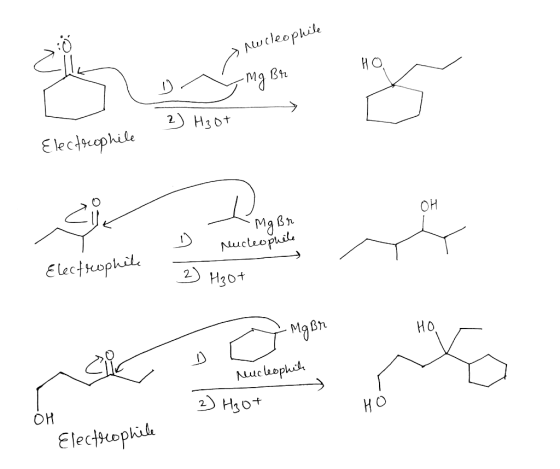
Carbonyl Reactions Identify the Nucleophile and the Electrophile and THEN predict...
1. a) (6 points) For each of the following reactions, identify the nucleophile and the electrophile...
 1. a) (6 points) For each of the following reactions, identify the nucleophile and the electrophile and draw the electron motion arrows required to generate the product given. nuc HOCH, HCH elec Hoe 09 OH CH OCH CH : ZEO: OCH,CH, ope
(a.) For each of the following reactions, identify the nucleophile and electrophile and draw the electron...
 (a.) For each of the following reactions, identify the
nucleophile and electrophile and draw the electron motion arrows
required to generate the product given.
(b.) The spectrum above was measured on a sample with
molecular formula C4H7ClO2. In the box in the middle of the
spectrum, draw the structure of a conpound with this formula that
is consistent with the spectrum above (there are wuite a few
structures that woukd fit). Do not attempt to match the fingerprint
region.
(c.)...
(a.) For each of the following reactions, identify the
nucleophile and electrophile and draw the electron motion arrows
required to generate the product given.
(b.) The spectrum above was measured on a sample with
molecular formula C4H7ClO2. In the box in the middle of the
spectrum, draw the structure of a conpound with this formula that
is consistent with the spectrum above (there are wuite a few
structures that woukd fit). Do not attempt to match the fingerprint
region.
(c.)...
Supply the arrows for each of the following reactions. Identify the nucleophile/base and the electrophile/acid (when...
 Supply the arrows for each of the following reactions. Identify the nucleophile/base and the electrophile/acid (when possible). Calcualte AH for each reaction. Estimate Keq (>1 or <1) for each reaction. Is the reaction exothermic or endothermic? You must answer all of the questions to receive full credit. Use the bond strength chart provided for bond dissociation energies. Upload answers (with your name clearly shown) as WORD, PDF or JPEG] Reaction 1 | 16-H 1 + + :NH, NH3 Reaction 2...
Predict the product of the reaction mechanisms. Identify the electrophile and nucleophile in each reaction. Propose...
 Predict the product of the reaction mechanisms. Identify the electrophile and nucleophile in each reaction. Propose a mechanism for each reaction below. This means show curved arrows. You may want to fill in any nonbonding electrons. Show an example of each of the following types of reactions and explain why it is that type: Addition elimination Rearrangement Substitution
Draw the mechanism for the previous 2 reactions. Remember arrows should go from nucleophile to electrophile....
 Draw the mechanism for the previous 2 reactions. Remember arrows
should go from nucleophile to electrophile. (Full: both mechanisms
correct with no more than 1 minor error, partial: one mechanism
correct with no more than 1 minor error OR both correct with no
more than 3 minor errors)
HNMR assignment, partial: correct NMR assignments) 460 OH 0.98 Br 0.98 \.92 (3.90 11.92 0.98 0.98 C7H 40 Reagents for Synthesis mg, Etzo 2 PPM 4.2 ppm, 1H, s 3.2 ppm, 1H,...
Draw the mechanism for the previous 2 reactions. Remember arrows
should go from nucleophile to electrophile. (Full: both mechanisms
correct with no more than 1 minor error, partial: one mechanism
correct with no more than 1 minor error OR both correct with no
more than 3 minor errors)
HNMR assignment, partial: correct NMR assignments) 460 OH 0.98 Br 0.98 \.92 (3.90 11.92 0.98 0.98 C7H 40 Reagents for Synthesis mg, Etzo 2 PPM 4.2 ppm, 1H, s 3.2 ppm, 1H,...
Please explain and show arrows if possible! Thank you! Q1) Identify the nucleophile and electrophile i...
 Please explain and show arrows if possible! Thank you!
Q1) Identify the nucleophile and electrophile i ction below and label them. (10 poin + H-C + CT 3 points 'О CN 2. 3 points 3. 4 points
Please explain and show arrows if possible! Thank you!
Q1) Identify the nucleophile and electrophile i ction below and label them. (10 poin + H-C + CT 3 points 'О CN 2. 3 points 3. 4 points
Predict whether they are nucleophiles, electrophile, oxidizing, reducing agent or none. 1) Predict whether each of the reagents would be primarily one of the following: a nucleophile, an electroph...
 Predict whether they are nucleophiles, electrophile,
oxidizing, reducing agent or none.
1) Predict whether each of the reagents would be primarily one of the following: a nucleophile, an electrophile, an oxidizing reagent, a reducing agent or none. (0.5 points each.) OsO4 H, KMnO4 CH3MgBr CH,-Cl C3Hg KOH NaCN For the following reactions, predict the major product. Assume that reagents dded are in excess when required. You do not need to show mechanisms (2 points ach). MgBr 1)
1) Predict whether...
Predict whether they are nucleophiles, electrophile,
oxidizing, reducing agent or none.
1) Predict whether each of the reagents would be primarily one of the following: a nucleophile, an electrophile, an oxidizing reagent, a reducing agent or none. (0.5 points each.) OsO4 H, KMnO4 CH3MgBr CH,-Cl C3Hg KOH NaCN For the following reactions, predict the major product. Assume that reagents dded are in excess when required. You do not need to show mechanisms (2 points ach). MgBr 1)
1) Predict whether...
Please show all arrows and explain the answer Predict the Product. Provide the stable organic product(s)...
 Please show all arrows and explain the answer
Predict the Product. Provide the stable organic product(s) for the reactions below. MgBr (1 eq.) von 1. Mgº, CH3CH2OCH2CH3 2. Å 3. H2O, HCI 1. CH,MgBr (xs) 2. H2O, HCI 1. Mg", CH3CH,OCH,CH3 2. D20
Please show all arrows and explain the answer
Predict the Product. Provide the stable organic product(s) for the reactions below. MgBr (1 eq.) von 1. Mgº, CH3CH2OCH2CH3 2. Å 3. H2O, HCI 1. CH,MgBr (xs) 2. H2O, HCI 1. Mg", CH3CH,OCH,CH3 2. D20
(d) Complete the following reactions by drawing the structure in the boxes provided of the carbonyl...
 (d) Complete the following reactions by drawing the structure in
the boxes provided of the carbonyl compound required for each
reaction.
Complete the following reactions by drawing the structure in the b provided of the carbonyl compound required for each reaction oxes (d) HO MgBr 1. 2. НО он MgBr 1. Excess 2. НО
(d) Complete the following reactions by drawing the structure in
the boxes provided of the carbonyl compound required for each
reaction.
Complete the following reactions by drawing the structure in the b provided of the carbonyl compound required for each reaction oxes (d) HO MgBr 1. 2. НО он MgBr 1. Excess 2. НО
Draw reaction mechanism using arrows. Please indicate nucleophile, electrophile, products, show intermediate structure a...
 Draw reaction mechanism using arrows.
Please indicate nucleophile, electrophile, products, show
intermediate structure and name (please show which carbon carriers
charges if possible), if anti/syn chemistry is involved
please indicate “anti” or “syn” at the end of the reaction
equation.
Please name the product.
53) Reaction of the following with HBr in electrophilic addition
reactions
Please indicate “follow Markovnikov’s rule” or “not follow
Markovnikov’s rule”. (If hydride shift is possible, please consider
it and show it in your reaction)
yo...
Draw reaction mechanism using arrows.
Please indicate nucleophile, electrophile, products, show
intermediate structure and name (please show which carbon carriers
charges if possible), if anti/syn chemistry is involved
please indicate “anti” or “syn” at the end of the reaction
equation.
Please name the product.
53) Reaction of the following with HBr in electrophilic addition
reactions
Please indicate “follow Markovnikov’s rule” or “not follow
Markovnikov’s rule”. (If hydride shift is possible, please consider
it and show it in your reaction)
yo...
 1. a) (6 points) For each of the following reactions, identify the nucleophile and the electrophile and draw the electron motion arrows required to generate the product given. nuc HOCH, HCH elec Hoe 09 OH CH OCH CH : ZEO: OCH,CH, ope
 (a.) For each of the following reactions, identify the
nucleophile and electrophile and draw the electron motion arrows
required to generate the product given.
(b.) The spectrum above was measured on a sample with
molecular formula C4H7ClO2. In the box in the middle of the
spectrum, draw the structure of a conpound with this formula that
is consistent with the spectrum above (there are wuite a few
structures that woukd fit). Do not attempt to match the fingerprint
region.
(c.)...
(a.) For each of the following reactions, identify the
nucleophile and electrophile and draw the electron motion arrows
required to generate the product given.
(b.) The spectrum above was measured on a sample with
molecular formula C4H7ClO2. In the box in the middle of the
spectrum, draw the structure of a conpound with this formula that
is consistent with the spectrum above (there are wuite a few
structures that woukd fit). Do not attempt to match the fingerprint
region.
(c.)...
 Supply the arrows for each of the following reactions. Identify the nucleophile/base and the electrophile/acid (when possible). Calcualte AH for each reaction. Estimate Keq (>1 or <1) for each reaction. Is the reaction exothermic or endothermic? You must answer all of the questions to receive full credit. Use the bond strength chart provided for bond dissociation energies. Upload answers (with your name clearly shown) as WORD, PDF or JPEG] Reaction 1 | 16-H 1 + + :NH, NH3 Reaction 2...
 Predict the product of the reaction mechanisms. Identify the electrophile and nucleophile in each reaction. Propose a mechanism for each reaction below. This means show curved arrows. You may want to fill in any nonbonding electrons. Show an example of each of the following types of reactions and explain why it is that type: Addition elimination Rearrangement Substitution
 Draw the mechanism for the previous 2 reactions. Remember arrows
should go from nucleophile to electrophile. (Full: both mechanisms
correct with no more than 1 minor error, partial: one mechanism
correct with no more than 1 minor error OR both correct with no
more than 3 minor errors)
HNMR assignment, partial: correct NMR assignments) 460 OH 0.98 Br 0.98 \.92 (3.90 11.92 0.98 0.98 C7H 40 Reagents for Synthesis mg, Etzo 2 PPM 4.2 ppm, 1H, s 3.2 ppm, 1H,...
Draw the mechanism for the previous 2 reactions. Remember arrows
should go from nucleophile to electrophile. (Full: both mechanisms
correct with no more than 1 minor error, partial: one mechanism
correct with no more than 1 minor error OR both correct with no
more than 3 minor errors)
HNMR assignment, partial: correct NMR assignments) 460 OH 0.98 Br 0.98 \.92 (3.90 11.92 0.98 0.98 C7H 40 Reagents for Synthesis mg, Etzo 2 PPM 4.2 ppm, 1H, s 3.2 ppm, 1H,...
 Please explain and show arrows if possible! Thank you!
Q1) Identify the nucleophile and electrophile i ction below and label them. (10 poin + H-C + CT 3 points 'О CN 2. 3 points 3. 4 points
Please explain and show arrows if possible! Thank you!
Q1) Identify the nucleophile and electrophile i ction below and label them. (10 poin + H-C + CT 3 points 'О CN 2. 3 points 3. 4 points
 Predict whether they are nucleophiles, electrophile,
oxidizing, reducing agent or none.
1) Predict whether each of the reagents would be primarily one of the following: a nucleophile, an electrophile, an oxidizing reagent, a reducing agent or none. (0.5 points each.) OsO4 H, KMnO4 CH3MgBr CH,-Cl C3Hg KOH NaCN For the following reactions, predict the major product. Assume that reagents dded are in excess when required. You do not need to show mechanisms (2 points ach). MgBr 1)
1) Predict whether...
Predict whether they are nucleophiles, electrophile,
oxidizing, reducing agent or none.
1) Predict whether each of the reagents would be primarily one of the following: a nucleophile, an electrophile, an oxidizing reagent, a reducing agent or none. (0.5 points each.) OsO4 H, KMnO4 CH3MgBr CH,-Cl C3Hg KOH NaCN For the following reactions, predict the major product. Assume that reagents dded are in excess when required. You do not need to show mechanisms (2 points ach). MgBr 1)
1) Predict whether...
 Please show all arrows and explain the answer
Predict the Product. Provide the stable organic product(s) for the reactions below. MgBr (1 eq.) von 1. Mgº, CH3CH2OCH2CH3 2. Å 3. H2O, HCI 1. CH,MgBr (xs) 2. H2O, HCI 1. Mg", CH3CH,OCH,CH3 2. D20
Please show all arrows and explain the answer
Predict the Product. Provide the stable organic product(s) for the reactions below. MgBr (1 eq.) von 1. Mgº, CH3CH2OCH2CH3 2. Å 3. H2O, HCI 1. CH,MgBr (xs) 2. H2O, HCI 1. Mg", CH3CH,OCH,CH3 2. D20
 (d) Complete the following reactions by drawing the structure in
the boxes provided of the carbonyl compound required for each
reaction.
Complete the following reactions by drawing the structure in the b provided of the carbonyl compound required for each reaction oxes (d) HO MgBr 1. 2. НО он MgBr 1. Excess 2. НО
(d) Complete the following reactions by drawing the structure in
the boxes provided of the carbonyl compound required for each
reaction.
Complete the following reactions by drawing the structure in the b provided of the carbonyl compound required for each reaction oxes (d) HO MgBr 1. 2. НО он MgBr 1. Excess 2. НО
 Draw reaction mechanism using arrows.
Please indicate nucleophile, electrophile, products, show
intermediate structure and name (please show which carbon carriers
charges if possible), if anti/syn chemistry is involved
please indicate “anti” or “syn” at the end of the reaction
equation.
Please name the product.
53) Reaction of the following with HBr in electrophilic addition
reactions
Please indicate “follow Markovnikov’s rule” or “not follow
Markovnikov’s rule”. (If hydride shift is possible, please consider
it and show it in your reaction)
yo...
Draw reaction mechanism using arrows.
Please indicate nucleophile, electrophile, products, show
intermediate structure and name (please show which carbon carriers
charges if possible), if anti/syn chemistry is involved
please indicate “anti” or “syn” at the end of the reaction
equation.
Please name the product.
53) Reaction of the following with HBr in electrophilic addition
reactions
Please indicate “follow Markovnikov’s rule” or “not follow
Markovnikov’s rule”. (If hydride shift is possible, please consider
it and show it in your reaction)
yo...
Most questions answered within 3 hours.
-
Where is the error in this code sequence?
String s1 = "Hello";
String s2 = "ello";...
asked 10 months ago -
Financial data for Joel de Paris, Inc., for last year
follow:
Joel de Paris, Inc.
Balance...
asked 10 months ago -
Consider this reaction:
Al2(SO4)3 (aq)+ BaCl3
(aq) Al2Cl6 (aq)- +
3BaSO4(s) . What is the...
asked 10 months ago -
Suppose that Savneet is considering increasing her
recent random sample from 20 car rentals to 40...
asked 10 months ago -
Trucks arrive at an unloading terminal at an average rate of 120
per hour.
Trucks arrive...
asked 10 months ago -
Why are methanol and ethanol completely soluble in water while
octanol is not very little soluble....
asked 10 months ago -
A facilities manager at a university reads in a research report
that the mean amount of...
asked 10 months ago -
When the CuSO4 is rehydrated by adding water to the anhydrous
compound, is this an endothermic...
asked 10 months ago -
A ray of sunlight is passing from diamond into crown glass; the
angle of incidence is...
asked 10 months ago -
A block of mass 0.249 kg is placed on top of a light, vertical
spring of...
asked 10 months ago -
how do the kidneys compensate in the presences of acidosis
a) trigger hyperventilate
b) reserve acid...
asked 10 months ago -
Question 501 pts
The rental rate of capital to the firm increases. Which of the
following...
asked 10 months ago