1. An airliner reaches its takeoff speed of 163
mph in 15 s. What is the magnitude of its average acceleration.
Give your answer with no decimal in units of
2. A spacecraft exploring a distant planet releases from rest a probe to explore the planet’s surface. The probe falls freely a distance of 48 m during the first 2.2 s after its release. What is the acceleration due to gravity on this planet? Give your answer to one decimal place.
3. How high can a human throw a ball if he can throw it directly upwards with an initial velocity 42 m/s?
4. A rock is dropped from a height of 84.3 m above the ground. How long does it take the rock to hit the ground? Give your answer to one decimal place.
Homework Answers

Add Answer to:
1. An airliner reaches its takeoff speed of 163
mph in 15 s. What is the...
An airliner reaches its takeoff speed of 163 mph in 5 s. What is the magnitude...
An airliner reaches its takeoff speed of 163 mph in 5 s. What is the magnitude of its average acceleration. Give your answer with no decimal in units of miles/hour^2
A 747 airliner reaches its takeoff speed of 159 mi/h in 35.3 s. Part A What...
A 747 airliner reaches its takeoff speed of 159 mi/h in 35.3 s. Part A What is the magnitude of its average acceleration?
An airplane reaches its takeoff speed of 60 m/s with constant acceleration in 30 s, starting...
 An airplane reaches its takeoff speed of 60 m/s with constant acceleration in 30 s, starting from rest. The time it takes to go from 40 m/s to 60 m / s is: A car starts moving from rest with an acceleration of 0.40 m/ s2. A minute later the acceleration stops, and the car moves with constant speed for 5.0 minutes. The car's brakes are finally applied and stops in 2.0 minutes slowing evenly. The total distance traveled by...
11. A DC-8 airplane reaches its takeoff speed of 78 s in a time of 35...
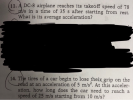 11. A DC-8 airplane reaches its takeoff speed of 78 s in a time of 35 s after starting from rest. What is its average acceleration? 14. The tires of a car begin to lose their grip on the ad at an acceleration of 5 m/s2. At this acceler- ation, how long does the car need to reach a speed of 25 m/s starting from 10 m/s?
1. A jet plane has a takeoff speed of ? = 75 m/s and can move...
1. A jet plane has a takeoff speed of ? = 75 m/s and can move along the runway at an average acceleration of 1.3 m/s2. If the length of the runway is 2.5 km, will the plane be able to use this runway safely? Defend your answer. 2. A person takes a trip, driving with a constant speed of 89.5 km/h, except for a 22.0 min rest stop. If the person’s average speed is 77.8 km/h, (a) how much...
At takeoff a commercial jet has a 55.0 m/s speed. Its tires have a diameter of...
At takeoff a commercial jet has a 55.0 m/s speed. Its tires have a diameter of 0.700 m. (a) At how many rpm are the tires rotating? Incorrect: Your answer is incorrect. rpm (b) What is the centripetal acceleration at the edge of the tire? Incorrect: Your answer is incorrect. m/s2 (c) With what force must a determined 10-15 kg bacterium cling to the rim? Incorrect: Your answer is incorrect. N (d) Take the ratio of this force to the...
1) An object undergoes uniformly accelerated motion from point x1 = 6 m at time t1...
1) An object undergoes uniformly accelerated motion from point x1 = 6 m at time t1 = 3 s to point x2 = 47 m at time t2 = 7 s. (The direction of motion of the object does not change.) (a) If the magnitude of the instantaneous velocity at t1 is v1 = 2 m/s, what is the instantaneous velocity v2 at time t2? (b) Determine the magnitude of the instantaneous acceleration of the object at time t2. 2)...
A 0.250-kg ball is thrown upwards with an initial velocity of 12.0 m/s at an angle...
A 0.250-kg ball is thrown upwards with an initial velocity of 12.0 m/s at an angle of 30.0 degrees. Determine the acceleration of the ball when it has reached the peak of its trajectory. Assume negligible air resistance. Give our answer to one decimal place.
If a rock is thrown upward on the planet Mars with a velocity of 17 m/s, its height (in meters) after t seconds is given by H = 17t - 1.86t^2.
If a rock is thrown upward on the planet Mars with a velocity of 17 m/s, its height (in meters) after t seconds is given by H = 17t - 1.86t^2.(a) Find the velocity of the rock after two seconds.(b) Find the velocity of the rock when t = a.(c) When will the rock hit the surface? (Round your answer to one decimal place.)(d) With what velocity will the rock hit the surface?
(1) An object moves with constant acceleration 3.26 m/s and over a time interval reaches a...
 (1) An object moves with constant acceleration 3.26 m/s and over a time interval reaches a final velocity of 10.8 m/s. a. If its initial velocity 5.39 m/s, what is its displacement during the time interval? Submit Answer Tries 0/10 b. What is the distance it travels during this interval? Submit Answer Tries 0/10 c. If its initial velocity is -5.39 m/s, what is its displacement during the time interval? Submit Answer Tries 0/10 d. What is the total distance...
 An airplane reaches its takeoff speed of 60 m/s with constant acceleration in 30 s, starting from rest. The time it takes to go from 40 m/s to 60 m / s is: A car starts moving from rest with an acceleration of 0.40 m/ s2. A minute later the acceleration stops, and the car moves with constant speed for 5.0 minutes. The car's brakes are finally applied and stops in 2.0 minutes slowing evenly. The total distance traveled by...
 11. A DC-8 airplane reaches its takeoff speed of 78 s in a time of 35 s after starting from rest. What is its average acceleration? 14. The tires of a car begin to lose their grip on the ad at an acceleration of 5 m/s2. At this acceler- ation, how long does the car need to reach a speed of 25 m/s starting from 10 m/s?
 (1) An object moves with constant acceleration 3.26 m/s and over a time interval reaches a final velocity of 10.8 m/s. a. If its initial velocity 5.39 m/s, what is its displacement during the time interval? Submit Answer Tries 0/10 b. What is the distance it travels during this interval? Submit Answer Tries 0/10 c. If its initial velocity is -5.39 m/s, what is its displacement during the time interval? Submit Answer Tries 0/10 d. What is the total distance...
Most questions answered within 3 hours.
-
Where is the error in this code sequence?
String s1 = "Hello";
String s2 = "ello";...
asked 11 months ago -
Financial data for Joel de Paris, Inc., for last year
follow:
Joel de Paris, Inc.
Balance...
asked 11 months ago -
Consider this reaction:
Al2(SO4)3 (aq)+ BaCl3
(aq) Al2Cl6 (aq)- +
3BaSO4(s) . What is the...
asked 11 months ago -
Suppose that Savneet is considering increasing her
recent random sample from 20 car rentals to 40...
asked 11 months ago -
Trucks arrive at an unloading terminal at an average rate of 120
per hour.
Trucks arrive...
asked 11 months ago -
Why are methanol and ethanol completely soluble in water while
octanol is not very little soluble....
asked 11 months ago -
A facilities manager at a university reads in a research report
that the mean amount of...
asked 11 months ago -
When the CuSO4 is rehydrated by adding water to the anhydrous
compound, is this an endothermic...
asked 11 months ago -
A ray of sunlight is passing from diamond into crown glass; the
angle of incidence is...
asked 11 months ago -
A block of mass 0.249 kg is placed on top of a light, vertical
spring of...
asked 11 months ago -
how do the kidneys compensate in the presences of acidosis
a) trigger hyperventilate
b) reserve acid...
asked 11 months ago -
Question 501 pts
The rental rate of capital to the firm increases. Which of the
following...
asked 11 months ago