
Homework Answers

Add Answer to:
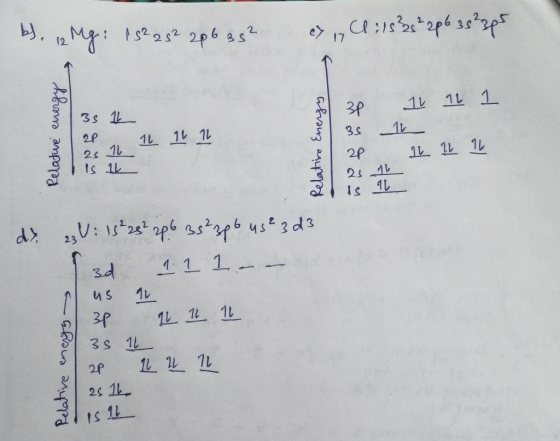
Exercises: 9. Complete an energy level diagram for each of the following elements, by adding electrons...
O THE TRANSITION METALS Adding electrons to a crystal field theory energy level di. The energies...
 O THE TRANSITION METALS Adding electrons to a crystal field theory energy level di. The energies of the valence d orbitals on the iron atom in the tetrahedral Fe(CN), complex are split according to the electron box level diagram below. (Note: the d orbitals are labeled with just their subscript, to make the labels easier to read.) Complete the diagram by adding the correct number of electrons to each orbital energy 1 Jxs ?
8. Which elements are represented by the following electron configurations? a. 15-2s 2p 3s 3p 3d...
 8. Which elements are represented by the following electron configurations? a. 15-2s 2p 3s 3p 3d 10 452 4p highest occupied orbitals valence electrons b. 1s 2s 2p 3s 3p 4s 3d highest occupied orbitals_ valence electrons c. [Kr] 5s 4d 0 5p? highest occupied orbitals valence electrons d. [Ne] 3s 3p highest occupied orbitals valence electrons e. [Ar]3d 4s? highest occupied orbitals valence electrons
Complete the MO energy diagram for HCOCI by adding the following:(1 point each) Label the orbitals...
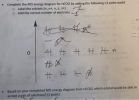 Complete the MO energy diagram for HCOCI by adding the following:(1 point each) Label the orbitals [o, o*, n, Tt, T*] O Add the correct number of electrons O 0 n ar Based on your completed MO energy diagram from HCOCI, which orbital would be able to accept a pair of electrons? (1 point)
1. In the first energy diagram, correctly place the electrons for elemental nitrogen in the appropriate...
 1. In the first energy diagram, correctly place the electrons for elemental nitrogen in the appropriate energy levels/orbitals. In the second diagram, correctly place (with regard to the first diagram) the hybridized and unhybridized orbitals in the second quantum level for an sp hybridized nitrogen atom and place electrons in these orbitals as appropriate. Label any occupied degenerate orbitals in either diagram. (8 points) 3p 3p 3s 3s 1/11 2p 1 AL 2s 1s Is 14 ,N sp2 hybridized 14...
An orbital-filling diagram shows the number of electrons m each orbital, which are shown in order...
 An orbital-filling diagram shows the number of electrons m each orbital, which are shown in order of energy. The placement of electrons in orbitals follows a certain set of rules. Lower energy subshells fill before higher energy subshells. The order of filling is 1s, 2s, 2p, 3s, 3p, 4s, 3d, 4p, 5s, 4d, 5p, 6s, 4f, 5d, 6p, 7s, 5f, 6d, 7p. The periodic table can be used to help you remember this order. An orbital can hold up to...
13. (14 pts) MO Theory Draw the complete (core and valence) molecular orbital energy level diagram...
 13. (14 pts) MO Theory Draw the complete (core and valence) molecular orbital energy level diagram for the homonuclear diatomic molecule Be2. Use standard MO symbols to label the energy levels (That is: o, o, , or n*, as needed, with subscripts indicating which atomic orbitals formed them.) a. Sketch the molecular orbital formed when two 2p orbitals, one each on each Be atom, overlap to form a o antibonding MO b. Using your MO energy level diagram in (a),...
Report: Quantum Numbers Assigning Quantum Numbers 1. For each element, complete the following tables. Write the...
 Report: Quantum Numbers Assigning Quantum Numbers 1. For each element, complete the following tables. Write the ground state condensed electron configuration, draw the energy level orbital diagram (see partial example with Na), and write the quantum numbers for the "last" electron in the atom. Element - Na Mg Condensed e configuration NC [NC] 35 Energy level orbital diagram (Ne) Quantum numbers (last e) 1300 / 300 / Si Element ised e configuration P Ve 3²38 Ne 35² 3p' ve 35²...
Enter the number of electrons in each energy level (shell) for the following elements. If the...
 Enter the number of electrons
in each energy level (shell) for the following elements. If the
energy level does not contain any electrons, enter a 0 (zero). It
may help to refer to the periodic table.
Enter the number of electrons
in each energy level (shell) for the following elements. If the
energy level does not contain any electrons, enter a 0 (zero). It
may help to refer to the periodic table.
Enter the number of electrons in each energy level (shell) for the following elements. If the...
 Enter the number of electrons in each energy level (shell) for the following elements. If the energy level does not contain any electrons, enter a 0 (zero). It may help to refer to the periodic table. W is the neutral atom t has its first two energy levels filled, has 5 electrons in its third energy level, and has no other electrons? Enter the name of the element, not the abbreviation.
1) Construct a crystal field energy-level diagram, assign the electrons to orbitals for [MnCl4]2− (tetrahedral). 2)...
1) Construct a crystal field energy-level diagram, assign the electrons to orbitals for [MnCl4]2− (tetrahedral). 2) Construct a crystal field energy-level diagram, assign the electrons to orbitals for [Co(NCS)4]2− (tetrahedral). 3) Construct a crystal field energy-level diagram, assign the electrons to orbitals for [Cu(en)2]2+ (square planar).
 O THE TRANSITION METALS Adding electrons to a crystal field theory energy level di. The energies of the valence d orbitals on the iron atom in the tetrahedral Fe(CN), complex are split according to the electron box level diagram below. (Note: the d orbitals are labeled with just their subscript, to make the labels easier to read.) Complete the diagram by adding the correct number of electrons to each orbital energy 1 Jxs ?
 8. Which elements are represented by the following electron configurations? a. 15-2s 2p 3s 3p 3d 10 452 4p highest occupied orbitals valence electrons b. 1s 2s 2p 3s 3p 4s 3d highest occupied orbitals_ valence electrons c. [Kr] 5s 4d 0 5p? highest occupied orbitals valence electrons d. [Ne] 3s 3p highest occupied orbitals valence electrons e. [Ar]3d 4s? highest occupied orbitals valence electrons
 Complete the MO energy diagram for HCOCI by adding the following:(1 point each) Label the orbitals [o, o*, n, Tt, T*] O Add the correct number of electrons O 0 n ar Based on your completed MO energy diagram from HCOCI, which orbital would be able to accept a pair of electrons? (1 point)
 1. In the first energy diagram, correctly place the electrons for elemental nitrogen in the appropriate energy levels/orbitals. In the second diagram, correctly place (with regard to the first diagram) the hybridized and unhybridized orbitals in the second quantum level for an sp hybridized nitrogen atom and place electrons in these orbitals as appropriate. Label any occupied degenerate orbitals in either diagram. (8 points) 3p 3p 3s 3s 1/11 2p 1 AL 2s 1s Is 14 ,N sp2 hybridized 14...
 An orbital-filling diagram shows the number of electrons m each orbital, which are shown in order of energy. The placement of electrons in orbitals follows a certain set of rules. Lower energy subshells fill before higher energy subshells. The order of filling is 1s, 2s, 2p, 3s, 3p, 4s, 3d, 4p, 5s, 4d, 5p, 6s, 4f, 5d, 6p, 7s, 5f, 6d, 7p. The periodic table can be used to help you remember this order. An orbital can hold up to...
 13. (14 pts) MO Theory Draw the complete (core and valence) molecular orbital energy level diagram for the homonuclear diatomic molecule Be2. Use standard MO symbols to label the energy levels (That is: o, o, , or n*, as needed, with subscripts indicating which atomic orbitals formed them.) a. Sketch the molecular orbital formed when two 2p orbitals, one each on each Be atom, overlap to form a o antibonding MO b. Using your MO energy level diagram in (a),...
 Report: Quantum Numbers Assigning Quantum Numbers 1. For each element, complete the following tables. Write the ground state condensed electron configuration, draw the energy level orbital diagram (see partial example with Na), and write the quantum numbers for the "last" electron in the atom. Element - Na Mg Condensed e configuration NC [NC] 35 Energy level orbital diagram (Ne) Quantum numbers (last e) 1300 / 300 / Si Element ised e configuration P Ve 3²38 Ne 35² 3p' ve 35²...
 Enter the number of electrons
in each energy level (shell) for the following elements. If the
energy level does not contain any electrons, enter a 0 (zero). It
may help to refer to the periodic table.
Enter the number of electrons
in each energy level (shell) for the following elements. If the
energy level does not contain any electrons, enter a 0 (zero). It
may help to refer to the periodic table.
 Enter the number of electrons in each energy level (shell) for the following elements. If the energy level does not contain any electrons, enter a 0 (zero). It may help to refer to the periodic table. W is the neutral atom t has its first two energy levels filled, has 5 electrons in its third energy level, and has no other electrons? Enter the name of the element, not the abbreviation.
Most questions answered within 3 hours.
-
Where is the error in this code sequence?
String s1 = "Hello";
String s2 = "ello";...
asked 10 months ago -
Financial data for Joel de Paris, Inc., for last year
follow:
Joel de Paris, Inc.
Balance...
asked 10 months ago -
Consider this reaction:
Al2(SO4)3 (aq)+ BaCl3
(aq) Al2Cl6 (aq)- +
3BaSO4(s) . What is the...
asked 10 months ago -
Suppose that Savneet is considering increasing her
recent random sample from 20 car rentals to 40...
asked 10 months ago -
Trucks arrive at an unloading terminal at an average rate of 120
per hour.
Trucks arrive...
asked 10 months ago -
Why are methanol and ethanol completely soluble in water while
octanol is not very little soluble....
asked 10 months ago -
A facilities manager at a university reads in a research report
that the mean amount of...
asked 10 months ago -
When the CuSO4 is rehydrated by adding water to the anhydrous
compound, is this an endothermic...
asked 10 months ago -
A ray of sunlight is passing from diamond into crown glass; the
angle of incidence is...
asked 10 months ago -
A block of mass 0.249 kg is placed on top of a light, vertical
spring of...
asked 10 months ago -
how do the kidneys compensate in the presences of acidosis
a) trigger hyperventilate
b) reserve acid...
asked 10 months ago -
Question 501 pts
The rental rate of capital to the firm increases. Which of the
following...
asked 10 months ago