
Homework Answers
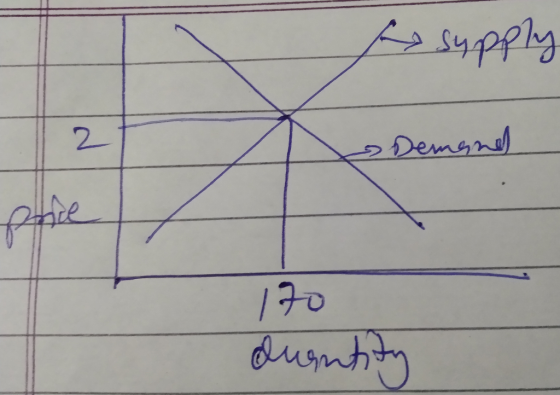
A) the EQUILIBRIUM will be at where demand equals to supply,
220-25p=20+75p
200=100p
P*=200/100=2
Q*=20+75*2=170
B)with tax of 0.5 , supply function will change to,
Qs=20+75(p-0.5)
Qs=20-37.5+75p=-17.5+75p
Equilibrium,
-17.5+75p=220-25p
100p=237.5
P*=237.5=2.375
Q*=-17.5+75*2.375=160.625
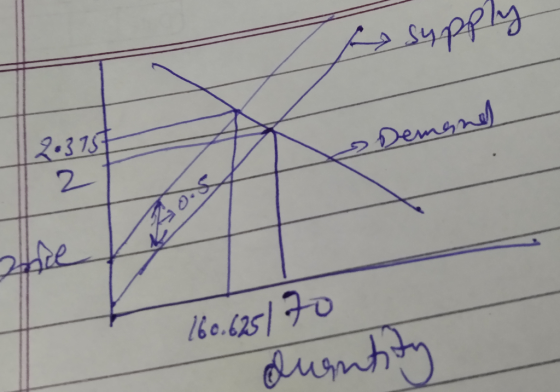
Tax incidence on buyers=new equilibrium price- old EQUILIBRIUM is price=2.325-2=0.325
Tax incidence on seller=tax - tax incidence on consumer=0.5-0.325=0.175
C) deadweight loss=1/2*tax* quantity difference=1/2*0.5*(170-160.625)=1/4*9.375=2.34
D) total tax revenue=tax* total quantity=0.5*160.625=80.3125
Add Answer to:
Part B. Analytical Questions 1. A country which does not tax cigarettes is considering the introduction...
Suppose the government is considering taxing cigarettes. Because it is often politically more popular to tax...
 Suppose the government is considering taxing cigarettes. Because it is often politically more popular to tax the producers of cigarettes than the consumers of cigałettes, the government first considers the impact on the market as a result of taxing the producers of cigarettes. a. Draw the after-tax supply curve if the government chooses to tax cigarette producers $2.50 per pack of cigarettes Instructions: Use the tool provided (S2) to plot the after-tax supply curve. Place your endpoints at Q-0 and...
. Refer to Figure 1-5. The figure above represents demand and supply in the market for cigarettes. Use the diagram to a...
 . Refer to Figure 1-5. The figure above represents demand and
supply in the market for cigarettes. Use the diagram to answer the
following questions.
a. How much is the government tax on each pack of
cigarettes?
b. What portion of the unit tax is paid by consumers?
c. What portion of the unit tax is paid by producers?
d. What is the quantity sold after the imposition of the
tax?
e. What is the after-tax revenue per pack received...
. Refer to Figure 1-5. The figure above represents demand and
supply in the market for cigarettes. Use the diagram to answer the
following questions.
a. How much is the government tax on each pack of
cigarettes?
b. What portion of the unit tax is paid by consumers?
c. What portion of the unit tax is paid by producers?
d. What is the quantity sold after the imposition of the
tax?
e. What is the after-tax revenue per pack received...
3. Consider the market for Sharpie markers (Q is a pack of 3 markers.) Suppose that......
3. Consider the market for Sharpie markers (Q is a pack of 3 markers.) Suppose that... - The demand curve for Sharpie is QD = 20 – P - The supply curve for Sharpie is QS = 4P – 5 - The government imposes a tax of $1 per pack of Sharpies because of the foul smell (4 points each) a. Before the tax is implemented, what is the equilibrium price paid by buyers, price received by sellers, and the...
Question 35 (1 point) Suppose a state government imposes a tax on carbonated drinks. Before the...
 Question 35 (1 point) Suppose a state government imposes a tax on carbonated drinks. Before the tax, 20 million six packs were sold at $2.50 per pack. With the tax in effect, 14 million six packs are sold, buyers pay $3.10 per pack, and sellers receive $2.30 per pack. What is the deadweight loss resulting from the tax? $1.4 million $3.6 million $1.8 million $2.4 million $4.8 million
The graph shows the market for pillows in which the government has imposed a sales tax of $4 per pillow on buyers. Draw a point to show the price of a pillow and the quantity of pillows bought and sold with no tax. Label it 1. Draw a point to show
 The graph shows the market for pillows in which the government has imposed a sales tax of $4 per pillow on buyers. Draw a point to show the price of a pillow and the quantity of pillows bought and sold with no tax. Label it 1. Draw a point to show the price paid by buyers and the quantity of pillows bought with the tax. Label it 2. Draw a point to show the price received by sellers and the quantity of pillows...
4. (10 points total) The graph below shows the market for gasoline. A per-unit tax is...
 4. (10 points total) The graph below shows the market for gasoline. A per-unit tax is imposed on sellers of gasoline as shown in the figure below. Price (dollars per gallon) 0 2 4 6 8 10 12 14 Quantity (thousands of gallons per day) (1 point) What is the amount of the per-unit tax? Explain briefly. (2 points) After the tax is imposed, what is the price paid by the buyers? Explain briefly. (2 points) After the tax is...
5. Consider a market in which demand and supply have the following functional forms: The free-market...
5. Consider a market in which demand and supply have the following functional forms: The free-market equilibrium is at P = $24 and Q = 12. Qd = 24-1/2PB and Qs = -12+PS a. Graph the free market equilibrium in the space below. Label the curves and show the values of ALL intercepts (show your work to find them). b. Now suppose that the Government decides to impose a $6 per-unit subsidy in this market. Calculate the price paid by...
5. Consider a market in which demand and supply have the following functional forms: The free-market...
5. Consider a market in which demand and supply have the following functional forms: The free-market equilibrium is at P = $24 and Q = 12. Qd = 24-1/2PB and Qs = -12+PS a. Graph the free market equilibrium in the space below. Label the curves and show the values of ALL intercepts (show your work to find them). b. Now suppose that the Government decides to impose a $6 per-unit subsidy in this market. Calculate the price paid by...
Part 1. What was the equilibrium price in this market before the tax? What is the amount of the tax? How much of the t...
 Part 1.
What was the equilibrium price in this market before the
tax?
What is the amount of the tax?
How much of the tax will the buyers pay?
How much of the tax will the sellers pay?
How much will the buyer pay for the product after the tax is
imposed?
How much will the seller receive after the tax is imposed?
As a result of the tax, what has happened to the level of
output?
Calculate the economic...
Part 1.
What was the equilibrium price in this market before the
tax?
What is the amount of the tax?
How much of the tax will the buyers pay?
How much of the tax will the sellers pay?
How much will the buyer pay for the product after the tax is
imposed?
How much will the seller receive after the tax is imposed?
As a result of the tax, what has happened to the level of
output?
Calculate the economic...
Number 6 please tax a. What is b. What is 102 Part 1 Basic Concepts c....
 Number 6 please
tax a. What is b. What is 102 Part 1 Basic Concepts c. Find the value of producer surplus received by dive shops. (Hint: It may help to draw a sold beef c. How much graph.) vices increases, and that the new demand is given by Q-7,000-20P. Calculate the impact of this change in demand on the values you calcu- gain? d. What is the l e. The president d. Suppose that the demand for scuba diving...
Number 6 please
tax a. What is b. What is 102 Part 1 Basic Concepts c. Find the value of producer surplus received by dive shops. (Hint: It may help to draw a sold beef c. How much graph.) vices increases, and that the new demand is given by Q-7,000-20P. Calculate the impact of this change in demand on the values you calcu- gain? d. What is the l e. The president d. Suppose that the demand for scuba diving...
 Suppose the government is considering taxing cigarettes. Because it is often politically more popular to tax the producers of cigarettes than the consumers of cigałettes, the government first considers the impact on the market as a result of taxing the producers of cigarettes. a. Draw the after-tax supply curve if the government chooses to tax cigarette producers $2.50 per pack of cigarettes Instructions: Use the tool provided (S2) to plot the after-tax supply curve. Place your endpoints at Q-0 and...
 . Refer to Figure 1-5. The figure above represents demand and
supply in the market for cigarettes. Use the diagram to answer the
following questions.
a. How much is the government tax on each pack of
cigarettes?
b. What portion of the unit tax is paid by consumers?
c. What portion of the unit tax is paid by producers?
d. What is the quantity sold after the imposition of the
tax?
e. What is the after-tax revenue per pack received...
. Refer to Figure 1-5. The figure above represents demand and
supply in the market for cigarettes. Use the diagram to answer the
following questions.
a. How much is the government tax on each pack of
cigarettes?
b. What portion of the unit tax is paid by consumers?
c. What portion of the unit tax is paid by producers?
d. What is the quantity sold after the imposition of the
tax?
e. What is the after-tax revenue per pack received...
 Question 35 (1 point) Suppose a state government imposes a tax on carbonated drinks. Before the tax, 20 million six packs were sold at $2.50 per pack. With the tax in effect, 14 million six packs are sold, buyers pay $3.10 per pack, and sellers receive $2.30 per pack. What is the deadweight loss resulting from the tax? $1.4 million $3.6 million $1.8 million $2.4 million $4.8 million
 4. (10 points total) The graph below shows the market for gasoline. A per-unit tax is imposed on sellers of gasoline as shown in the figure below. Price (dollars per gallon) 0 2 4 6 8 10 12 14 Quantity (thousands of gallons per day) (1 point) What is the amount of the per-unit tax? Explain briefly. (2 points) After the tax is imposed, what is the price paid by the buyers? Explain briefly. (2 points) After the tax is...
 Part 1.
What was the equilibrium price in this market before the
tax?
What is the amount of the tax?
How much of the tax will the buyers pay?
How much of the tax will the sellers pay?
How much will the buyer pay for the product after the tax is
imposed?
How much will the seller receive after the tax is imposed?
As a result of the tax, what has happened to the level of
output?
Calculate the economic...
Part 1.
What was the equilibrium price in this market before the
tax?
What is the amount of the tax?
How much of the tax will the buyers pay?
How much of the tax will the sellers pay?
How much will the buyer pay for the product after the tax is
imposed?
How much will the seller receive after the tax is imposed?
As a result of the tax, what has happened to the level of
output?
Calculate the economic...
 Number 6 please
tax a. What is b. What is 102 Part 1 Basic Concepts c. Find the value of producer surplus received by dive shops. (Hint: It may help to draw a sold beef c. How much graph.) vices increases, and that the new demand is given by Q-7,000-20P. Calculate the impact of this change in demand on the values you calcu- gain? d. What is the l e. The president d. Suppose that the demand for scuba diving...
Number 6 please
tax a. What is b. What is 102 Part 1 Basic Concepts c. Find the value of producer surplus received by dive shops. (Hint: It may help to draw a sold beef c. How much graph.) vices increases, and that the new demand is given by Q-7,000-20P. Calculate the impact of this change in demand on the values you calcu- gain? d. What is the l e. The president d. Suppose that the demand for scuba diving...
Most questions answered within 3 hours.
-
Where is the error in this code sequence?
String s1 = "Hello";
String s2 = "ello";...
asked 10 months ago -
Financial data for Joel de Paris, Inc., for last year
follow:
Joel de Paris, Inc.
Balance...
asked 10 months ago -
Consider this reaction:
Al2(SO4)3 (aq)+ BaCl3
(aq) Al2Cl6 (aq)- +
3BaSO4(s) . What is the...
asked 10 months ago -
Suppose that Savneet is considering increasing her
recent random sample from 20 car rentals to 40...
asked 10 months ago -
Trucks arrive at an unloading terminal at an average rate of 120
per hour.
Trucks arrive...
asked 10 months ago -
Why are methanol and ethanol completely soluble in water while
octanol is not very little soluble....
asked 10 months ago -
A facilities manager at a university reads in a research report
that the mean amount of...
asked 10 months ago -
When the CuSO4 is rehydrated by adding water to the anhydrous
compound, is this an endothermic...
asked 10 months ago -
A ray of sunlight is passing from diamond into crown glass; the
angle of incidence is...
asked 10 months ago -
A block of mass 0.249 kg is placed on top of a light, vertical
spring of...
asked 10 months ago -
how do the kidneys compensate in the presences of acidosis
a) trigger hyperventilate
b) reserve acid...
asked 10 months ago -
Question 501 pts
The rental rate of capital to the firm increases. Which of the
following...
asked 10 months ago