
Homework Answers
5) For the compound on the left: (3S)-3-chloro-4-ethyl-2-methyloctane
The compound on the right: (5E)-3,4-diethyl-5-ethylidene-2-methyloctane
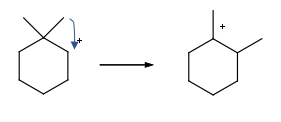
6) The carbocation will undergo rearrangement, since it is right next to a more stable position for the positive charge. The movement of atoms and of the positive charge is:
Add Answer to:
(5) (6 pts) Provide names for each of the following: H (6) (3 pts) Will the...
1. Rank the following carbocations in order from most stable (1) to least stable (4). o...
 1. Rank the following carbocations in order from most stable (1) to least stable (4). o ó no 8 2. Consider the following carbocation. Would this carbocation undergo a rearrangement? If so, show the mechanism (curved arrows) for the rearrangement (including the rearranged cation that is the product of your curved arrows) and explain why it happens. If not, explain why it would not rearrange.
3. (2 pts) Determine if the carbocation below is expected to undergo a rearrangement. Write N.R....
 3. (2 pts) Determine if the carbocation below is expected to undergo a rearrangement. Write N.R. if no rearrangement. If one is expected, show the mechanism and draw the result of the rearrangement
3. (2 pts) Determine if the carbocation below is expected to undergo a rearrangement. Write N.R. if no rearrangemen...
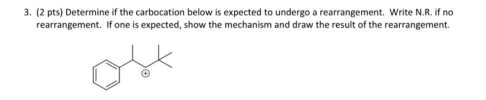 3. (2 pts) Determine if the carbocation below is expected to undergo a rearrangement. Write N.R. if no rearrangement. If one is expected, show the mechanism and draw the result of the rearrangement.
For each of the following pairs of organic molecules, circle the one that would react with...
 For each of the following pairs of organic molecules, circle the one that would react with a given nucleophile at a faster rate in the Sw1 reaction, and briefly explain your choice. нссн, vs. H₂C CH₂ CH Hoc tots vs. Ho C^ots 6. Each of the following carbocations can undergo a rearrangement to give a more stable carbocation. In each case, draw the structure of the rearranged carbocation, and show the mechanism of the 1,2 hydride shift or 1,2-alkyl shift...
Provide the electron-pushing arrows to complete the mechanism below. Identify the arrow-pushing pattern(s) used in each...
 Provide the electron-pushing arrows to complete the mechanism
below. Identify the arrow-pushing pattern(s) used in each step.
(1) Provide electron-pushing arrows to complete the mechanism shown below. Identify the arrow.pushing pattern(s) used at each step. :NH3 H H-NH2 -NH2 NO RO: R R 0 I- -H20 NH2 .NH HN R
Provide the electron-pushing arrows to complete the mechanism
below. Identify the arrow-pushing pattern(s) used in each step.
(1) Provide electron-pushing arrows to complete the mechanism shown below. Identify the arrow.pushing pattern(s) used at each step. :NH3 H H-NH2 -NH2 NO RO: R R 0 I- -H20 NH2 .NH HN R
2. (5 pts) Provide a mechanism for this rearrangement. Include all intermediates. Show all electron pushing....
 2. (5 pts) Provide a mechanism for this rearrangement. Include all intermediates. Show all electron pushing. Give a reason why this process occurs; that is, what makes this reaction an exothermic process?
Addition of HCl to 1-isopropylcyclohexene yields a rearranged product in several steps. Propose a mechanism, using...
 Addition of HCl to 1-isopropylcyclohexene yields a rearranged
product in several steps. Propose a mechanism, using curved arrows
to show the movement of electrons, for the step shown below.
Addition of HCl to l-isopropylcyclohexene yields a rearranged product in several steps. Propose a mechanism, using curved arrows to show the movement of electrons, for the step shown below. Arrow-pushing Instructions no XT - CH3 Τ Η C CH3 C-CH3 : H-01: →
Addition of HCl to 1-isopropylcyclohexene yields a rearranged
product in several steps. Propose a mechanism, using curved arrows
to show the movement of electrons, for the step shown below.
Addition of HCl to l-isopropylcyclohexene yields a rearranged product in several steps. Propose a mechanism, using curved arrows to show the movement of electrons, for the step shown below. Arrow-pushing Instructions no XT - CH3 Τ Η C CH3 C-CH3 : H-01: →
complete the following reaction mechanisms by drawing the correct product or intermediate formed in each reaction....
 complete the following reaction mechanisms by drawing the
correct product or intermediate formed in each reaction. on the
side of the reactants, label the nucleophile and the electrophile
(front)
show using electron-pushinh arrows how the anion shown is
converted to two other resonance structures (back)
Complete the Following Reaction Mechanisms by drawing the correcting product or intermediate formed in each reaction. On the side of the reactants, label the nucleophile and electrophile. (4 points each) Ci Me H Ме Me...
complete the following reaction mechanisms by drawing the
correct product or intermediate formed in each reaction. on the
side of the reactants, label the nucleophile and the electrophile
(front)
show using electron-pushinh arrows how the anion shown is
converted to two other resonance structures (back)
Complete the Following Reaction Mechanisms by drawing the correcting product or intermediate formed in each reaction. On the side of the reactants, label the nucleophile and electrophile. (4 points each) Ci Me H Ме Me...
Provide a mechanism and final product for the following reaction. (6 pts) KCN, EtOH/H0 H CH3 Provide a mechanism fo...
 Provide a mechanism and final product for the following reaction. (6 pts) KCN, EtOH/H0 H CH3 Provide a mechanism for the reaction shown below. (6 pts.) Actones KOHO CH, Part V. Separation,
Provide a mechanism and final product for the following reaction. (6 pts) KCN, EtOH/H0 H CH3 Provide a mechanism for the reaction shown below. (6 pts.) Actones KOHO CH, Part V. Separation,
Provide a mechanism and final product for the following reaction. (6 pts) KCN, EtOH/H0 H CH3 Provide a mechanism for the reaction shown below. (6 pts.) Actones KOHO CH, Part V. Separation,
1) Which of the following molecules would not undergo an aldol condensation with itself? Circle each...
 1) Which of the following molecules would not undergo an aldol condensation with itself? Circle each that apply (3 points) CH, OCH, H 2) How could the following crossed-aldol condensation be performed to obtain the product selectively? Devise a method, and detail what to do in the lab below. Also include a full mechanism. (5 points) S. 7-8 4) Provide a complete, electron-pushing mechanism for the reactions shown below (7 points each) (1) "omo (2) H30 HOCI
 1. Rank the following carbocations in order from most stable (1) to least stable (4). o ó no 8 2. Consider the following carbocation. Would this carbocation undergo a rearrangement? If so, show the mechanism (curved arrows) for the rearrangement (including the rearranged cation that is the product of your curved arrows) and explain why it happens. If not, explain why it would not rearrange.
 3. (2 pts) Determine if the carbocation below is expected to undergo a rearrangement. Write N.R. if no rearrangement. If one is expected, show the mechanism and draw the result of the rearrangement
 3. (2 pts) Determine if the carbocation below is expected to undergo a rearrangement. Write N.R. if no rearrangement. If one is expected, show the mechanism and draw the result of the rearrangement.
 For each of the following pairs of organic molecules, circle the one that would react with a given nucleophile at a faster rate in the Sw1 reaction, and briefly explain your choice. нссн, vs. H₂C CH₂ CH Hoc tots vs. Ho C^ots 6. Each of the following carbocations can undergo a rearrangement to give a more stable carbocation. In each case, draw the structure of the rearranged carbocation, and show the mechanism of the 1,2 hydride shift or 1,2-alkyl shift...
 Provide the electron-pushing arrows to complete the mechanism
below. Identify the arrow-pushing pattern(s) used in each step.
(1) Provide electron-pushing arrows to complete the mechanism shown below. Identify the arrow.pushing pattern(s) used at each step. :NH3 H H-NH2 -NH2 NO RO: R R 0 I- -H20 NH2 .NH HN R
Provide the electron-pushing arrows to complete the mechanism
below. Identify the arrow-pushing pattern(s) used in each step.
(1) Provide electron-pushing arrows to complete the mechanism shown below. Identify the arrow.pushing pattern(s) used at each step. :NH3 H H-NH2 -NH2 NO RO: R R 0 I- -H20 NH2 .NH HN R
 2. (5 pts) Provide a mechanism for this rearrangement. Include all intermediates. Show all electron pushing. Give a reason why this process occurs; that is, what makes this reaction an exothermic process?
 Addition of HCl to 1-isopropylcyclohexene yields a rearranged
product in several steps. Propose a mechanism, using curved arrows
to show the movement of electrons, for the step shown below.
Addition of HCl to l-isopropylcyclohexene yields a rearranged product in several steps. Propose a mechanism, using curved arrows to show the movement of electrons, for the step shown below. Arrow-pushing Instructions no XT - CH3 Τ Η C CH3 C-CH3 : H-01: →
Addition of HCl to 1-isopropylcyclohexene yields a rearranged
product in several steps. Propose a mechanism, using curved arrows
to show the movement of electrons, for the step shown below.
Addition of HCl to l-isopropylcyclohexene yields a rearranged product in several steps. Propose a mechanism, using curved arrows to show the movement of electrons, for the step shown below. Arrow-pushing Instructions no XT - CH3 Τ Η C CH3 C-CH3 : H-01: →
 complete the following reaction mechanisms by drawing the
correct product or intermediate formed in each reaction. on the
side of the reactants, label the nucleophile and the electrophile
(front)
show using electron-pushinh arrows how the anion shown is
converted to two other resonance structures (back)
Complete the Following Reaction Mechanisms by drawing the correcting product or intermediate formed in each reaction. On the side of the reactants, label the nucleophile and electrophile. (4 points each) Ci Me H Ме Me...
complete the following reaction mechanisms by drawing the
correct product or intermediate formed in each reaction. on the
side of the reactants, label the nucleophile and the electrophile
(front)
show using electron-pushinh arrows how the anion shown is
converted to two other resonance structures (back)
Complete the Following Reaction Mechanisms by drawing the correcting product or intermediate formed in each reaction. On the side of the reactants, label the nucleophile and electrophile. (4 points each) Ci Me H Ме Me...
 Provide a mechanism and final product for the following reaction. (6 pts) KCN, EtOH/H0 H CH3 Provide a mechanism for the reaction shown below. (6 pts.) Actones KOHO CH, Part V. Separation,
Provide a mechanism and final product for the following reaction. (6 pts) KCN, EtOH/H0 H CH3 Provide a mechanism for the reaction shown below. (6 pts.) Actones KOHO CH, Part V. Separation,
Provide a mechanism and final product for the following reaction. (6 pts) KCN, EtOH/H0 H CH3 Provide a mechanism for the reaction shown below. (6 pts.) Actones KOHO CH, Part V. Separation,
 1) Which of the following molecules would not undergo an aldol condensation with itself? Circle each that apply (3 points) CH, OCH, H 2) How could the following crossed-aldol condensation be performed to obtain the product selectively? Devise a method, and detail what to do in the lab below. Also include a full mechanism. (5 points) S. 7-8 4) Provide a complete, electron-pushing mechanism for the reactions shown below (7 points each) (1) "omo (2) H30 HOCI
Most questions answered within 3 hours.
-
Where is the error in this code sequence?
String s1 = "Hello";
String s2 = "ello";...
asked 11 months ago -
Financial data for Joel de Paris, Inc., for last year
follow:
Joel de Paris, Inc.
Balance...
asked 11 months ago -
Consider this reaction:
Al2(SO4)3 (aq)+ BaCl3
(aq) Al2Cl6 (aq)- +
3BaSO4(s) . What is the...
asked 11 months ago -
Suppose that Savneet is considering increasing her
recent random sample from 20 car rentals to 40...
asked 11 months ago -
Trucks arrive at an unloading terminal at an average rate of 120
per hour.
Trucks arrive...
asked 11 months ago -
Why are methanol and ethanol completely soluble in water while
octanol is not very little soluble....
asked 11 months ago -
A facilities manager at a university reads in a research report
that the mean amount of...
asked 11 months ago -
When the CuSO4 is rehydrated by adding water to the anhydrous
compound, is this an endothermic...
asked 11 months ago -
A ray of sunlight is passing from diamond into crown glass; the
angle of incidence is...
asked 11 months ago -
A block of mass 0.249 kg is placed on top of a light, vertical
spring of...
asked 11 months ago -
how do the kidneys compensate in the presences of acidosis
a) trigger hyperventilate
b) reserve acid...
asked 11 months ago -
Question 501 pts
The rental rate of capital to the firm increases. Which of the
following...
asked 11 months ago