![5. Consider a double slit experiment conducted with a laser source at 540 nm wavelength. The two slits are separated at a distance of 4 mm. As shown in Figure 3.2, a thin glass plate is placed in front of one of the two slits, resulting in each bright fringe moving to the location of the adjacent bright fringe. Determine the minimum thickness of the glass plate. Assume that the refractive index of the glass is 1.56. Ignore the reflections caused by the glass plate. [964.29 nm] -t Glass plate Figure 3.2](http://img.homeworklib.com/questions/665ede80-77ff-11ea-bb4b-f51e5cd31799.png?x-oss-process=image/resize,w_560)
Homework Answers
![7 = 540 x107m d=4x10³ m Number of bright fringes shuffed =) 4-) 540x10] 1.56-1 - 964.2858109 = 964.29x1099 t=964.29 nm](http://img.homeworklib.com/questions/66e86200-77ff-11ea-9479-f9156cb0ab86.png?x-oss-process=image/resize,w_560)
Add Answer to:
Please explain thankyou
5. Consider a double slit experiment conducted with a laser source at 540...
1.) In a double-slit experiment, it is observed that the distance between adjacent maxima on a...
1.) In a double-slit experiment, it is observed that the distance between adjacent maxima on a remote screen is 1.0 cm. What happens to the distance between adjacent maxima when the slit separation is doubled? A.) It decreases to 0.5 cm. B.) It increases to 4.0 cm. C.) It increases to 2.0 cm. D.) It decreases to 0.25 cm. E.) It remains the same. 2.) In a two-slit experiment, monochromatic coherent light of wavelength 500 nm passes through a pair...
3. A double slit experiment uses a laser with a wavelength of 633 nm and a slit separation of 120...
 3. A double slit experiment uses a laser with a wavelength of 633 nm and a slit separation of 120 um The fringes are observed on a screen at a distance of 100 mm. The experiment is performed in air and then repeated under water (n 1.33). a. What is the fringe spacing in air? b. What is the fringe spacing under water? c. When a thin sheet of plastic (n 1.91) is placed over one of the slits in...
You perform a double-slit experiment in order to measure the wavelength of the new laser that...
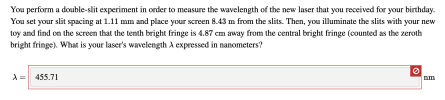 You perform a double-slit experiment in order to measure the wavelength of the new laser that you received for your birthday. You set your slit spacing at 1.11 mm and place your screen 8.43 m from the slits. Then, you illuminate the slits with your new toy and find on the screen that the tenth bright fringe is 4.87 cm away from the central bright fringe (counted as the zeroth bright fringe). What is your laser's wavelength 1 expressed in...
A two-slit interference experiment was done where the aperture to screen distance is 1m, wavelength of...
A two-slit interference experiment was done where the aperture to screen distance is 1m, wavelength of light is 632nm, fringe spacing is 0.5mm, and the slit separation is found to be 1.26mm. Then, a thin plate of glass of thickness 0.03mm and refractive index n=1.4 is placed over one of the slits. What is the resulting lateral fringe displacement at the screen?
Two lasers are shining on a double slit, with slit separation d. Laser 1 has a...
 Two lasers are shining on a double slit, with slit separation
d. Laser 1 has a wavelength of d/20, whereas
laser 2 has a wavelength of d/15. The lasers produce
separate interference patterns on a screen a distance 4.40 m away
from the slits
Coherent light with wavelength 600 nm passes through two very
narrow slits, and the interference pattern is observed on a screen
a distance of 3.00 m from the slits. The first-order bright fringe
is a distance...
Two lasers are shining on a double slit, with slit separation
d. Laser 1 has a wavelength of d/20, whereas
laser 2 has a wavelength of d/15. The lasers produce
separate interference patterns on a screen a distance 4.40 m away
from the slits
Coherent light with wavelength 600 nm passes through two very
narrow slits, and the interference pattern is observed on a screen
a distance of 3.00 m from the slits. The first-order bright fringe
is a distance...
Problem 2 (25 points) Figure shows Young's double-slit experiment with coherent light source wavelength of the...
 Problem 2 (25 points) Figure shows Young's double-slit experiment with coherent light source wavelength of the light λ is 500 nm, the slit separation d is 025 mm and the slit-screen separi on 50 cm. Assume that θ is small enough to use the approximation sin θ tan θ (a) (15 points) Let's assume that there is a constant phase offset π (1800) between the lights after thesíts 1 and s2. What is the distance y on the screen between...
2. In the double slit diffraction experiment, the geometric relationship is d sine, = ma Where...
 2. In the double slit diffraction experiment, the geometric relationship is d sine, = ma Where di is the two slits separation, a is the laser wavelength, m: is an integer representing the order of the fringe and e: is the angle of the morder dark fringe. S. a. In the lab you have measured L = 400 cm, and the diffraction angle em, between the center of the zero order bright fringe and the second order dark fringe was...
Consider double slit experiment with two slits are separated by d=0,715 mm
Consider double slit experiment with two slits are separated by d=0.715 mm and each slit width is 0.00321 mm. Screen is placed L=1.28 m away from the slits. a) Derive an algebraic equation to find linear distance of interference bright fringe on the screen from central bright (central maxima) fringe? b) Consider interference pattern due to light of unknown wavelength and linear separation between 2 and 5" bright fringes is 3.05 mm. Find the wavelength of the light? c) Now consider double slit...
In a Young's double slit experiment a screen is placed 85.0 cm from two slits that...
 In a Young's double slit experiment a screen is placed 85.0 cm from two slits that have a spacing of 0.300 mm. The slits are illuminated with coherent light with a wavelength of 540 nm. (a) What is the distance between the first and third-order dark fringes? (b) What is the distance between the first-order bright fringe and the second order dark fringe?
A pair of closely spaced slits is illuminated with 626.0-nm light in a Young's double-slit experiment....
A pair of closely spaced slits is illuminated with 626.0-nm light in a Young's double-slit experiment. During the experiment, one of the two slits is covered by an ultrathin heavy flint glass plate with index of refraction n = 1.890. What is the minimum thickness of the heavy flint glass plate that produces a dark fringe at the center of the viewing screen? ______________nm
 3. A double slit experiment uses a laser with a wavelength of 633 nm and a slit separation of 120 um The fringes are observed on a screen at a distance of 100 mm. The experiment is performed in air and then repeated under water (n 1.33). a. What is the fringe spacing in air? b. What is the fringe spacing under water? c. When a thin sheet of plastic (n 1.91) is placed over one of the slits in...
 You perform a double-slit experiment in order to measure the wavelength of the new laser that you received for your birthday. You set your slit spacing at 1.11 mm and place your screen 8.43 m from the slits. Then, you illuminate the slits with your new toy and find on the screen that the tenth bright fringe is 4.87 cm away from the central bright fringe (counted as the zeroth bright fringe). What is your laser's wavelength 1 expressed in...
 Two lasers are shining on a double slit, with slit separation
d. Laser 1 has a wavelength of d/20, whereas
laser 2 has a wavelength of d/15. The lasers produce
separate interference patterns on a screen a distance 4.40 m away
from the slits
Coherent light with wavelength 600 nm passes through two very
narrow slits, and the interference pattern is observed on a screen
a distance of 3.00 m from the slits. The first-order bright fringe
is a distance...
Two lasers are shining on a double slit, with slit separation
d. Laser 1 has a wavelength of d/20, whereas
laser 2 has a wavelength of d/15. The lasers produce
separate interference patterns on a screen a distance 4.40 m away
from the slits
Coherent light with wavelength 600 nm passes through two very
narrow slits, and the interference pattern is observed on a screen
a distance of 3.00 m from the slits. The first-order bright fringe
is a distance...
 Problem 2 (25 points) Figure shows Young's double-slit experiment with coherent light source wavelength of the light λ is 500 nm, the slit separation d is 025 mm and the slit-screen separi on 50 cm. Assume that θ is small enough to use the approximation sin θ tan θ (a) (15 points) Let's assume that there is a constant phase offset π (1800) between the lights after thesíts 1 and s2. What is the distance y on the screen between...
 2. In the double slit diffraction experiment, the geometric relationship is d sine, = ma Where di is the two slits separation, a is the laser wavelength, m: is an integer representing the order of the fringe and e: is the angle of the morder dark fringe. S. a. In the lab you have measured L = 400 cm, and the diffraction angle em, between the center of the zero order bright fringe and the second order dark fringe was...
 In a Young's double slit experiment a screen is placed 85.0 cm from two slits that have a spacing of 0.300 mm. The slits are illuminated with coherent light with a wavelength of 540 nm. (a) What is the distance between the first and third-order dark fringes? (b) What is the distance between the first-order bright fringe and the second order dark fringe?
Most questions answered within 3 hours.
-
Where is the error in this code sequence?
String s1 = "Hello";
String s2 = "ello";...
asked 10 months ago -
Financial data for Joel de Paris, Inc., for last year
follow:
Joel de Paris, Inc.
Balance...
asked 10 months ago -
Consider this reaction:
Al2(SO4)3 (aq)+ BaCl3
(aq) Al2Cl6 (aq)- +
3BaSO4(s) . What is the...
asked 10 months ago -
Suppose that Savneet is considering increasing her
recent random sample from 20 car rentals to 40...
asked 10 months ago -
Trucks arrive at an unloading terminal at an average rate of 120
per hour.
Trucks arrive...
asked 10 months ago -
Why are methanol and ethanol completely soluble in water while
octanol is not very little soluble....
asked 10 months ago -
A facilities manager at a university reads in a research report
that the mean amount of...
asked 10 months ago -
When the CuSO4 is rehydrated by adding water to the anhydrous
compound, is this an endothermic...
asked 10 months ago -
A ray of sunlight is passing from diamond into crown glass; the
angle of incidence is...
asked 10 months ago -
A block of mass 0.249 kg is placed on top of a light, vertical
spring of...
asked 10 months ago -
how do the kidneys compensate in the presences of acidosis
a) trigger hyperventilate
b) reserve acid...
asked 10 months ago -
Question 501 pts
The rental rate of capital to the firm increases. Which of the
following...
asked 10 months ago