1.) In a double-slit experiment, it is observed that the distance between adjacent maxima on a...
1.) In a double-slit experiment, it is observed that the distance between adjacent maxima on a remote screen is 1.0 cm. What happens to the distance between adjacent maxima when the slit separation is doubled?
A.) It decreases to 0.5 cm.
B.) It increases to 4.0 cm.
C.) It increases to 2.0 cm.
D.) It decreases to 0.25 cm.
E.) It remains the same.
2.) In a two-slit experiment, monochromatic coherent light of wavelength 500 nm passes through a pair of slits separated by 1.30 x 10⁻⁵ m. At what angle away from the centerline does the first bright fringe occur?
A.) 1.56°
B.) 2.20°
C.) 3.85°
D.) 2.73°
E.) 4.40°
3.) In a two-slit experiment, the slit separation is 6.50 × 10⁻⁵ m. The interference pattern is created on a screen that is 1.60 m away from the slits. If the 6th bright fringe on the screen is 8.00 cm away from the central fringe, what is the wavelength of the light?
A.) 138 nm
B.) 204 nm
C.) 271 nm
D.) 417 nm
E.) 542 nm
Homework Answers
1)
given the distance between adjacent maxima on a remote screen is y1
= 1.0 cm
let the separation between the slits is d1.
if the separation between the slits is double that is d2 = 2d1
then y2 =?
we know the relation is y = m*lambda *D/d
where D is separation of slits and screen here it is constant , and
wavelength lambda also
so y2/y1 = d1/d2
y2 = d1*y1/d2
y2 = d1*y1/2*d1
y2 = y1/2
means y2 = 1.0/2 cm = 0.5 cm
answer is opiton A) It decreases to 0.5 cm.
2)
condition for the bright fringe is
d sin theta = m*lambda
sin theta = m*lambda/d
for cnetral fringe
sin theta = 1*lambda/d
theta = arc sin (lambda/d)
theta = arc sin ((500*10^-9)/(1.30*10^-5)) degrees
theta = 2.20 degrees
answer is option B
3)
slit separation d = 6.50*10^-5 m
D = 1.60 m
m= 6
y6 = 8.00 cm
we know that the mth bright fringe distance from the
central bright fringe is
ym = m*lambda*D/d
lambda = ym*d/(m*D)
here m = 6
lambda = (y6*d)/(m*D)
lambda = (0.08*6.50*10^-5)/(6*1.6) m
lambda = 5.4166666666667*10^-7 m
lambda = 541.66 nm = 542 nm
Answer is option E 542 nm
Add Answer to:
1.) In a double-slit experiment, it is observed that the
distance between adjacent maxima on a...
1. In a double-slit experiment with a slit spacing of 0.35 mm, the center-to-center distance between a dark region and the nearest bright spot is 1.1 mm, on a screen that is 1.4 m away. Assume small...
 1. In a double-slit experiment with a slit spacing of 0.35 mm, the center-to-center distance between a dark region and the nearest bright spot is 1.1 mm, on a screen that is 1.4 m away. Assume small angles. (a) How wide is the bright fringe? (b) How wide is the central maximum? TIm (c) How wide is the first dark fringe? TTIM (d) How far apart are adjacent maxima? (e) How far apart are adjacent minima? mIm (0 What is...
QUESTION Which of the following make the separation between fringes greater in the two slit interference...
 QUESTION Which of the following make the separation between fringes greater in the two slit interference experiment? (Select all that apply □ wider slits Smaller separation of the two slits Larger separation of the two slits Narrower slits PRACTICE IT Use the worked example above to help you solve this problem. A screen is separated from a double-slit source by 1.28 m. The distance between the two slits is 0.0296 mm. The second-order bright fringe (m = 2) is measured...
Two lasers are shining on a double slit, with slit separation d. Laser 1 has a...
 Two lasers are shining on a double slit, with slit separation
d. Laser 1 has a wavelength of d/20, whereas
laser 2 has a wavelength of d/15. The lasers produce
separate interference patterns on a screen a distance 4.40 m away
from the slits
Coherent light with wavelength 600 nm passes through two very
narrow slits, and the interference pattern is observed on a screen
a distance of 3.00 m from the slits. The first-order bright fringe
is a distance...
Two lasers are shining on a double slit, with slit separation
d. Laser 1 has a wavelength of d/20, whereas
laser 2 has a wavelength of d/15. The lasers produce
separate interference patterns on a screen a distance 4.40 m away
from the slits
Coherent light with wavelength 600 nm passes through two very
narrow slits, and the interference pattern is observed on a screen
a distance of 3.00 m from the slits. The first-order bright fringe
is a distance...
In a two-slit experiment using laser light, the distance between the slits and the screen is...
In a two-slit experiment using laser light, the distance between the slits and the screen is 1.10 m, and the distance between the slits is 0.040 mm. If the second order (m=2) bright fringe is measured to be 4.20 cm from the centerline on the screen, what is the wavelength of light?
In a two - slit experiment, the slit separation is 3.00 × m. The interference pattern...
In a two - slit experiment, the slit separation is 3.00 × m. The interference pattern is created on a screen that is 2.00 m away from the slits. If the 7th bright fringe on the screen is 10.0 cm away from the central fringe, what is the wavelength of the light? A) 100 nm B) 204 nm C) 214 nm D) 224 nm E) 234 nm
can somebody please help me with these questions, thank you very much 10. In Young's double-slit...
 can
somebody please help me with these questions, thank you very
much
10. In Young's double-slit apparatus the slits are senerated by a distance of 0.55 x 10 m. A screen 15 located 4 m from the plane of the slits. When light of wavelength 550 nm illuminates the slits, the distance on the screen between the central bright fringe and the third bright fringe on either side is a 4x 10mb. 8x 10-m c. 12 x 10 m d...
can
somebody please help me with these questions, thank you very
much
10. In Young's double-slit apparatus the slits are senerated by a distance of 0.55 x 10 m. A screen 15 located 4 m from the plane of the slits. When light of wavelength 550 nm illuminates the slits, the distance on the screen between the central bright fringe and the third bright fringe on either side is a 4x 10mb. 8x 10-m c. 12 x 10 m d...
A screen is seperated from a double-slit source by 1.20 m. The distance between the two...
A screen is seperated from a double-slit source by 1.20 m. The distance between the two slits is 0.05 mm. The fifth-order bright fringe is measured to be 9.0 cm from the centerline. Find a) the wavelength of light b) the distance between adjacent bright fringes
Consider double slit experiment with two slits are separated by d=0,715 mm
Consider double slit experiment with two slits are separated by d=0.715 mm and each slit width is 0.00321 mm. Screen is placed L=1.28 m away from the slits. a) Derive an algebraic equation to find linear distance of interference bright fringe on the screen from central bright (central maxima) fringe? b) Consider interference pattern due to light of unknown wavelength and linear separation between 2 and 5" bright fringes is 3.05 mm. Find the wavelength of the light? c) Now consider double slit...
1( A) In a Young's double-slit experiment, a set of parallel slits with a separation of...
1( A) In a Young's double-slit experiment, a set of parallel slits with a separation of 0.102 mm is illuminated by light having a wavelength of 576 nm and the interference pattern observed on a screen 3.50 m from the slits. What is the difference in path lengths from the two slits to the location of a third order bright fringe on the screen? 1(B) In a Young's double-slit experiment, a set of parallel slits with a separation of 0.102...
77) In the two-slit experiment, the distance between the slits and the screen is 1.1 m...
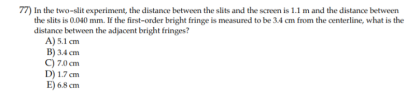 77) In the two-slit experiment, the distance between the slits and the screen is 1.1 m and the distance between the slits is 0.040 mm. If the first-order bright fringe is measured to be 3.4 cm from the centerline, what is the distance between the adjacent bright fringes? A) 5.1 cm B) 3.4 cm C) 7.0 cm D) 1.7 cm E) 6.8 cm
 1. In a double-slit experiment with a slit spacing of 0.35 mm, the center-to-center distance between a dark region and the nearest bright spot is 1.1 mm, on a screen that is 1.4 m away. Assume small angles. (a) How wide is the bright fringe? (b) How wide is the central maximum? TIm (c) How wide is the first dark fringe? TTIM (d) How far apart are adjacent maxima? (e) How far apart are adjacent minima? mIm (0 What is...
 QUESTION Which of the following make the separation between fringes greater in the two slit interference experiment? (Select all that apply □ wider slits Smaller separation of the two slits Larger separation of the two slits Narrower slits PRACTICE IT Use the worked example above to help you solve this problem. A screen is separated from a double-slit source by 1.28 m. The distance between the two slits is 0.0296 mm. The second-order bright fringe (m = 2) is measured...
 Two lasers are shining on a double slit, with slit separation
d. Laser 1 has a wavelength of d/20, whereas
laser 2 has a wavelength of d/15. The lasers produce
separate interference patterns on a screen a distance 4.40 m away
from the slits
Coherent light with wavelength 600 nm passes through two very
narrow slits, and the interference pattern is observed on a screen
a distance of 3.00 m from the slits. The first-order bright fringe
is a distance...
Two lasers are shining on a double slit, with slit separation
d. Laser 1 has a wavelength of d/20, whereas
laser 2 has a wavelength of d/15. The lasers produce
separate interference patterns on a screen a distance 4.40 m away
from the slits
Coherent light with wavelength 600 nm passes through two very
narrow slits, and the interference pattern is observed on a screen
a distance of 3.00 m from the slits. The first-order bright fringe
is a distance...
 can
somebody please help me with these questions, thank you very
much
10. In Young's double-slit apparatus the slits are senerated by a distance of 0.55 x 10 m. A screen 15 located 4 m from the plane of the slits. When light of wavelength 550 nm illuminates the slits, the distance on the screen between the central bright fringe and the third bright fringe on either side is a 4x 10mb. 8x 10-m c. 12 x 10 m d...
can
somebody please help me with these questions, thank you very
much
10. In Young's double-slit apparatus the slits are senerated by a distance of 0.55 x 10 m. A screen 15 located 4 m from the plane of the slits. When light of wavelength 550 nm illuminates the slits, the distance on the screen between the central bright fringe and the third bright fringe on either side is a 4x 10mb. 8x 10-m c. 12 x 10 m d...
 77) In the two-slit experiment, the distance between the slits and the screen is 1.1 m and the distance between the slits is 0.040 mm. If the first-order bright fringe is measured to be 3.4 cm from the centerline, what is the distance between the adjacent bright fringes? A) 5.1 cm B) 3.4 cm C) 7.0 cm D) 1.7 cm E) 6.8 cm
Most questions answered within 3 hours.
-
Where is the error in this code sequence?
String s1 = "Hello";
String s2 = "ello";...
asked 10 months ago -
Financial data for Joel de Paris, Inc., for last year
follow:
Joel de Paris, Inc.
Balance...
asked 10 months ago -
Consider this reaction:
Al2(SO4)3 (aq)+ BaCl3
(aq) Al2Cl6 (aq)- +
3BaSO4(s) . What is the...
asked 10 months ago -
Suppose that Savneet is considering increasing her
recent random sample from 20 car rentals to 40...
asked 10 months ago -
Trucks arrive at an unloading terminal at an average rate of 120
per hour.
Trucks arrive...
asked 10 months ago -
Why are methanol and ethanol completely soluble in water while
octanol is not very little soluble....
asked 10 months ago -
A facilities manager at a university reads in a research report
that the mean amount of...
asked 10 months ago -
When the CuSO4 is rehydrated by adding water to the anhydrous
compound, is this an endothermic...
asked 10 months ago -
A ray of sunlight is passing from diamond into crown glass; the
angle of incidence is...
asked 10 months ago -
A block of mass 0.249 kg is placed on top of a light, vertical
spring of...
asked 10 months ago -
how do the kidneys compensate in the presences of acidosis
a) trigger hyperventilate
b) reserve acid...
asked 10 months ago -
Question 501 pts
The rental rate of capital to the firm increases. Which of the
following...
asked 10 months ago