
Homework Answers

Add Answer to:
Part b Assume the electric field has a magnitude of |.3 nd the particle has a...
Part b Assume the electric field has a magnitude of E-61.3 vi, and the particle has...
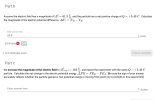 Part b Assume the electric field has a magnitude of E-61.3 vi, and the particle has a net positive charge of Q-+5.40 C. Calculate the magnitude of the electric potential difference, AVI-|VB - VA Enter answer here 69.8 Volts 69.8Volts of 6 attempts used Part c CHECK ANSWER We increase the magnitude of the electric field to Enew183 , and repeat the experiment with the same Q +5.40 C particle. Calculate the net change in the electric potential energy, APE...
A particle of net charge, +Q, is moved from point (A) to point (B) along the...
 A particle of net charge, +Q, is moved from point (A) to point (B) along the path shown in the figure below. We want to calculate the voltage difference between the end point, (B), and the start point, (A), for the particle. 3 5 m 寸 3 m Assume the electric field has a magnitude of E 55.8 , and the particle has a net positive charge of Q5.40 C. Calculate the magnitude of the electric potential difference, Enter answer...
A = 3, B = 3, C = 33 A uniform electric field of magnitude E...
 A = 3, B = 3, C = 33
A uniform electric field of magnitude E (150. 10*A) V/m is pointed in the positive x- direction. A positive charge, Q-+ (B + 10.) uc (micro-coulombs) moves from an origin (0, 0) to a point (x, y) (C, C+ 15) cm. Through what potential difference, in volts (V) does the charge move? Round your answer to two significant figures. Do NOT post your work, just your answer. Your answer is either...
A = 3, B = 3, C = 33
A uniform electric field of magnitude E (150. 10*A) V/m is pointed in the positive x- direction. A positive charge, Q-+ (B + 10.) uc (micro-coulombs) moves from an origin (0, 0) to a point (x, y) (C, C+ 15) cm. Through what potential difference, in volts (V) does the charge move? Round your answer to two significant figures. Do NOT post your work, just your answer. Your answer is either...
A uniform electric field of magnitude E = (180) V/m is pointed in the positive x-direction....
A uniform electric field of magnitude E = (180) V/m is pointed in the positive x-direction. A positive charge, Q = + (11) μC (micro-coulombs) moves from an origin (0, 0) to a point (x, y) = (13, 28) cm. Through what potential difference, in volts (V) does the charge move? Round your answer to two significant figures.
Distribution of Charges Part A Calculate the magnitude of the electric field at the origin due...
 Distribution of Charges Part A Calculate the magnitude of the electric field at the origin due to the following distribution of charges: -q at (x,y) - (a,a),-q at (a,-a), +q at (-a,-a) and +q at (-a,a), where q = 3.25 × 10⁻⁷ C . and a 4.40 cm2 Submit Answer Tries 0/6 Part B Set up an 8-point compass at the origin, where north points along the positive y-axis, such as that shown in the diagram to the right. What...
QUESTION 1 For a positive electric charge, The Electric Field of that particle points the charge....
 QUESTION 1 For a positive electric charge, The Electric Field of that particle points the charge. O A. toward OB. away from OC. Toward or away from , depending on the magnitude of the charge OD. neither toward or away, as the field does not depend on the sign of the charge QUESTION 2 The Electric Potential of a positive charge is O positive O negative O positive or negative depending on the magnitude of the charge the sign of...
At a distance of 12 mm from a charged particle, the electric field has a magnitude...
 At a distance of 12 mm from a charged particle, the electric
field has a magnitude of 100 N/CN/C.
Part A
At what distance is the electric field 400 N/CN/C?
Express your answer with the appropriate units.
r1r1 =
SubmitPrevious AnswersRequest Answer
Incorrect; Try Again; 5 attempts remaining
Part B
At what distance is it 16 N/CN/C?
Express your answer with the appropriate units.
r2r2 =
nothingnothing
SubmitRequest Answer
Provide Feedback
Next
At a distance of 12 mm from a charged particle, the electric
field has a magnitude of 100 N/CN/C.
Part A
At what distance is the electric field 400 N/CN/C?
Express your answer with the appropriate units.
r1r1 =
SubmitPrevious AnswersRequest Answer
Incorrect; Try Again; 5 attempts remaining
Part B
At what distance is it 16 N/CN/C?
Express your answer with the appropriate units.
r2r2 =
nothingnothing
SubmitRequest Answer
Provide Feedback
Next
A particle has a charge of -3.10 nC . A.)Find the magnitude of the electric field...
A particle has a charge of -3.10 nC . A.)Find the magnitude of the electric field due to this particle at a point 0.235 m directly above it. B.) Find the direction of the electric field at this point. (upward or downward) C.) At what distance from the particle does its electric field have a magnitude of 10.5 N/C ?
A uniform electric field has magnitude E and is directed in the negative i direction. The...
A uniform electric field has magnitude E and is directed in the negative i direction. The potential difference between point a (at x= 0.65 m) and point b (at x = 0.90 m) is 260 V.Calculate the value of E. Part C A negative point charge q= -0.200 pC is moved from b to a. Calculate the work done on the point charge by the electric field.
5. A particle of mass M carries electric potential drop AV. Derive uniform B field. Express...
 5. A particle of mass M carries electric potential drop AV. Derive uniform B field. Express this result in terms of a formula for the radius of curvature of the path B ric charge q. Find the speed of the particle after it passes through a taken by the particle in the V, B, q, and M. Sketch the path of a particle with the same charge q and four times the mass
 Part b Assume the electric field has a magnitude of E-61.3 vi, and the particle has a net positive charge of Q-+5.40 C. Calculate the magnitude of the electric potential difference, AVI-|VB - VA Enter answer here 69.8 Volts 69.8Volts of 6 attempts used Part c CHECK ANSWER We increase the magnitude of the electric field to Enew183 , and repeat the experiment with the same Q +5.40 C particle. Calculate the net change in the electric potential energy, APE...
 A particle of net charge, +Q, is moved from point (A) to point (B) along the path shown in the figure below. We want to calculate the voltage difference between the end point, (B), and the start point, (A), for the particle. 3 5 m 寸 3 m Assume the electric field has a magnitude of E 55.8 , and the particle has a net positive charge of Q5.40 C. Calculate the magnitude of the electric potential difference, Enter answer...
 A = 3, B = 3, C = 33
A uniform electric field of magnitude E (150. 10*A) V/m is pointed in the positive x- direction. A positive charge, Q-+ (B + 10.) uc (micro-coulombs) moves from an origin (0, 0) to a point (x, y) (C, C+ 15) cm. Through what potential difference, in volts (V) does the charge move? Round your answer to two significant figures. Do NOT post your work, just your answer. Your answer is either...
A = 3, B = 3, C = 33
A uniform electric field of magnitude E (150. 10*A) V/m is pointed in the positive x- direction. A positive charge, Q-+ (B + 10.) uc (micro-coulombs) moves from an origin (0, 0) to a point (x, y) (C, C+ 15) cm. Through what potential difference, in volts (V) does the charge move? Round your answer to two significant figures. Do NOT post your work, just your answer. Your answer is either...
 Distribution of Charges Part A Calculate the magnitude of the electric field at the origin due to the following distribution of charges: -q at (x,y) - (a,a),-q at (a,-a), +q at (-a,-a) and +q at (-a,a), where q = 3.25 × 10⁻⁷ C . and a 4.40 cm2 Submit Answer Tries 0/6 Part B Set up an 8-point compass at the origin, where north points along the positive y-axis, such as that shown in the diagram to the right. What...
 QUESTION 1 For a positive electric charge, The Electric Field of that particle points the charge. O A. toward OB. away from OC. Toward or away from , depending on the magnitude of the charge OD. neither toward or away, as the field does not depend on the sign of the charge QUESTION 2 The Electric Potential of a positive charge is O positive O negative O positive or negative depending on the magnitude of the charge the sign of...
 At a distance of 12 mm from a charged particle, the electric
field has a magnitude of 100 N/CN/C.
Part A
At what distance is the electric field 400 N/CN/C?
Express your answer with the appropriate units.
r1r1 =
SubmitPrevious AnswersRequest Answer
Incorrect; Try Again; 5 attempts remaining
Part B
At what distance is it 16 N/CN/C?
Express your answer with the appropriate units.
r2r2 =
nothingnothing
SubmitRequest Answer
Provide Feedback
Next
At a distance of 12 mm from a charged particle, the electric
field has a magnitude of 100 N/CN/C.
Part A
At what distance is the electric field 400 N/CN/C?
Express your answer with the appropriate units.
r1r1 =
SubmitPrevious AnswersRequest Answer
Incorrect; Try Again; 5 attempts remaining
Part B
At what distance is it 16 N/CN/C?
Express your answer with the appropriate units.
r2r2 =
nothingnothing
SubmitRequest Answer
Provide Feedback
Next
 5. A particle of mass M carries electric potential drop AV. Derive uniform B field. Express this result in terms of a formula for the radius of curvature of the path B ric charge q. Find the speed of the particle after it passes through a taken by the particle in the V, B, q, and M. Sketch the path of a particle with the same charge q and four times the mass
Most questions answered within 3 hours.
-
Where is the error in this code sequence?
String s1 = "Hello";
String s2 = "ello";...
asked 11 months ago -
Financial data for Joel de Paris, Inc., for last year
follow:
Joel de Paris, Inc.
Balance...
asked 11 months ago -
Consider this reaction:
Al2(SO4)3 (aq)+ BaCl3
(aq) Al2Cl6 (aq)- +
3BaSO4(s) . What is the...
asked 11 months ago -
Suppose that Savneet is considering increasing her
recent random sample from 20 car rentals to 40...
asked 11 months ago -
Trucks arrive at an unloading terminal at an average rate of 120
per hour.
Trucks arrive...
asked 11 months ago -
Why are methanol and ethanol completely soluble in water while
octanol is not very little soluble....
asked 11 months ago -
A facilities manager at a university reads in a research report
that the mean amount of...
asked 11 months ago -
When the CuSO4 is rehydrated by adding water to the anhydrous
compound, is this an endothermic...
asked 11 months ago -
A ray of sunlight is passing from diamond into crown glass; the
angle of incidence is...
asked 11 months ago -
A block of mass 0.249 kg is placed on top of a light, vertical
spring of...
asked 11 months ago -
how do the kidneys compensate in the presences of acidosis
a) trigger hyperventilate
b) reserve acid...
asked 11 months ago -
Question 501 pts
The rental rate of capital to the firm increases. Which of the
following...
asked 11 months ago